



































































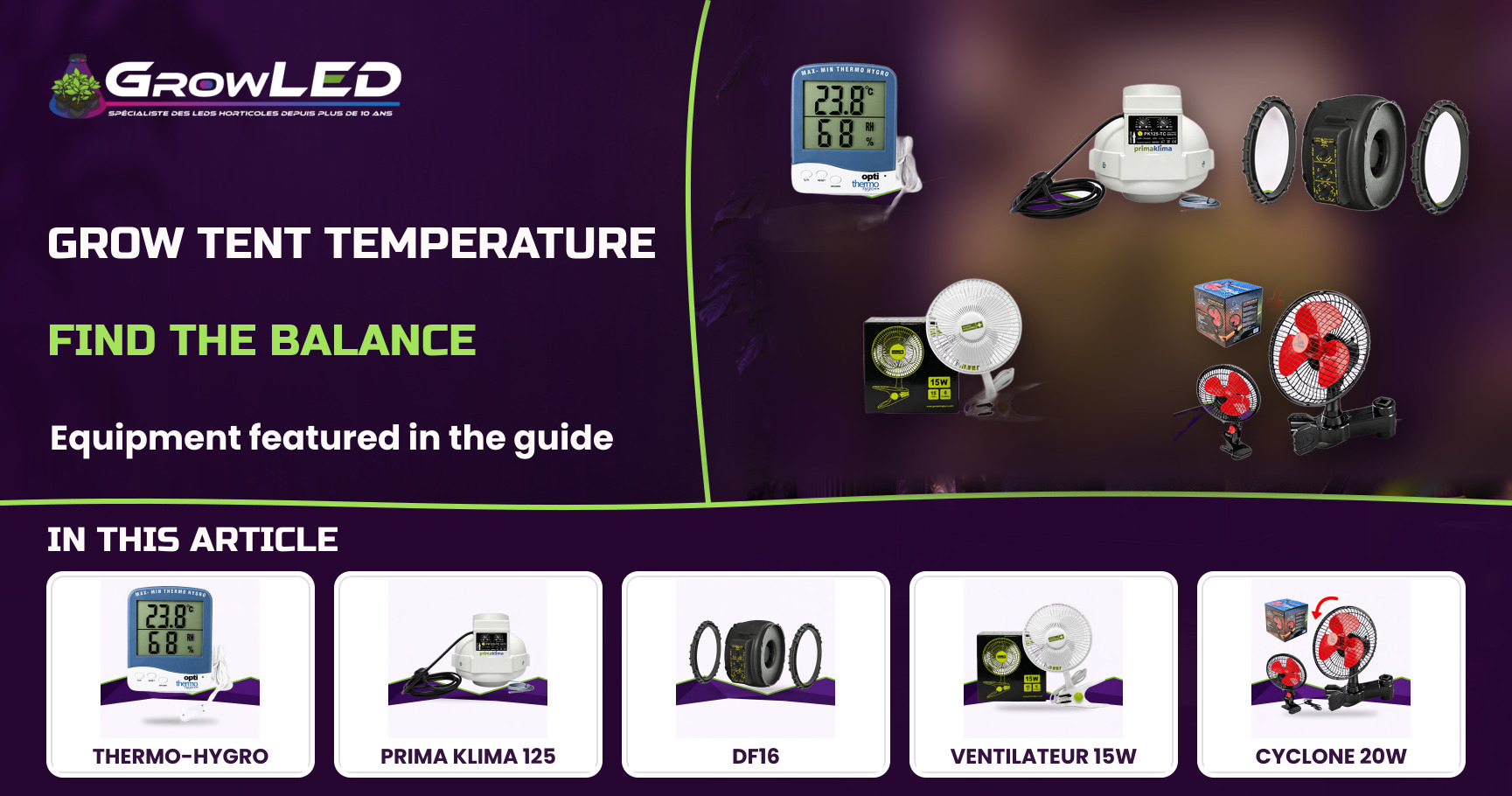
In a grow tent, temperature is never a figure that stands on its own: it comes from a constant balance between the heat given off by the lighting, the speed at which the air circulates and the structure's ability to expel the surplus. In this article, I explain how to measure, regulate and correct that trio, point by point, using the tools I actually rely on in my own setups.
1Measure before you regulate: the basis of the trio
Before you talk about heat, lighting or extraction, you need a reliable reading, otherwise you are adjusting blind. It is the mistake I see most often with beginners: they move their fan or pull their bulb back on a hunch, without knowing whether the temperature at the canopy has really shifted by half a degree or by five.
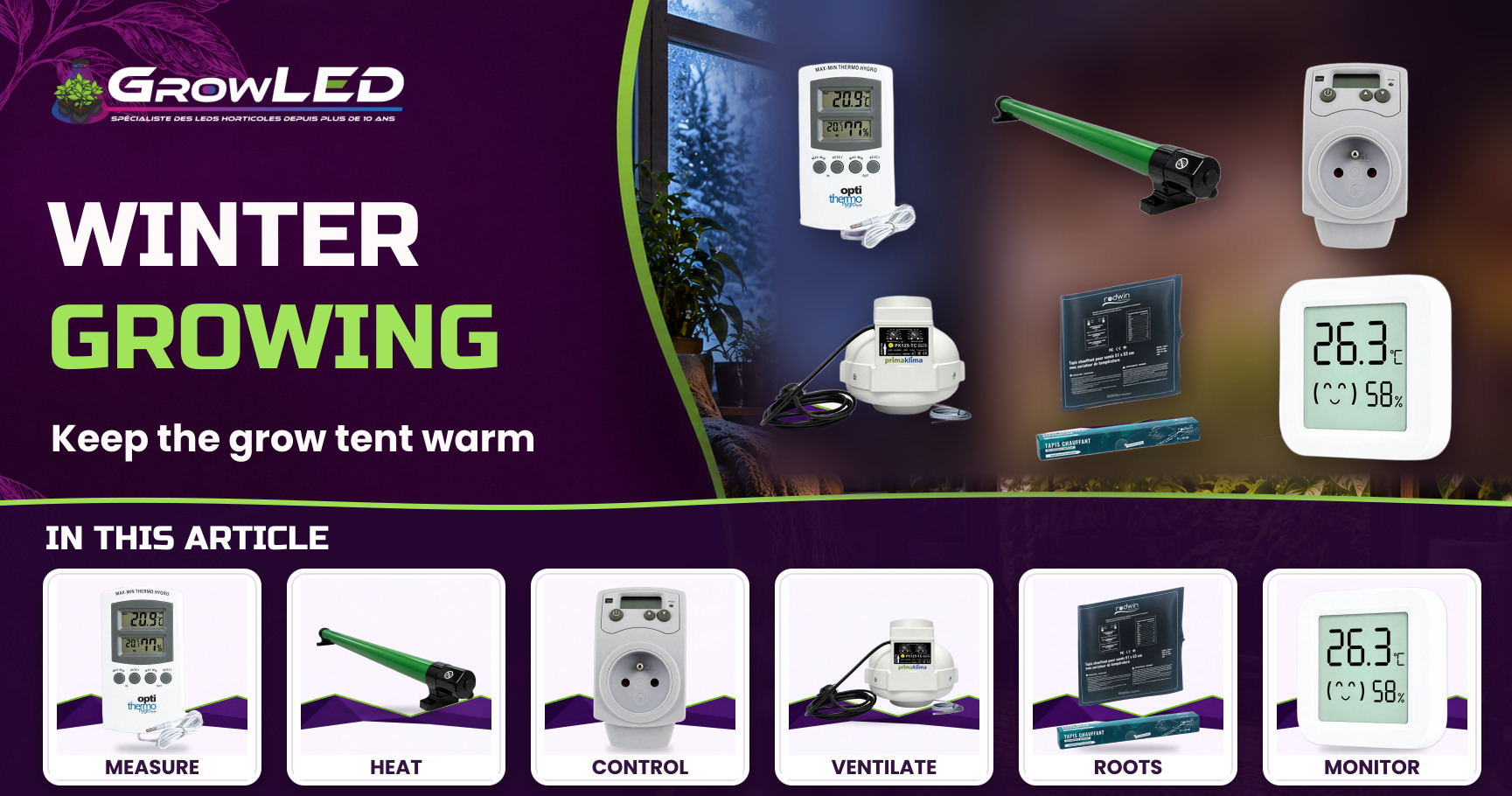
The digital hydro thermometer does this job with a remote, immersible probe on top of the ambient reading, and that changes everything: you track the air temperature at canopy height AND the temperature of the substrate or reservoir at the same time, over a range from -50°C to +70°C with an accuracy of ±1°C and ±5% relative humidity. The Digital Hydro Thermometer - Probe for temperature and humidity remains one of the most sought-after measuring instruments among our customers, and that is no accident: it is the first thing I install in a tent, even before the first fan.
- Place the ambient probe at canopy height, not on the floor or stuck against the wall: warm air rises, and a sensor set too low will always underestimate the temperature the plants are actually experiencing.
- Use the remote probe in the substrate or the reservoir, because root temperature reacts with a lag compared with the air and directly affects water and nutrient uptake.
- Take the temperature several times through the cycle, in particular one hour after the light comes on, the moment when the heat peak is usually reached.

2Heat: managing temperature without watching around the clock
A standard extractor runs at the same speed whether it is 22°C or 32°C inside the tent: it is up to the user to watch and adjust it by hand, which quickly becomes unworkable once you are running several cycles without being in front of your tent all the time.
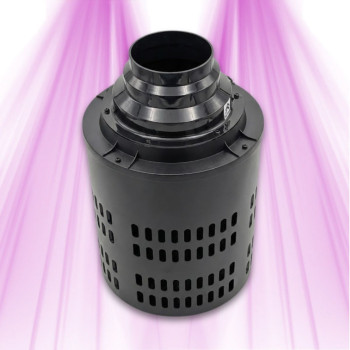
The whole point of a built-in thermo controller is precisely to take the human out of that loop: an internal thermal probe continuously compares the air temperature against a threshold set on the unit, and the motor adjusts its airflow accordingly, from 0 up to 400 m³/h. On the Prima Klima Thermo Controller Extractor Ø125mm – 400m³/h – Wired, this threshold tops out at 42°C, a ceiling value, not a target: in practice I always set the trigger several degrees lower, depending on what the variety being grown can tolerate in full flowering.
The concrete benefit is that the unit speeds up on its own during the heat peak that follows the lamps switching on, then slows down once balance is restored, which avoids the two classic extremes: extraction running flat out at all times, which dries out the air and drives up the noise, or a forgotten setting that lets the temperature climb unchecked for hours.
🌱 Joseph's tip
I never set the thermo controller threshold to the maximum allowed, I aim instead for 2 to 3°C below my real comfort limit: by the time the motor picks up speed, the tent has already had time to climb a little higher, and it is better to anticipate than to chase the temperature.
3Heat: tailoring regulation to compact tents
A 400 m³/h unit in a 60x60 tent is like fitting a truck radiator in a studio flat: the airflow is out of all proportion, the negative pressure created is too strong, and the unit struggles to fine-tune within the small ranges where you would actually need precision.
Secret Jardin's DF16 fills that gap, with an explicit adjustable temperature range from 15°C to 35°C and airflow that can be set across three steps, 50, 100 or 150 m³/h. The Thermo-Controlled Extractor - DF16 - Airflow 50/100/150m³/h - Secret Jardin is aimed squarely at micro-tents and propagation spaces, where the PK125-TC would be oversized.
That low 15°C setting is no minor detail, it is also useful in winter or in a poorly heated room, where the risk is no longer overheating but overcooling by extracting the warm air faster than it is replaced: being able to set a low threshold keeps the tent from dropping below the comfort zone of young plants or cuttings that have just been potted up.
4Light: the heat source everyone forgets
We talk a lot about extraction and ventilation, but the number one heat source in a tent is often the lighting itself, and yet it is the point most people overlook when they are trying to stabilise the temperature.
Moving the bulb a few centimetres closer or further away changes the temperature felt by the foliage far more than you would think, because thermal radiation drops off quickly with distance: a lamp pressed right up to the top of the plant heats a small area but intensely, whereas the same lamp pulled back spreads a gentler heat over a wider surface.
The trouble is that most sockets are rigidly fixed, which forces you to dismantle the whole structure just to adjust the height of a single bulb. The Clamp with socket and 3m cable for E27 horticultural bulb - FloraCLIP solves this with an aluminium body that dissipates the heat from the socket itself, and a 3-metre cable with a switch that lets you reposition the source away from the foliage without touching the rest of the setup.
- Move it away first, adjust the extraction afterwards: fixing a lamp that is too close with more ventilation means treating the symptom rather than the cause.
- Make the most of the long cable to test several heights, comparing the thermometer reading at each position before locking the setup in for good.
5Ventilation: moving the air without drying it out
Many people confuse circulating and extracting, when these are two different jobs: an extractor removes the warm air from the tent and replaces it with outside air, while a circulation fan simply stirs the air already present, without changing its volume.
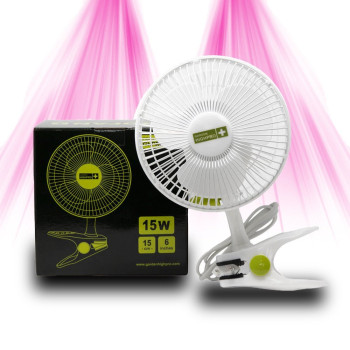
Yet this internal circulation is the single most important thing day to day, because it stops warm air from settling in a pocket at the top of the plant, near the lamp, while the cooler air sits still at floor level. The Garden High Pro Clip Fan (Ø 15 cm - 15W) - 2 speeds moves 200 m³/h and clamps directly onto the bars of the structure, which is why it is the best-selling product in the entire range: it is often the very first regulation accessory I install, even before the extractor.
The two speeds avoid a common mistake, that of circulating too hard over young plants or cuttings: an excessive airflow over still-fragile foliage speeds up transpiration to the point of stressing the plant, whereas a moderate speed is enough to keep the air from stagnating without drying out the most tender tissues.
🌱 Joseph's tip
I always set my circulation fan offset from the extractor, never in its direct line: otherwise you create an air corridor that empties the tent on one side and leaves the other barely stirred.
| Unit | Airflow / power | Built-in thermo control | Role in the trio |
|---|---|---|---|
| PK Thermo Controller 125mm (Prima Klima) | 0 to 400 m³/h modulated, Tmax 42°C | Yes | Extraction driven automatically by heat |
| DF16 (Secret Jardin) | 50/100/150 m³/h, range 15-35°C | Yes | Driven extraction, compact format |
| PROFAN 125mm (Garden HighPro) | 190 m³/h, 20W, 37dB | No | Basic manual extraction |
| Garden HighPro Clip Fan | 200 m³/h, 15W, 2 speeds | No (internal circulation) | Air circulation without renewal |
| Cyclone oscillating fan | 20W, 180° oscillation | No (internal circulation) | Clearing dead zones |
6Ventilation: expelling the built-up warm air
Not every extractor needs a built-in thermo controller, especially when you already control the speed through a separate variable regulator or a programmable socket: in that case, a simple, reliable model is more than enough, and stays easier to maintain over time.
The PROFAN extractor is a good illustration of basic air renewal, the kind that brings the temperature down by several degrees simply by replacing the built-up warm air with cooler outside air. The PROFAN Inline Duct Extractor 125mm - Garden HighPro - 190 m³/h runs at 190 m³/h for only 20W, with a noise level of 37dB and a 100% copper motor, a point that matters for motor longevity when the unit runs continuously over several months of growing.
The rule I always give a beginner is never to neglect this fresh-air renewal in favour of internal circulation alone: circulating evens out the temperature within the tent, but only extraction genuinely expels the excess heat and humidity to the outside.
7Ventilation: getting rid of dead zones
Even with a good extractor and a good fixed fan, there are almost always dead zones left in a tent: a corner behind a pot, under a trellis net, or against a wall, where the air barely moves and where heat and humidity build up in a pocket.
That is exactly the problem the Cyclone targets, literally described on its product page as an answer to pockets of warm, humid air. The Cyclone Oscillating Clip Fan 20W – 20cm sweeps 180° instead of blowing steadily along a single axis, which lets it gradually cover the corners that a fixed fan ignores.
I see it less as a product to fit as standard than as a targeted fix: if the thermometer's remote probe shows a clear gap between two zones of the tent, or if spots of stagnant humidity appear under dense foliage, an oscillating fan aimed at that specific area solves the problem without having to resize the entire ventilation setup.
- Spot the dead zone before you act, by comparing several thermometer readings at different points in the tent rather than guessing where it is stuck.
- Point the oscillation at the weak spot you have identified, not at the centre of the tent, which is generally already well circulated by the fixed fan.
Ready to stabilise your tent's temperature?
Always start by measuring: the Digital Hydro Thermometer - Probe for temperature and humidity gives you the baseline reading, then round it out with a thermo-regulated extractor like the Prima Klima Thermo Controller Extractor Ø125mm – 400m³/h – Wired. Find all the gear for regulating heat, light and ventilation on our growshop.
See the growshop →After dozens of cycles, I remain convinced that no single device sorts out a tent's temperature: it is the combination that does the work, a reliable reading so you know where you stand, an extraction that can react to the heat without you having to think about it, a repositionable lamp so you do not stack up heat sources needlessly, and circulation that hunts down the last stagnant corners. Put this trio in place in that order, measure first, regulate second, correct last, and temperature will stop being a constant source of stress in your grow.