




































































Vanguard Hydroponics
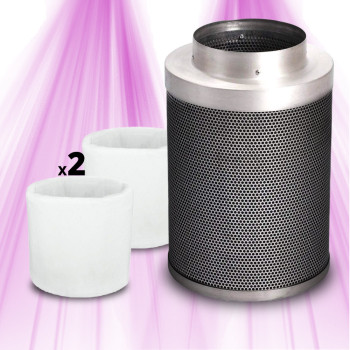
FALCON carbon filter - from 100mm to 315mm - Easy to install with clips
In stock · Shipped within 24 h
49,90 €

Product successfully added to your shopping cart
Ça pousse dans le bon sens

5 products
200mm carbon filters are designed for large-scale indoor cultivation setups. With their impressive diameter, they pair perfectly with powerful extractors ranging from 800 to 1500m3/h to effectively neutralize odors in spaces from 3 to 6m². These filters are the technical choice when you're serious about filtration.
The 200mm diameter truly makes a difference in terms of performance. Frankly, when compared to 150mm, you gain in active carbon contact surface, which drastically improves filtration efficiency. These filters typically incorporate 3 to 5kg of Australian or European active carbon, with an optimized particle size between 3 and 5mm to maximize the adsorption of odor molecules.
The robust construction of these filters allows them to handle high flow rates without excessive pressure drop. Their reinforced metal flanges resist vibrations from large extractors, and the double layer of pre-filtration protects the carbon from airborne particles. This is particularly important in grow rooms where humidity can reach 60-70% during certain phases.
The major technical advantage is their lifespan. With more active carbon spread over a larger surface, these 200mm filters easily last 18 to 24 months in intensive use, compared to a maximum of 12 months for smaller diameters. This changes everything in terms of cost-effectiveness.
First criterion: your extractor's flow rate. For 200mm, we generally aim for extractors from 800 to 1500m3/h. The technical rule is to choose a filter whose nominal flow rate is slightly higher than that of the extractor to avoid overpressure, which reduces efficiency.
Length also matters. Short models (40-50cm) are suitable for confined spaces but offer less contact surface. Long versions (60-80cm) maximize filtration but require more space. For a 240x120x200cm tent, a 60cm model is manageable while offering excellent performance.
The type of carbon makes a difference. Australian carbon remains the benchmark with its high porosity and superior adsorption capacity. Some manufacturers offer European carbon, which is cheaper but has a reduced lifespan. The particle size must be uniform: too fine, it creates pressure drops; too coarse, it reduces efficiency.
Pay attention to the flanges: check that the diameter exactly matches your extractor. Some models offer 200/150mm reducers, which are practical if you want to upgrade without changing your extractor, but this creates a point of turbulence that can generate noise.
For a 900m3/h extractor, choose a filter with a nominal flow rate of 1000-1200m3/h to avoid overpressure. In a 2.4m² tent, a 60cm long model will be perfect. Make sure the filter is equipped with Australian carbon with a 3-5mm particle size for maximum efficiency. The pre-filtration should be washable polyester to extend the carbon's lifespan.
In normal use with controlled humidity (50-60%), a good 200mm filter lasts 18 to 24 months. If you regularly exceed 70% humidity, expect 12-15 months instead, as humidity saturates the carbon faster. The first signs of wear generally appear after 12 months: a slight decrease in efficiency at the end of the cycle. Regular maintenance of the pre-filter can extend its lifespan by 20-30%.
Mount the filter inside the grow space, ideally suspended from the ceiling with adjustable straps. Connect it directly to the extractor via a rigid or semi-rigid duct to avoid pressure drops. The extractor should be placed outside to reduce noise and heat. Observe the direction of airflow: air should enter through the outside of the filter and exit through the center towards the extractor.
The pre-filter should be washed every 2-3 months with lukewarm water without detergent, then thoroughly dried before reassembly. Active carbon cannot be regenerated: when efficiency drops, the entire filter must be replaced. Monitor odors at the end of the cycle to detect saturation. Some growers test with an electronic nose, but usually, the sense of smell is sufficient. A saturated filter loses 50% of its efficiency within a few weeks.
Technically yes, but these extreme conditions significantly reduce its lifespan. At 70% humidity and 35°C, the carbon saturates 40% faster than under normal conditions (50% RH, 25°C). Filtration efficiency also decreases because hot, humid air transports odor molecules less effectively to the carbon. If you cannot reduce these parameters, plan for replacement every 10-12 months instead of the usual 18-24 months.
Available in 9 models
Available in 9 models
Help & advice
About 200mm — click a question to see the answer.
To choose the right 200mm carbon filter, I always advise you to pair it with an extractor of equivalent or slightly higher power. The idea is that the filter should not restrict the airflow of your extractor. If your extractor is 1000m³/h, aim for a filter capable of filtering at least that amount of air. This is key for optimal efficiency and to prevent premature wear.
Generally, a 200mm carbon filter is designed to work with powerful extractors, ranging from 800 to 1500 m³/h. What I often see is growers using it with 1000m³/h extractors for medium to large grow rooms. The goal is to ensure sufficient air exchange while guaranteeing effective odor filtration.
The lifespan of a 200mm carbon filter depends on several factors, but on average, I'd say it lasts between 12 and 24 months. This varies depending on ambient humidity, the concentration of odors to be filtered, and frequency of use. Too high humidity saturates the carbon more quickly, thus reducing its absorption capacity. I recommend checking it regularly to ensure its effectiveness.
Installing a 200mm carbon filter is quite simple. I advise placing it inside your grow room, at height, just before the extractor. You connect it to the extractor via a duct of the same diameter (200mm). Make sure the connections are airtight to prevent any leakage of unfiltered air. The stale air is thus drawn through the filter before being expelled.
The best 200mm carbon filter in terms of value for money is often one that offers a good density of quality activated carbon, such as virgin coconut or bituminous coal, for a respectable lifespan. I invite you to consult our product descriptions to compare specifications and customer reviews. What I often see is that brands renowned for their high-quality carbon, even if they are a bit more expensive upfront, prove to be more economical in the long run due to their durability.
The most common mistake I see is undersizing the filter relative to the extractor, or vice versa. A filter that is too small for a powerful extractor will be less effective and wear out prematurely. Conversely, an oversized filter is not necessarily a problem, but it is an unnecessary cost. Always ensure that the air volume the filter can handle matches the capacity of your extractor.
To extend the lifespan of your 200mm carbon filter, I advise you to maintain stable and moderate relative humidity in your grow space, ideally below 70%. Excessive humidity saturates the carbon more quickly. You can also regularly clean the fabric pre-filter (the sock) that surrounds the filter to prevent it from getting clogged with dust, which would improve airflow and overall efficiency.
Cannot find your answer? 01 88 33 45 52 or by message.


