

































































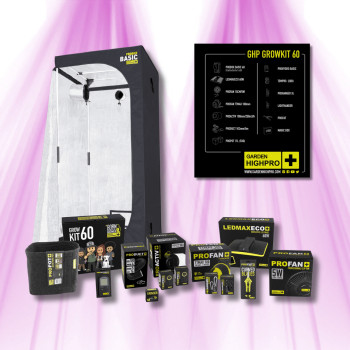
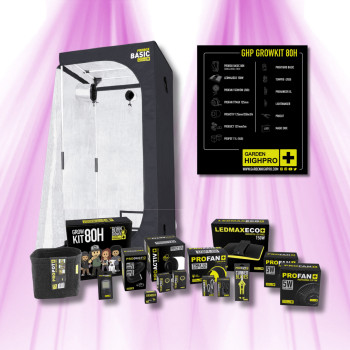


Complete pack 120x120cm – Zeus 600W PRO 2.9 and console - Box AQ 120+…
Ships within 2 weeks
2 006,63 € 2 229,59 € or 3× 668,88 €

Product successfully added to your shopping cart
Ça pousse dans le bon sens

5 products
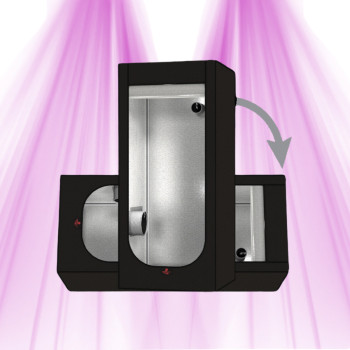
Complete 120cm x 120cm kits are the ideal format for serious indoor growing over 1.4m². These all-in-one kits include the grow tent, lighting, ventilation, and all the necessary accessories to get started immediately. With this surface area, you can grow 4 to 6 plants depending on your technique, whether in soil, coco, or hydroponics.
Frankly, it's the size that makes all the difference when you want to step up your game. With 1.4m² and a typical height of 200cm, you finally have the space to let your plants truly flourish. 120x120 kits integrate powerful lighting – often between 240W and 400W for LED or 400W-600W for HPS – which perfectly covers this area. Ventilation is sized accordingly with extractors from 200 to 315mm and airflows of 400 to 800 m³/h.
The major advantage? Everything is designed to work together. The extractor is suited to the volume of the tent (approximately 2.9m³), the carbon filter matches the airflow, and the lighting provides the correct PPFD across the entire canopy. No more headaches with compatibility issues or undersized components often seen with DIY setups.
First criterion: the type of lighting. LED kits consume less (240-320W) and generate little heat, perfect if your grow space is already warm. HPS versions (400-600W) generate more heat, but some growers still swear by their spectrum for flowering. Budget-wise, expect 200-300W of LED to properly cover 1.4m² with a PPFD of 600-800 µmol/m²/s.
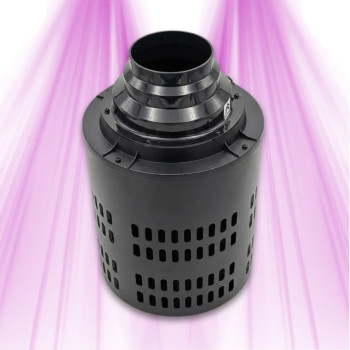
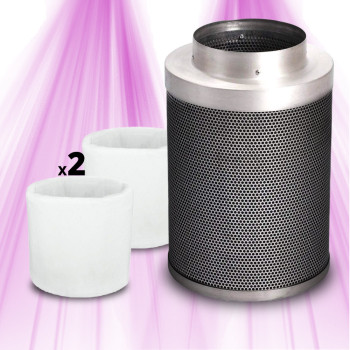
For ventilation, ensure the extractor provides at least 400 m³/h – ideally 600-800 m³/h to renew the air 15-20 times per hour. The carbon filter must have the same capacity as the extractor. For the tent itself, opt for thick fabric (600D minimum) and solid structures that will support the weight of suspended lighting.
The choice mainly depends on your environment and electricity budget. 120x120 LED kits consume 240-320W compared to 400-600W for HPS, resulting in 40-50% savings on your bill. LEDs generate less heat, which avoids temperature problems in summer, but some growers still prefer the warmth of HPS in winter. In terms of yield, modern LEDs largely compete with HPS, especially full-spectrum ones that better meet plant needs. For beginners, I recommend LED: less heat to manage, reduced consumption, and longer lifespan (50,000h vs. 10,000h).
Installation follows a precise logic. First, assemble the tent structure, then attach the extractor at the top with the carbon filter inside. The passive intake should be placed at the bottom on the opposite side to create a diagonal airflow. For lighting, use the provided adjustable straps and position the lamp in the center, 40-60cm from the plants depending on power. Ensure cables do not touch the fabric and that the extractor vents properly to the outside. Test everything 24 hours before introducing your plants to stabilize temperature and humidity.
The distance varies depending on the type and power of the lighting. With a 240-320W LED, maintain 40-50cm during vegetative growth and 30-40cm during flowering. For a 400W HPS, allow at least 50-60cm to avoid heat stress. Use your hand as a test: if you feel uncomfortable heat at canopy level, it's too close. A lux meter or PPFD device will give you precise measurements: aim for 300-500 µmol/m²/s during vegetative growth and 600-900 µmol/m²/s during flowering. Adjust regularly as plants grow and needs evolve.
Regular maintenance ensures system efficiency. Clean fan blades every 2-3 weeks with a dry brush to prevent dust accumulation, which reduces airflow. The carbon filter should be replaced every 12-18 months depending on usage, but you can extend its life by gently shaking it every 2 months to decompact the carbon. Also check ducts: a kink or obstruction drastically reduces efficiency. If odors start to pass despite the filter, it's a sign it needs replacing. A manometer on the extractor indicates pressure drop and thus clogging.
Both techniques work perfectly in 1.4m². In soil, 4 plants in 11-15L pots allow for optimal development with room to circulate. 6 plants require smaller pots (7-11L) and stricter pruning. Hydroponics allows for higher density because roots take up less space: 6-9 plants in a DWC or NFT system depending on the variety. The advantage of hydro: faster growth and precise nutrient control. Disadvantage: more technical and risk of failure. For beginners, soil is more forgiving of errors. The kit's lighting perfectly covers both techniques; the important thing is to adjust the height according to the final canopy.
Available in 3 models
Help & advice
About 120cm x 120cm - 1.4m² — click a question to see the answer.
For a 120cm x 120cm area, what I generally recommend is an LED power that is between 400W and 600W of actual consumption. This ensures homogeneous and sufficient light coverage for all growth phases of your plants, from vegetative to flowering. In practice, I often see growers achieve excellent results with this power range.
The installation distance of an LED light depends heavily on its power and model. In general, I recommend starting at a distance of approximately 40 to 60 cm from the plant apexes during the vegetative phase, then adjusting it to 30-45 cm during flowering. Observing your plants is crucial: if the leaves yellow or curl, the light may be too close; if they stretch, it is too far. Do not hesitate to consult the specific recommendations of your light's manufacturer.
The main difference lies in efficiency and light spectrum. LEDs are very energy efficient, produce less heat, and offer a customizable spectrum for each plant phase. HPS (High-Pressure Sodium) lights are powerful and inexpensive to purchase, but consume more and emit a lot of heat. Fluorescent lights, on the other hand, are more suitable for young seedlings and vegetative growth, but lack power for flowering. If I had to choose for a 120x120 surface, I would clearly lean towards LED for its versatility and long-term efficiency.
In a 1.4m² (120cm x 120cm) area, you can reasonably grow between 4 and 6 plants. This number can vary depending on the cultivation technique you use (SCROG, SOG, pruning, etc.) and the final size you want your plants to reach. The goal is to maximize space without overcrowding so that each plant receives enough light and air.
For vegetative growth, I prefer a spectrum richer in blue light, which promotes compact and robust plant development. For flowering, a redder and orange spectrum is ideal, as it stimulates flower and fruit production. Most modern horticultural LED lights offer full or adjustable spectra, which is a significant advantage for optimizing each cultivation phase. Some high-end models even allow for modulation of color ratios.
Cannot find your answer? 01 88 33 45 52 or by message.


