





































































Hydro Digital Thermometer - Probe for temperature and humidity
In stock · Shipped within 24 h
21,89 €

Product successfully added to your shopping cart
Ça pousse dans le bon sens

6 products
A thermometer hygrometer is an essential tool for monitoring temperature and humidity in your grow space. Without this precise data, it's impossible to maintain the optimal conditions your plants demand. Whether in a 60x60 tent or a converted closet, these small devices give you crucial information to adjust ventilation, heating, or dehumidification.
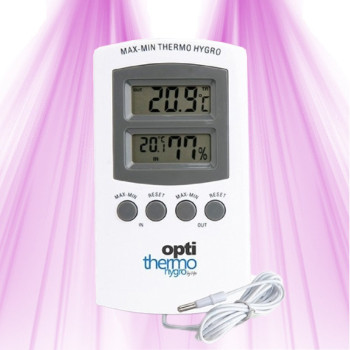
Digital models offer incomparable precision compared to analog versions. With an error margin often less than 1°C and 3% humidity, you get reliable measurements to react quickly. The Optithermo Digital Medium Hydro Thermometer simultaneously displays temperature and humidity on an easy-to-read LCD screen, with batteries already included to get started immediately.
The advantage of versions with a remote probe becomes evident when your space is difficult to access. You place the sensor at the heart of the canopy and the screen remains visible outside. The Digital Hydro Thermometer with Probe offers precisely this practical configuration with a cable long enough to adapt to different setups.
Accuracy remains the number one criterion. Look for models guaranteeing ±1°C for temperature and ±3% for humidity. Simultaneous display of both values saves you from juggling multiple screens. Some models store min/max values, which is useful for identifying variations during your absence.
For placement, opt for a model with a remote probe if your setup requires completely closing the space. The cable length determines your installation flexibility. A backlit screen makes reading easier in dark environments, although it's not essential with good ambient lighting.
Digital models with electronic sensors offer the best precision, generally ±1°C and ±3% humidity. Avoid analog needle versions that drift over time. Reputable brands often offer more rigorous factory calibration. A good digital thermometer hygrometer will last several years without losing its accuracy if you follow the usage conditions.
Position the sensor at canopy height, neither too close to the lighting nor against the walls. The ideal spot is halfway between the lights and the plants, in an area representative of the general climate. Avoid direct drafts from fans that would skew measurements. With a remote probe, you can place the screen outside while keeping the sensor in the right place.
Most digital thermometers have a °C/°F toggle button, often marked "Unit" or represented by a symbol. Hold this button down for a few seconds or press it briefly depending on the model. Some devices require turning the device off and then on again after the change. Consult the provided manual as the procedure varies slightly between manufacturers.
Regularly clean the screen with a dry cloth to maintain good readability. Avoid excessive moisture on the main casing, even if the sensor handles humid environments well. Replace batteries at the first signs of weakness to prevent acid leaks. Store the device in a dry place if you use it seasonally. Minimal maintenance is enough for several years of service.
WiFi-connected models allow monitoring from your smartphone, which is convenient for extended absences. Look for devices with data history and configurable alerts via SMS or notification. Bluetooth range is limited to a few meters, while WiFi offers access from anywhere. Check compatibility with your home network and the quality of the mobile application before purchasing.

Help & advice
About Thermometer / Hygrometer — click a question to see the answer.
In indoor growing, the thermometer hygrometer is your best friend! It allows me to monitor the temperature and relative humidity of the air in your grow space in real-time. These two parameters are absolutely crucial because they directly influence plant transpiration, nutrient absorption, photosynthesis, and ultimately, the health and yield of your crops. Without this data, it's impossible to properly adjust your ventilation, heating, or dehumidifier to maintain an optimal environment.
That's an excellent question, even though often the two are combined! A thermometer measures air temperature, expressed in degrees Celsius (°C) or Fahrenheit (°F). A hygrometer, on the other hand, measures the relative humidity of the air, which is the amount of water vapor present compared to the maximum amount the air could hold at that temperature, expressed as a percentage (%). For indoor growing, I always use devices that combine both functions to get a complete and accurate picture of the climate.
Ideal conditions vary depending on your plants' stage of development. During the vegetative growth phase, I generally aim for a temperature between 22 and 26°C and a relative humidity between 60 and 75%. During flowering, I gradually reduce humidity to prevent mold problems, aiming for 40 to 55% humidity and similar temperatures. It's essential to adapt these values to the specific needs of the species you are cultivating and always prioritize stability.
For an accurate reading, placement is key! I advise you to place your thermometer hygrometer at the height of your plants' canopy, meaning at the same height as the top of your plants. Avoid positioning it directly under a light, as the radiant heat would skew the temperature measurement, or right in front of an air intake. The idea is to get a representative measurement of your plants' direct environment. If your device has an external probe, I place the probe in the heart of the canopy and the screen outside or on the side of the tent.
When I need to choose a thermometer hygrometer, I look at several criteria. First, accuracy is paramount; I prefer models with a low margin of error. Then, reliability and durability are important, as the growing environment can be demanding. I also check for the presence of an external probe, which is very practical for measuring as close to the plants as possible while keeping the screen outside. Finally, features like min/max value recording or an alarm can be a real plus for optimal monitoring. Feel free to consult our selection to find the one that meets your needs.
For a small 60x60 tent, space is a factor to consider. I recommend a compact and accurate model, ideally with a remote probe. This allows you to place the probe in the heart of your canopy for an exact measurement, while having the display screen outside the tent or on the side so as not to obstruct the space. The min/max function is also very useful for checking the extremes reached during your absence. A simple but reliable model will be perfectly suitable for this type of setup.
That's an excellent question to ensure the reliability of your data! For temperature, you can compare it with a trusted medical thermometer or another device whose accuracy you know. For humidity, it's a bit trickier. A common method is the salt test: place your hygrometer in an airtight bag with a saturated solution of table salt (water + salt) for a few hours. The humidity should stabilize around 75%. If your device shows a different value, you have an idea of its deviation.
The main error I often see is poor positioning. Avoid placing it directly under the lighting, near an air intake/outlet, or against a tent wall, as this would skew the measurements. Another error is not regularly checking its accuracy or not changing the batteries in time, which can lead to erroneous readings. Finally, not acting on the data it provides you is a major error; the device is a decision-making tool to adjust your growing environment.
Cannot find your answer? 01 88 33 45 52 or by message.