





















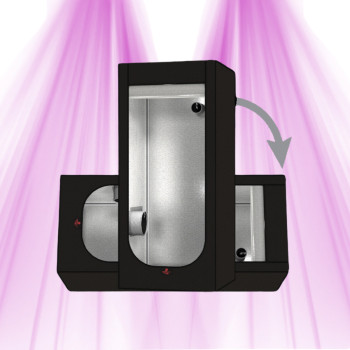












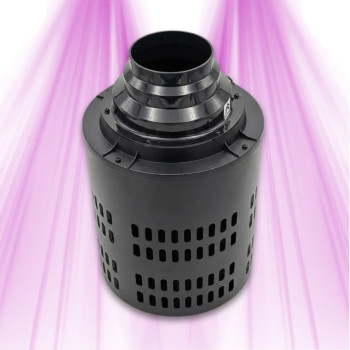
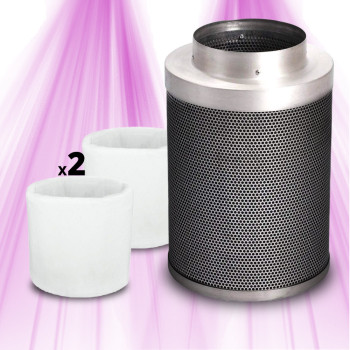
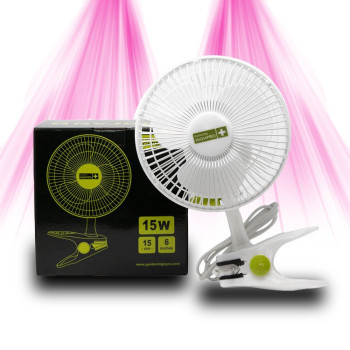

































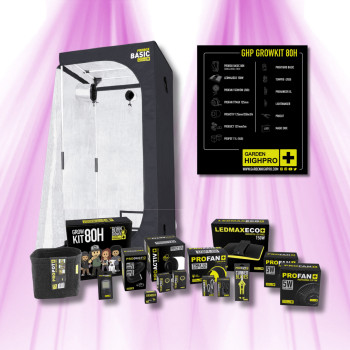


30x30 - Pack Plug & Play LED bulb BloomLED X30 + HomeBox 30x30x60 cm + cable
Ships within 2 weeks
158,70 € 167,05 € or 3× 52,90 €

Product successfully added to your shopping cart
Ça pousse dans le bon sens

29 products
Horticultural LED lighting + grow tent kits bring together all the essential equipment to set up your first indoor grow. No more headaches choosing components: these ready-to-grow kits combine a suitable LED lamp with a perfectly sized grow tent. It's the simplest solution to start without making mistakes in technical specifications.
Honestly, when you're starting out, it's easy to mess up dimensions or power. With a kit, everything is already calculated to work together. For example, the 30x30 - BloomLED X30 LED Bulb + HomeBox 30cm x 30cm x 60cm Kit is custom-made: the SpectraBULB X30 delivers exactly the necessary power to optimize a 30x30 cm space. No oversizing that drives up the electricity bill, no under-lighting that plummets yields.
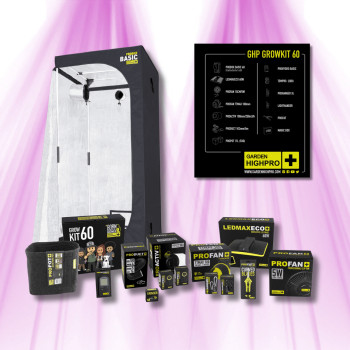
The other big advantage is time-saving. No need to compare dozens of references, check compatibilities, or search for missing accessories. The 30x30 - Plug & Play BloomLED X30 LED Bulb + HomeBox 30cm x 30cm x 60cm + Cable Kit goes even further: it even includes the cabling for direct connection. It's ready to grow in 10 minutes flat.
It all starts with the available space and the number of plants you're aiming for. For one or two plants in a discreet setup, 30x30 cm formats are perfect. If you want to go bigger, look at 60x60 cm options, which allow for 4 to 6 plants depending on the growing technique. Height also matters: a minimum of 60 cm for autoflowers, 120 cm or more for stretching varieties.
Regarding lighting, ensure the LED covers the full spectrum. SpectraBULBs integrate warm white, cool white, and deep red to support both growth and flowering. For beginners, E27 screw-in bulbs like those in the Complete Horticultural Kit SpectraBULB X55 + Hydro Shoot 60 + Reflector + Mechanical Timer are simpler to install than a complex LED panel.
Last point: included accessories. A reflector improves light distribution, a timer automates day/night cycles. The more complete the kit, the fewer additional purchases you'll need to plan for.
For a 30x30 cm (0.09 m²) surface, count on 25 to 40W of quality LED. This is exactly what the SpectraBULB X30 delivers with its 30W actual power. This power allows for approximately 300-400 µmol/m²/s at plant level, which perfectly covers the needs from growth to flowering. With a less efficient LED, you would need to go up to 50-60W for the same result.
Absolutely, that's one of the big advantages of indoor growing. LEDs generate very little heat compared to HPS, so there's no overheating problem in summer. In winter, the tent maintains a stable temperature thanks to insulation. With good humidity and ventilation control, you can cycle continuously. Autoflowering varieties are particularly suitable for regular harvests every 10-12 weeks.
It is highly recommended, even if LEDs generate less heat than traditional lamps. An extractor of 100-150 m³/h is sufficient for a 30x30 cm tent, 200-300 m³/h for a 60x60 cm. Ventilation removes humidity, renews CO2, and prevents mold. Some kits already include a ventilation system; otherwise, it's the first accessory to add to secure your crops.
A 30W SpectraBULB X30 consumes 0.72 kWh per day on an 18/6 cycle (growth) or 0.36 kWh on a 12/12 cycle (flowering). At €0.20 per kWh, that's about 14 cents per day during growth, 7 cents during flowering. Over a complete 3-month cycle, expect a maximum of €15-20 in electricity. This is negligible compared to old HPS lamps, which consumed 3 to 4 times more.
That's exactly their purpose. No need for extensive technical knowledge: everything is sized to work together. SpectraBULBs screw in like a classic light bulb, and tents can be assembled in 15 minutes without tools. Mechanical timers are simpler than digital versions for beginners. With a complete kit, you avoid 90% of beginner mistakes related to mismatched equipment.
Available in 2 models
Available in 2 models
Available in 3 models
Available in 3 models
Available in 3 models
Available in 2 models
Help & advice
About LED horticultural lighting + Grow box packs — click a question to see the answer.
To start, I recommend starting small to master the basics. A kit with a 60cm x 60cm grow box (0.4m²) is often an excellent compromise between footprint and growing area. This will allow you to accommodate 1 to 2 plants without too much difficulty. I often see beginners wanting to go too big, which can quickly become complex to manage.
The choice of LED power is crucial and directly depends on the surface area of your grow box. Generally, for optimal cultivation, I advise aiming for approximately 300 to 500 PPFD (photosynthetic photon flux density) on average across the canopy. To give you an idea, a 60x60cm grow box (0.4m²) will need an LED lamp with about 100 to 150W of actual power consumption to be effective. It's a matter of balance to avoid under-lighting or over-lighting your plants.
The ideal distance varies greatly depending on the power of your LED lamp and the growth stage of your plants. Generally, I start with a distance of 40 to 60 cm for young seedlings, then gradually reduce it to 30-40 cm during vegetative growth and flowering to maximize light intensity. The best indicator remains observing your plants: if the leaves yellow or burn, the lamp is too close; if they stretch (etiolate), it's too far. It's a constant adjustment!
Light requirements vary depending on the life stage of your plants. For vegetative growth, I generally recommend 18 hours of light and 6 hours of darkness. Once you transition to the flowering phase, you need to reduce it to 12 hours of light and 12 hours of darkness to stimulate flower production. This is an essential photoperiodic cycle to respect for good results.
The main difference, and it's a significant one, is that full-spectrum LEDs emit light that covers all wavelengths necessary for photosynthesis, from blue to infrared. So-called 'classic' or 'blue/red' LEDs often only provide a few specific peaks. In practice, full spectrum promotes more balanced and robust plant development, from germination to flowering, because it better mimics natural sunlight. It's an investment that's worth it for the quality of your harvest.
If your LED lamp has spectrum adjustment, which I highly recommend, you can optimize it for each phase. For growth, favor a spectrum richer in blue, which promotes vegetative development and robust leaves. For flowering, increase the proportion of red and infrared, which stimulate flower and fruit production. Some models have pre-programmed 'Veg' and 'Bloom' modes that greatly simplify this adjustment. This is one of the great strengths of LED compared to other technologies!
The power consumption of a horticultural LED lamp is generally much lower than that of HPS or MH lamps for comparable light efficiency. For example, a 150W actual consumption LED lamp can replace a 250W HPS. The exact consumption will depend on the power of your lamp and the number of hours of lighting per day. This is a significant economic and ecological advantage in the long term, which I often explain to my clients.
Cannot find your answer? 01 88 33 45 52 or by message.


