



































































Garden HighPro
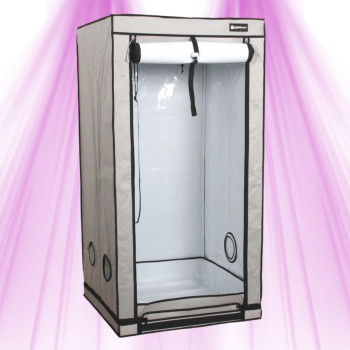
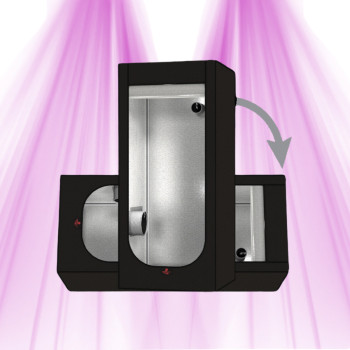
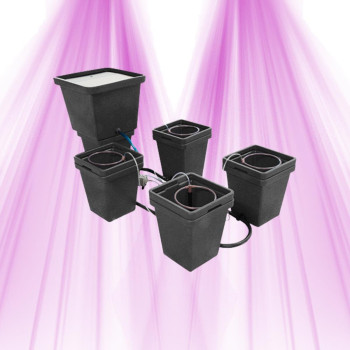
PROBOX Propagator M - Grow box 80x60x40 cm
Available in 4 models
In stock · Shipped within 24 h
63,90 € or 3× 21,30 €

Product successfully added to your shopping cart
Ça pousse dans le bon sens

14 products
80x80cm grow tents are the go-to size for getting started with indoor cultivation without breaking the bank or taking over your entire living room. With 0.64m² of floor space and typically 160 to 180cm in height, these tents offer the perfect area to master the basics of indoor growing. Frankly, it's the sweet spot between a small footprint and satisfying yields.
This dimension allows for easy installation of all necessary equipment: LED lighting, extractor fan, internal ventilation, without it becoming a cluttered mess. And unlike smaller sizes, you have enough room to move around your plants during maintenance.
The 80x80cm size hits the mark for several concrete reasons. First, the floor space allows you to cultivate 4 to 9 plants depending on your technique (SOG, SCROG, or classic cultivation). This is more than enough to experiment with different varieties without overdoing it from the start.
In terms of electricity consumption, a 200 to 300W LED is ample to uniformly illuminate the entire surface. This keeps your electricity bill reasonable, unlike larger setups that require 600W or more. Extraction is usually handled by a 250 to 400m³/h fan, which is also affordable equipment.
Practically speaking, these tents fit through most standard doorways (exactly 80cm wide) and are easily set up in a closet, a spare room, or even a corner of a garage. The discretion-to-efficiency ratio is truly excellent.
Not all 80x80 models are created equal, and a few details make all the difference. Fabric density is measured in deniers: aim for a minimum of 600D, ideally 1680D for ultimate durability. Seams should be double-stitched, otherwise you risk light leaks after a few months.
The structural poles are crucial: 19mm metal minimum, otherwise they'll bend under the weight of lighting and carbon filter. Also check the number of openings: you need at least one top outlet for extraction, one bottom inlet for fresh air, plus a few passages for cables.
Height varies between 160 and 200cm depending on the model. If you have the choice, opt for 180cm: this leaves room to hang the lighting high enough and prevent your plants from touching the LEDs at the end of flowering. Budget-wise, expect to pay between 80 and 150€ for decent equipment.
In an 80x80cm tent, you can grow between 4 and 9 plants depending on your method. In classic cultivation with 11L pots, 4 plants allow for optimal development with 40cm between each plant. For SOG (Sea of Green), you can grow up to 9 small plants in 6L pots for a faster harvest. The SCROG (Screen of Green) technique works perfectly with 1 to 4 plants trained under a net.
For an 80x80cm tent, a 200 to 300W LED is more than sufficient. Count approximately 35 to 40W per square foot, or 225 to 260W for 0.64m². A 240W full spectrum LED perfectly covers this surface with a homogeneous PPFD of 400 to 600 µmol/m²/s. Avoid oversizing: beyond 350W, you risk overheating and light stress without any gain in yield.
Installing an 80x80cm tent takes 30 minutes without any tools. Start by assembling the metal frame by fitting the poles into the plastic connectors. Then slide the fabric over the top, like a giant cover. Secure the velcro straps at the corners to tension the fabric. Finish by installing the openings and ventilation sleeves. Most recent models use a clip and snap system, no screws or screwdrivers needed.
For an 80x80cm tent, a 250 to 400m³/h extractor fan is ample. Calculate the volume of your tent (0.64m² × height) and multiply by 60 to get the minimum hourly flow rate. A 315m³/h model with a dimmer allows you to adjust according to the season and the lighting used. Opt for mixed-flow (centrifugal) extractors, which are quieter than axial fans, especially if the tent is in a living area.
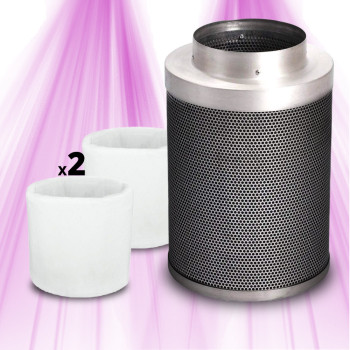
A carbon filter for an 80x80cm tent should be replaced every 12 to 18 months depending on use. To extend its lifespan, regularly vacuum the external pre-filter that traps large particles and dust. Avoid excessive humidity (above 70%) which degrades activated carbon. If odors start to escape despite a running extractor, it's a sign that the carbon is saturated. A 400 to 500m³/h filter is perfectly suitable for this size of tent.
Available in 4 models
Available in 7 models
Available in 3 models
Available in 5 models
Available in 19 models
Available in 4 models
Available in 6 models
Available in 19 models
Help & advice
About 80cm x 80cm — click a question to see the answer.
For an 80x80cm grow tent, I generally recommend an LED power between 200W and 300W actual draw. This range ensures optimal light coverage without overheating or excessive power consumption. The goal is to achieve sufficient PPFD (Photosynthetic Photon Flux Density) for vigorous growth and abundant flowering across the entire surface.
The ideal distance between the LED light and plants in an 80x80cm grow tent depends on your LED's power and the plants' development stage. Generally, I start growth at about 40-60 cm and gradually lower it to 30-45 cm during flowering. It's crucial to observe your plants: if the leaves yellow or curl upwards, the light is too intense, and you need to raise the lamp. Conversely, if they stretch, the light is too weak.
For an 80x80cm grow tent, I would clearly lean towards LED. Although HPS has proven its worth, modern LEDs offer better energy efficiency, a longer lifespan, and a light spectrum better suited for plants, while emitting less heat. This greatly simplifies temperature and humidity management in such a compact space, and will allow you to reduce your electricity consumption.
For an 80x80cm grow tent, I prefer a 'full spectrum' light spectrum. This type of spectrum contains a balance of blues for vegetative growth and reds for flowering, simulating natural sunlight. If your LED allows it, you can slightly increase the proportion of blue during growth and red during flowering to optimize each phase, but a good full spectrum will suffice for the entire cycle.
In an 80x80cm grow tent, I generally recommend growing 1 to 4 plants, depending on the cultivation technique and desired final size. For medium-sized plants or techniques like SCROG (Screen of Green), 1 to 2 plants can fill the space. If you opt for smaller plants or a SOG (Sea of Green), you might fit 4, but you'll need to manage the canopy well. The important thing is not to overcrowd the space so that each plant receives enough light and air.
Cannot find your answer? 01 88 33 45 52 or by message.