Air Extractors for Indoor Growing: Mastered Air Renewal
Air extractors are the lungs of your indoor growing setup. They remove hot, humid air while creating negative pressure that draws in fresh air. Without an efficient extraction system, your plants risk suffocating in stale air, with rising temperatures and stagnant humidity.
Why choose the right air extractor
A good air extractor keeps your grow space within optimal parameters. It removes heat generated by your lights, regulates humidity, and ensures a constant supply of fresh CO2. Power is measured in m³/h: for an 80x80x160 cm grow tent (approximately 1m³), aim for a minimum of 150-200 m³/h without a carbon filter. With a filter, increase by 30% as it creates resistance.
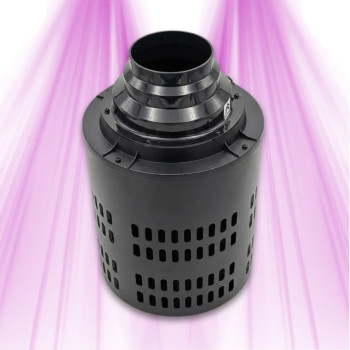
Centrifugal extractors are quieter than axial fans, crucial if your grow is near living areas. Some models go below 25 dB, others reach 45 dB. The difference is noticeable, especially at night. Extractors with speed controllers allow you to adjust the flow rate as needed: stronger during flowering when humidity increases, gentler during vegetative growth.
How to choose your air extractor
First criterion: calculate the volume of your space (length x width x height) and multiply by 60 to get the minimum hourly flow rate. For a 120x120x200 cm grow tent (2.88 m³), aim for a minimum of 170 m³/h. If you use a carbon filter, add a 20-30% extra margin.
Second point: noise level. Below 30 dB, it's truly silent. Between 30-40 dB, it remains discreet. Above 45 dB, it starts to become noticeable. "Turbine" type centrifugal extractors are generally quieter than classic axial fans.
Third criterion: compatibility with your ducts. Standard diameters are 100mm, 125mm, 150mm, and 200mm. The larger the diameter, the less resistance and noise for the same flow rate. A 150mm extractor at 300 m³/h will be quieter than a 125mm at the same flow rate.
Frequently Asked Questions
How to calculate the necessary air extractor power for my 80x80x160 cm tent with a carbon filter?
Your grow tent is 1.024 m³ (0.8 x 0.8 x 1.6). Multiply by 60 to get a minimum of 61 m³/h, but this is truly the bare minimum. In practice, aim for 150-200 m³/h for good air exchange. With a carbon filter, add a 30% margin as it restricts airflow: so, count on 200-260 m³/h. A 250-300 m³/h extractor will be perfect, with the option to reduce speed if needed.
Do I need a silent extractor if my indoor grow is in a room near the bedroom?
Absolutely, it's even crucial for your peace of mind. An extractor running 18 hours/day at 45 dB quickly becomes unbearable. Prioritize models below 30 dB or with a speed controller to reduce the speed at night. "Mixed-flow" type centrifugal extractors are generally quieter than axial fans. You can also install silencers on the air intake and exhaust ducts.
Where should I install the extractor: inside or outside the grow tent?
The extractor is always placed outside the grow tent, connected by a duct to the hot air outlet point (at the top of the tent). This configuration avoids adding heat to the grow space and facilitates maintenance. If you use a carbon filter, it is placed inside the tent, connected to the extractor by a duct. Air first passes through the filter, then is expelled by the extractor.
Do I need an intake fan in addition to the extractor for my indoor grow?
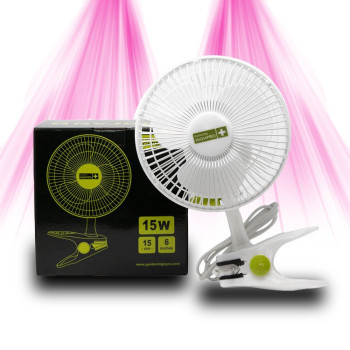
Not necessarily, it depends on your setup. The extractor creates negative pressure that naturally draws fresh air through passive inlets (holes with grilles). For small grow tents (less than 2 m³), this passive intake is largely sufficient. For larger setups or if you have temperature problems, an intake fan can help force fresh air in. General rule: the intake fan should have a lower flow rate than the extractor to maintain slight negative pressure.
How to maintain and replace the carbon filter of my air extractor?
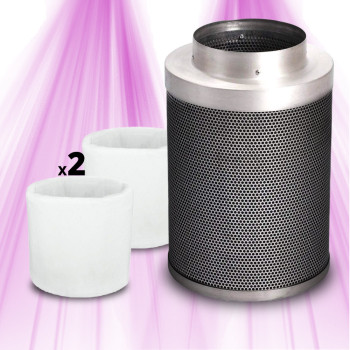
The carbon filter should be changed every 12-18 months depending on usage and air quality. You'll know it's saturated when odors start to pass through despite the extraction system. For maintenance, regularly dust the pre-filter (white sock) by washing or replacing it. The activated carbon itself cannot be cleaned; the entire filter must be replaced. Store new filters in a dry place, as humidity degrades activated carbon even when unused.