



































































Watering Solutions for Green Plants
6 products
Plant Watering Solutions for Green Plants: Keep Your Plants Hydrated
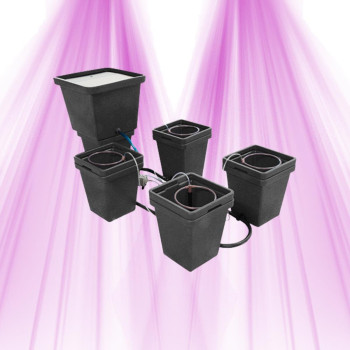
Plant watering solutions are revolutionizing the way you care for your indoor plants. Whether you're going on vacation or simply want to optimize your plants' hydration, these systems ensure a regular and appropriate water supply. From programmable drip irrigation to self-watering pots, each solution meets specific needs depending on the type of plant and your lifestyle.
Why choose a suitable watering system
Manual watering is often approximate and inconsistent. Honestly, who hasn't forgotten to water their plants for a week? Automatic watering systems eliminate this problem by delivering the exact amount of water at the right time. Drip systems provide precise flow rates, typically between 2 and 8 liters per hour depending on the model, directly at the roots. This is where it makes all the difference: your plants receive exactly what they need, without excess or deficiency. Pots with integrated water reservoirs offer autonomy of 7 to 21 days depending on their capacity, perfect for extended absences. These solutions also reduce water stress, a major factor in the decline of indoor plants.
How to choose the right watering solution
The choice mainly depends on three criteria: the number of plants, their type, and your frequency of absence. For 1 to 5 plants, a drip kit with a timer is more than sufficient. These systems generally cover an area of 2 to 10 m² with adjustable flow rates from 0 to 60 liters per hour. For tropical plants that love constant humidity, opt for reservoir systems with capillary action. Succulents and cacti prefer infrequent but generous watering: a timer with long cycles will be more suitable. Also check the electrical autonomy if you choose a programmed system – some models run for 6 months on batteries. Water pressure is crucial: most domestic systems require between 0.5 and 2 bars to function correctly.
Frequently Asked Questions
Which automatic watering system should I choose between programmed drip irrigation and pots with integrated water reservoirs?
Programmed drip irrigation is better suited for setups with several plants with similar needs. It offers remarkable precision with flow rates adjustable to the nearest milliliter and can manage up to 20 watering points simultaneously. Self-watering pots are more suitable for isolated plants or beginners because they require no technical adjustments. Their capillary system ensures a constant supply for 2 to 3 weeks depending on the reservoir size. For demanding plants like orchids or ferns, drip irrigation remains superior because it allows for fine adjustment of substrate moisture.
How to properly install a drip system on my indoor plants without damaging the roots?
Installation requires a few simple but essential precautions. Plant the drippers 5-8 cm from the base of the plant, never directly against the stem to avoid collar rot. The ideal depth is 3-4 cm into the substrate, enough to stabilize the dripper without piercing superficial roots. Always start with a minimal flow rate (1-2 liters/hour) and gradually increase it according to the plant's reaction. Test the system 24-48 hours before an absence to ensure water diffuses uniformly throughout the pot. A pro tip: place a saucer under each pot for the first few days to detect any potential overwatering.
What is the difference between top watering and bottom watering, and which is more effective?
Top watering mimics natural rain and is suitable for most indoor plants. It allows for rinsing the foliage and uniformly moistening the substrate from the surface to the deep roots. Bottom watering involves placing the pot in a tray of water for 15-30 minutes: water rises by capillary action from the drainage holes. This method is excellent for plants with sensitive roots like African violets or carnivorous plants. Bottom watering also avoids wetting the foliage, which is crucial for species susceptible to fungal diseases. In indoor cultivation, top watering is more practical for daily use, but bottom watering proves more effective for rehydrating very dry substrate.
Do automatic watering systems work well for all varieties of indoor plants, or are there exceptions?
Most indoor plants adapt perfectly to automatic systems, but there are a few exceptions. Epiphytic orchids prefer misting rather than water supply to the substrate. Cacti and succulents require very spaced watering cycles (7-15 days) that not all programmers can manage. Carnivorous plants like sundews require demineralized water, which is incompatible with systems connected to the mains. On the other hand, tropical plants (pothos, monstera, ficus) love automatic watering because they appreciate constant humidity. Modern programmers allow for up to 4 different cycles, perfect for adapting watering according to the species.
How long can an automatic watering system keep my plants hydrated during a prolonged absence?
Autonomy essentially depends on the reservoir capacity and your plants' needs. A 10-liter reservoir with a flow rate of 2 liters/hour for 5 plants provides approximately 15 days of autonomy under normal conditions. Battery-powered systems generally offer 3 to 6 months of operation depending on the programmed watering frequency. For absences longer than a month, opt for systems connected to the water supply with an electronic programmer. Be aware of temperature variations that increase evaporation: in summer, reduce the expected autonomy by 30%. A practical tip: always test your system a week before departure to adjust the settings and avoid unpleasant surprises.