


































































HydroRDWC
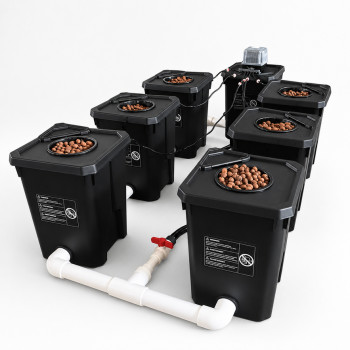
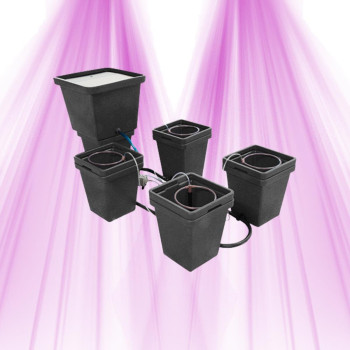
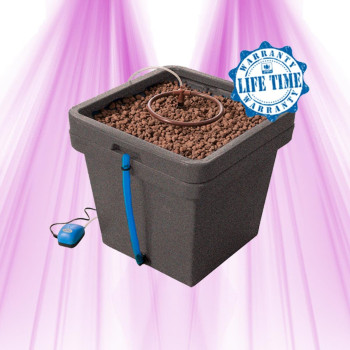
RDWC Hydroponic System 4 pots 27L – Performance and Simplicity for Indoor…
In stock · Shipped within 24 h
429,00 € or 3× 143,00 €

Product successfully added to your shopping cart
Ça pousse dans le bon sens

2 products
PRO RDWC (Recirculating Deep Water Culture) systems represent the ultimate evolution in hydroponic cultivation. These setups continuously circulate an oxygenated nutrient solution between multiple grow pots connected to a master reservoir. The principle? Your plants develop their roots directly in enriched water, with a constant supply of oxygen that dramatically boosts growth.
Unlike classic DWC systems where each pot operates in isolation, PRO RDWC systems create a closed circuit. This continuous circulation maintains homogeneous parameters (pH, EC, temperature) throughout the entire setup. The result: uniform growth and yields that can exceed those obtained in soil by 30%.
The continuous circulation of the nutrient solution eliminates stagnant areas where bacteria and algae can develop. Constant oxygenation of the roots via air pumps and diffusers creates an optimal root environment. Your plants absorb nutrients more efficiently, leading to explosive vegetative growth and denser flowering.
The major advantage of RDWC is parameter stability. With a master reservoir of 50 to 200 liters depending on the model, pH and EC fluctuations are significantly reduced. No more adjusting each pot individually as in simple DWC. A single control point for your entire setup truly makes a difference in daily management.
PRO systems are distinguished by their robustness: high-quality pumps, reinforced tubing, opaque anti-algae buckets. These setups are designed to run 24/7 for months without a hitch. Maintenance is limited to checking levels and cleaning pump filters.
The number of pots determines your primary choice. For a 1m² space, count a maximum of 4 pots. A 1.2m x 1.2m space can accommodate 6 to 9 pots depending on their diameter. 20cm pots are suitable for medium-sized plants, 25cm for large specimens. The rule: better fewer, well-spaced pots than too many crowded ones.
The capacity of the master reservoir influences system stability. A minimum of 10 liters per grow pot, ideally 15-20 liters. A 6-pot system therefore requires a 90 to 120-liter reservoir for optimal operation. The larger the volume, the more stable the parameters remain.
Check the power of the circulation and oxygenation pumps. For circulation, count 300-500 L/h per pot. For oxygenation, a minimum 15W air pump for 4 pots, 25W for 6-8 pots. Diffusers should be ceramic or porous stone for fine and efficient bubbling.
Material quality matters greatly. Opaque food-grade plastic buckets, watertight fittings, UV-resistant hoses. PRO systems often use reputable submersible pumps with a manufacturer's warranty. It's an investment, but one that pays off in the long run.
For an 80x80cm space, limit yourself to a maximum of 4 x 20cm pots or 3 x 25cm pots. A square meter can accommodate 4 to 6 pots depending on their size and desired spacing. In a 120x120cm space, you can install 6 to 9 pots in a 2x3 or 3x3 configuration. The classic mistake is trying to cram too many: your plants need space to develop their branching. Better to have 4 well-developed plants than 8 that hinder each other.
Place the master reservoir at the lowest level of your setup to facilitate gravity return. Connect each pot to the next with minimum 16mm hoses, with a return to the reservoir from the last pot. The circulation pump is placed in the master reservoir and pushes the solution to the first pot. Install an external air pump with diffusers in each pot and the reservoir. Check the watertightness of all connections before the first watering.
The optimal temperature for the nutrient solution is between 18 and 22°C. Above 24°C, oxygen dissolves less effectively, and the risk of pythium increases. In summer or under powerful HPS lights, a chiller often becomes essential. Calculate 100W of cooling per 100L of solution to maintain 20°C with an ambient temperature of 25°C. A less expensive alternative: insulate the reservoir and use rotating frozen water bottles.
Exclusively use liquid hydro fertilizers or soluble powders; never use organics, as they cloud the water. Start with an EC of 0.8 during vegetative growth, gradually increasing to 1.4-1.6 during flowering, depending on the varieties. The pH should remain between 5.5 and 6.2 for optimal absorption. Completely renew the solution every 2 weeks at a minimum. Between changes, only adjust the level with pH-adjusted water, no additional fertilizer.
Daily check pH, EC, and water level, especially in the first few weeks. Clean air diffusers weekly as they quickly get clogged. Between grows, disassemble the entire system and disinfect with 1% diluted bleach, then rinse thoroughly. Replace hoses every 6 months as they accumulate biofilm and residues. Always keep reverse osmosis water on hand and pH+ and pH- solutions for quick adjustments.
Help & advice
About PRO RDWC Systems — click a question to see the answer.
A PRO RDWC system is designed for high-performance hydroponic cultivation. Its primary goal is to maximize the growth and yield of your plants by providing them with a constant and optimized supply of nutrients and oxygen. In practice, I find that this results in more vigorous plants, exceptional root development, and abundant harvests, often far superior to other cultivation methods.
The main difference lies in the circulation of the nutrient solution. In classic DWC (Deep Water Culture), each plant has its own static or almost static reservoir. With RDWC (Recirculating Deep Water Culture), as its name suggests, the solution continuously circulates between all grow pots and a central reservoir. This ensures perfect homogeneity of nutrients and pH for all your plants, which I consider a major asset for the stability of your crop.
I recommend the PRO RDWC if you are looking for optimal performance and rapid growth, especially for nutrient-hungry plants. It is particularly suitable if you already have some experience in hydroponics or if you are willing to invest time in parameter management. However, if you are a complete beginner, a simpler system like Ebb & Flow, which I explain in more detail in this article, might be a good starting point before moving on to RDWC.
The LED lighting power will depend on the cultivation area covered by your RDWC system and the specific needs of your plants. For an RDWC system, which aims for high performance, I generally advise high light intensity. In practice, for a 1m² area, I often recommend between 300W and 600W of quality full-spectrum LEDs, or even more for certain demanding crops, to ensure sufficient light penetration and optimal development.
The ideal distance between your LEDs and the top of your plants in an RDWC system is crucial and depends on your lighting power and the growth stage. Generally, I start in growth at about 40-60 cm, then gradually reduce it during flowering, going down to 20-30 cm for powerful LEDs, while carefully monitoring for signs of heat stress. The goal is to provide maximum light intensity without burning the leaves.
For an RDWC system, which promotes often larger and more vigorous plants, I generally lean towards bar-type LED panels. What I often see is that LED bars offer better light uniformity across the entire canopy, which is essential to avoid shaded areas and ensure homogeneous development of all plants. Compact panels can be effective for small areas, but to optimize space and light in an RDWC, bars are often a better choice.
For the growth phase with an RDWC system, I recommend a blue-rich spectrum, which promotes robust vegetative development and short internodes. For flowering, you need to switch to a spectrum richer in red and orange, with a presence of green and white for photosynthesis, which will stimulate flower and fruit production. Many modern LED panels offer adjustable spectra or growth/flowering modes, which greatly simplifies management.
Cannot find your answer? 01 88 33 45 52 or by message.