


































































Expert LED horticole depuis 2009 +50 000 commandes livrées Note boutique 4,7/5 · 1 766 avis King-Avis SAV horticole français
Catalog
Scales
4 products
Precision scales for indoor growing: perfect dosing for your fertilizers
In indoor growing, precision makes all the difference. Whether it's for dosing your liquid fertilizers, weighing your substrates, or measuring your additives, a reliable scale quickly becomes indispensable. Frankly, when you see the difference between approximate dosing and millimeter-perfect dosing, you quickly understand why experienced growers swear by their precision scales.
Why invest in a precision scale for your grow
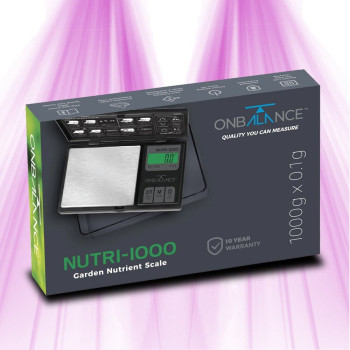
Precise dosing is the foundation of balanced nutrition. With a suitable scale, you avoid overdosing that can burn your plants or underdosing that slows their development. The 1000g Precision Scale - 0.1g Accuracy, for example, allows you to weigh up to 1kg with a tenth of a gram accuracy, perfect for large volumes of dry fertilizers or substrates.
The advantage of modern digital scales is their ease of use. Backlit display for working in your tent even with low light, tare function to deduct container weight, automatic shut-off to save battery. These small details really make a difference day-to-day, especially when you're handling multiple products consecutively.
For ultra-precise dosing of concentrated additives or boosters, the 100g Precision Scale - 0.01g Accuracy steps up with its hundredth of a gram accuracy. Its ergonomic design and robust construction make it a durable tool that will withstand the sometimes humid conditions of your grow spaces.
How to choose the right scale for your needs
First question: what maximum capacity? If you primarily work with liquid fertilizers and additives, 100 to 200g is more than enough. For weighing substrates, soil mixes, or large volumes of amendments, aim for 500g to 1kg capacity.
Accuracy depends on what you're dosing. For basic fertilizers (NPK, calcium, magnesium), 0.1g accuracy works perfectly. However, for root stimulators, hormones, or highly concentrated additives where a few milligrams can change everything, 0.01g accuracy becomes necessary.
Regarding power, battery-powered models offer more flexibility for moving around your grow space. Just check the battery life and automatic shut-off function. Some models also offer mains power, practical if your scale stays fixed on your workbench.
Also consider the usage environment. A scale with a protective cover will better resist humidity and splashes. The backlit display becomes essential if you often work in dim light.
Frequently Asked Questions
Which precision scale should I choose for weighing my fertilizers and substrates in indoor growing?
It depends on your volumes and the type of products you use. For liquid fertilizers and additives in small quantities, a 100-200g scale with 0.01g accuracy is perfect. If you prepare your own substrate mixes or dose large volumes of dry fertilizers, opt for a 500g-1kg capacity with 0.1g accuracy. The ideal is to have both: a small, very precise one for concentrated additives and a larger one for significant volumes.
How do I properly calibrate my scale before first use?
Most modern scales calibrate automatically on startup, but you can force a manual calibration. Place your scale on a perfectly flat and stable surface, away from vibrations. Turn it on and wait for it to display zero. Use the provided calibration weights (often 50g or 100g) following the manual's procedure. If you don't have the original weights, coins can help: a 1€ coin weighs exactly 7.5g, a 2€ coin is 8.5g.
What's the difference between a 0.1g and a 0.01g digital scale for my needs?
The difference lies in dosing precision. A 0.1g scale is perfectly suitable for basic fertilizers, substrates, and most common additives. However, for highly concentrated stimulators, rooting hormones, or boosters where the recommended dose is in milligrams per liter, 0.01g accuracy becomes crucial. Basically, if your products are dosed in grams, 0.1g is sufficient. If they are dosed in milligrams, go for 0.01g.
Should I use battery or mains power for installing the scale in my grow tent?
Battery-powered models offer more flexibility for moving around and avoid cables cluttering your tent. Battery life varies from a few hours to several weeks depending on usage and the automatic shut-off function. Mains power is better if your scale remains fixed on a workbench outside the tent. Some hybrid models offer both options, providing maximum flexibility of use.
How do I clean and maintain my scale to keep it accurate long-term?
Avoid water and harsh chemicals that can damage the electronics. Use a slightly damp cloth to clean the tray and screen, then dry immediately. For sticky fertilizer residues, a cotton swab with a little isopropyl alcohol works wonders. Store your scale in a dry place, away from temperature variations. Recalibrate it regularly, especially if you move it often or notice discrepancies in your usual measurements.
Showing 1-4 of 4 1/1

GrowLED Essentials
Precision balance 1000Gr - Accuracy to 0.1g
Available in 2 models
In stock · Shipped within 24 h
26,80 €


GrowLED Essentials
1 Review(s)
100Gr precision balance - Accuracy to 0.01g
Available in 2 models
Ships within 2 weeks
19,89 €
Satisfait ou remboursé
14 jours
Retour 14 jours
Frais de retour à votre charge
SAV expert FR
Conseil horticole
Paiement en 3, 4 ou 10 fois
Sans frais par CB