



































































BloomLED
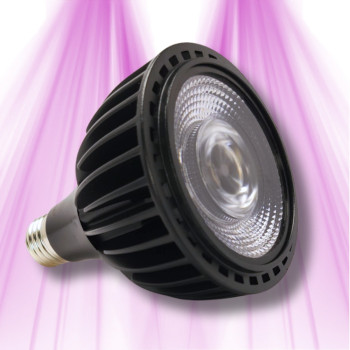
E27 LED horticultural bulb for plants SpectraBULB X30 - 35W
Available in 3 models
In stock · Shipped within 24 h
85,90 € or 3× 28,63 €

Product successfully added to your shopping cart
Ça pousse dans le bon sens

7 products
A 40cm x 40cm - 0.2m² lighting area is perfect for small indoor growing setups or spaces dedicated to young plants. This compact surface requires precise and adapted lighting to maximize yield without wasting energy. Whether for a starter box, a cloning space, or a single-pot grow, choosing the right LED light for these dimensions makes all the difference.
Frankly, properly lighting 0.2m² is not as easy as it seems. Too much power and you'll burn your plants; too little and they'll stretch. Modern LED lights offer precise control of light intensity with adjustable PPFD (photosynthetic photon flux density) between 200 and 800 µmol/m²/s depending on the growth stage. For this area, a 30 to 60-watt light is more than enough, unlike older HPS lights which required a minimum of 150W for the same surface.
The major advantage of LEDs for 40x40cm is thermal management. With a well-sized light, the temperature remains stable around 24-26°C without additional forced ventilation. Samsung LM301B or LM301H diodes generate less than 0.3W of heat per watt consumed, compared to 0.8W for HPS. The result: your plants grow in optimal conditions without thermal stress.
For a 40cm x 40cm area, several criteria determine the choice of your LED lighting. First, power: count 150 to 300 watts per m², which means 30 to 60 actual watts for your 0.2m². Beware of "equivalent" watts, which are often misleading on product sheets. Always check the actual consumption indicated in small print.
The light spectrum plays a crucial role on this small surface. A full spectrum 3000K-6500K with peaks in red (660nm) and blue (450nm) covers all photosynthetic needs. Lights with dimmers allow you to adjust the intensity: 40% for seedlings, 70% for vegetative growth, 100% for flowering. This is where flexibility makes all the difference.
Installation height varies depending on power: 30-40cm for a 30W, 40-60cm for a 60W. A good indicator: if you can hold your hand under the light for 30 seconds without discomfort, that's the right distance. Lights with 90° or 120° optics distribute light better over this square surface than 60° optics.
For 0.2m², a 30 to 50 actual watt light is more than sufficient. Below 30W, you risk insufficient lighting during flowering. Above 60W, you enter the overheating zone without gaining yield. Samsung or Osram lights in this range maintain a surface temperature around 45°C, which is perfectly manageable. Prioritize models with aluminum heat sinks and avoid lights without passive cooling that reach 70°C+.
The optimal height depends on the power and growth stage. For a 30W, start at 45cm from the plants and gradually lower to 30cm by the end of vegetative growth. With a 50W, start at 60cm and stabilize at 40cm. Uniformity is simply checked: measure the light intensity at the four corners with a lux meter; the deviation should not exceed 20%. If the edges receive less light, raise the light slightly.
Full spectrum LED lights perfectly cover both phases on 40x40cm. During vegetative growth, use 60-70% power with a blue-rich spectrum (6500K) to promote foliage development. During flowering, switch to 100% with a red dominance (3000K) to stimulate flower and essential oil production. Aromatic plants like basil, mint, or thyme respond excellently to this protocol with yields 30% higher than crops grown under fluorescent lights.
Maintenance of an LED on this surface remains minimal but crucial for longevity. Clean the diodes every 15 days with a slightly damp microfiber cloth to remove dust, which reduces efficiency by 15% in 6 months. Check that the heat sink fins are not obstructed, especially in high-humidity growing environments. Avoid thermal shocks by allowing it to cool for 10 minutes before complete shutdown. A well-maintained LED retains 90% of its power after 50,000 hours, which is 10 years of normal use.
A programmable timer is essential to respect photoperiods: 18h/6h for vegetative growth, 12h/12h for flowering. Mechanical timers are sufficient for this power; there's no need for expensive electronic models. Regarding the reflector, it's less obvious for 0.2m². Modern LED lights already integrate optics that direct 95% of the light downwards. A reflector only provides 5-10% additional efficiency, often offset by the temperature increase it generates in such a confined space.
Available in 3 models
Available in 3 models
Available in 3 models
Help & advice
About 40cm x 40cm - 0.2m² — click a question to see the answer.
For a 40cm x 40cm (0.2m²) area, I generally recommend an LED power between 50 and 80 actual Watts. This range ensures sufficient light intensity for the growth and flowering of most plants, without overheating your small space. If you opt for very light-hungry plants, you might go slightly higher, but be mindful of heat management.
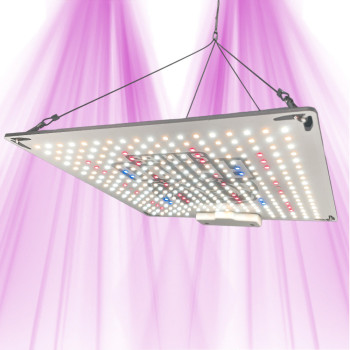
For this small area, I advise prioritizing LED lights with a good PAR (Photosynthetic Active Radiation) and homogeneous light distribution. Look for compact models, often in the form of bars or small panels, which will fit well in the space. Also, consider ease of installation and the presence of an efficient heat sink to avoid heat issues. If you have specific needs, such as intensive cultivation, this might influence your choice towards more powerful models.
The installation distance depends heavily on your LED's power and your plants' growth stage. Generally, for a 50-80W LED over 40x40cm, I start by positioning the lamp approximately 30-40 cm from young seedlings. As they grow, I can adjust this distance, often moving it a bit closer (20-30 cm) for more mature and flowering plants, while carefully monitoring for signs of light stress on the leaves.
The most common mistake I see is underestimating heat management, even in a small area. An LED that is too powerful or poorly ventilated can quickly raise the temperature. Also, avoid choosing an unsuitable light spectrum, or not adjusting the lamp's distance. Finally, do not neglect the importance of a good light cycle; constant lighting is not always beneficial for all plants.
For versatile cultivation in 0.2m², I recommend a full spectrum. It is the most versatile and suitable for all growth phases, from seedlings to flowering. If you have more specific needs, for example for cloning or vegetative growth only, a spectrum with a dominant blue can be interesting. For flowering, a red-enriched spectrum will promote flower and fruit production. For other uses, a more specific spectrum might be considered.
The number of light hours depends entirely on your plants' development stage. For the vegetative phase, I generally recommend a cycle of 18 hours of light and 6 hours of darkness. For flowering, most photoperiodic plants require a cycle of 12 hours of light and 12 hours of darkness. It is crucial to respect these cycles for the proper development of your crops.
Cannot find your answer? 01 88 33 45 52 or by message.