





































































GrowLED Essentials
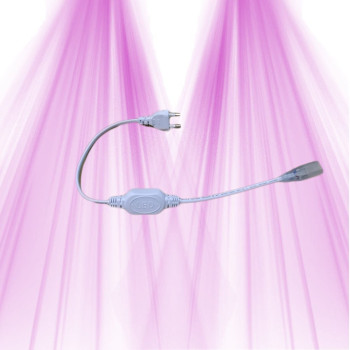
Câble Plug & Play avec douille E27 - 100/300cm - Blanc/Noir
In stock · Shipped within 24 h
20,90 €

Product successfully added to your shopping cart
Ça pousse dans le bon sens

38 products
Electrical accessories are the backbone of any serious indoor growing setup. Between extractors, LED lights, fans, and all the gadgets that keep your grow space running, you need reliable electrical equipment to avoid problems. We're talking about suitable cables, robust power strips, and extension cords that can withstand the humidity and demands of a growing environment.
Frankly, this is not the time to DIY with supermarket plugs. A poorly designed installation risks short circuits, crop loss, or worse. Here, we focus on equipment designed for the specific constraints of our installations.
The difference between a generic electrical accessory and one adapted for growing is its resistance to humidity and its ability to handle significant loads. Take the Power Strip with 5 sockets - 1m Cable - Switch - MAX 3500W: with its 3500W max and integrated switch, it can power several heavy pieces of equipment without flinching. This is exactly what you need when you have a 200W extractor, fans, and lighting on the same line.
Cables are also crucial. The Stripped Mains Cable Black - 150cm - EU Plug allows you to properly connect equipment sold without a power supply. No more fiddling with terminal blocks that end up overheating. And for specific LED installations, the Lumatek LED Extension Cables - 5m offer the necessary flexibility to position the power supply away from the humid area.
First reflex: calculate the total power of your equipment. A 125mm TT extractor consumes about 35W, a 240W actual LED, plus the fans... It adds up quickly. Make sure your power strips and cables can easily handle this load. A minimum 30% margin is essential.
For extension cords, the cable cross-section matters a lot. The Extension Cord 5m - 3 x 1.5mm² + NF Safety with its 1.5mm² cross-section and NF certification, it easily handles high-consumption devices over 5 meters. Below 1.5mm², you risk voltage drop and overheating.
Also consider the length. Sometimes you need to relocate the power supply or reach a distant outlet. The IEC Cable Extension 4M solves this problem for lamps with a standard IEC connector. Four meters gives you the flexibility to organize your space as you wish.
For a standard extractor up to 100W and a few fans, 1.5mm² is largely sufficient. Beyond 150W total or for distances greater than 10 meters, switch to 2.5mm² to avoid voltage drops. The golden rule: always allow a 30% margin on the cable's nominal power. A 1.5mm² cable theoretically supports 16A or 3680W, but in practice, we stay below 2500W for safety.
Always place the power strip high up, never on the ground where humidity can accumulate. Ideally at least 50cm from the ground and away from watering areas. Use a power strip with a switch as a reference to quickly cut power in case of a problem. If your installation does not have a 30mA differential upstream, add a portable differential block. Regularly check that the outlets are not heating up, a sign of overload or poor contact.
For a Pure Fan TT, count on a controller supporting at least 1.5 times the nominal power of the fan. A 125mm TT consumes about 35W, so take a minimum 60W controller. Modern electronic controllers maintain torque even at low speeds, unlike older thyristor models that caused airflow to drop. Avoid going below 40% of the nominal speed to maintain effective airflow.
Yes, most standard pre-wired conduits fit into 20 or 25mm diameter IRL tubes depending on the conductor cross-section. For 1.5mm² with 3 conductors, 20mm IRL tube is sufficient. Beyond 2.5mm² or with more than 3 conductors, switch to 25mm. The advantage of pre-wired conduits is that they slide easily into tubes thanks to their smooth sheath, unlike rigid cables that snag.
Dust off connectors every 3 months with a dry brush and check the tightness of the terminals. Humidity can cause oxidation on copper contacts; clean with a specialized contact product if necessary. For cable ties, replace them as soon as they show signs of fatigue or cracking. A broken tie means a dangling cable and potentially a short circuit. Store spare ties in a dry place to prevent them from becoming brittle.
Help & advice
About Electrical accessories — click a question to see the answer.
For an indoor setup, I recommend using power strips with surge protection and good waterproofing. You should avoid low-end power strips that are not designed for this environment. I also make sure that the maximum power supported by the power strip is greater than the sum of the powers of all the devices I plan to connect to it, especially LED lights which can draw a lot of current.
Installing electrical cables in indoor growing requires rigor. I always make sure that the cables are suspended and not in direct contact with the ground or water. I use cable ties to organize them and prevent them from trailing. I also regularly check the condition of the sheaths to detect any wear. Safety is paramount to prevent any risk of electrocution or fire.
For LED grow lights, I recommend choosing cables whose cross-section is adapted to the power of your lighting. Generally, for powerful LED lights, a 1.5mm² cross-section cable is a minimum to avoid overheating. If you have doubts, it is better to slightly oversize the cross-section for more safety. A cable like the Power cable for Sanlight Serie Q Generation 2 is specifically designed for high-quality lights.
The most common mistakes I see are overloading outlets, using equipment not suitable for humidity, and poor cable organization. It is absolutely essential to avoid leaving cables trailing on the floor, plugging too many devices into a single outlet, or using outdoor extension cords indoors. Also, remember to unplug devices before any handling. I have also written an article on how to reduce electricity consumption, which includes safety tips.
A Lumatek LED extension cable is used to extend the distance between your ballast and your Lumatek LED bar. This is very practical when you want to move the ballast outside the growing area to reduce heat or to facilitate access to settings. It offers valuable flexibility in arranging your space and managing temperature.
To know if an extension cord is suitable for humidity, I check its Ingress Protection (IP) rating. For indoor growing, I look for at least an IP44, which indicates protection against splashing water. I also prefer robust cable sheaths and sockets with protective caps if they are not in use. An NF certified extension cord with a good cross-section is a good indicator of quality.
The main difference is their termination. A stripped cable is, as its name suggests, without a connector at one end, which allows it to be connected directly to a terminal block, a transformer, or a device requiring a wired connection. An IEC cable (like the IEC 4M cable) has standardized connectors (C13/C14 for example) and is used to power electronic equipment such as grow lights or computers. I use them according to the specific needs of my devices.
To secure an indoor setup, I would advise starting with a good extension cord with NF safety, like the 5m Extension Cord - 3 x 1.5mm² + Secu NF. Then, a power strip with surge protection is essential. I also make sure that all my cables are of good quality and adapted to the power of my equipment. Finally, never underestimate the importance of a good residual current device on your general electrical installation.
To connect a 2000W fan heater in indoor growing, I first make sure it is plugged into a dedicated wall outlet if possible, or into a power strip capable of supporting its high power without overloading the circuit. I ensure it is placed on a stable surface, away from any water splashes or flammable materials. I never plug it into a low cross-section extension cord, as this could lead to overheating. The ideal is to couple it with a thermostat to regulate the temperature and prevent it from running continuously.
Cannot find your answer? 01 88 33 45 52 or by message.