









































































Domiz·Home automation for indoor cultivation
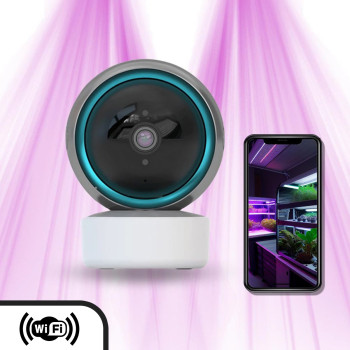
Wifi surveillance camera for culture chamber
Réf. CAM-SURV-WIFI-CHBR-CULT-DOMIZ Domiz
Wifi surveillance camera for culture chamber
Imperméable Caméra de surveillance Smart Life, ONVIF
- Ideal camera for monitoring your indoor growing space.
- Controllable with your smartphone using the Smart Life application.
- Cloud compatibility to store and view recordings remotely.
Satisfait ou remboursé
14 jours
Retour 14 jours
Frais de retour à votre charge
SAV expert FR
Conseil horticole
Paiement en plusieurs fois
with Alma, from €50 — or pay in 15 days from €100

Wifi surveillance camera for culture...
44,90 €
Highlights
Étanche
Imperméable
Parraine tes proches
5 % pour toi & 5 % pour ton ami
Description
Product presentation
The 1080 IP tuya wireless wifi camera is a high definition security camera designed for indoor use.
It is equipped with 5MP video resolution and night vision for optimal image quality even in low light conditions.
It also has auto-tracking, which allows the camera to automatically follow the movements of an object or person in its field of view.
Use for indoor growing
This camera is ideal for monitoring your growing space, such as your plants in a greenhouse or your indoor garden. The camera can help you check the growth and health of your plants, record changes and identify possible problems quickly.
It is also possible to monitor the growing environment using the camera's night vision and automatic tracking functions. This can help identify issues such as humidity, temperature or lighting that may be affecting plant growth.
Using the camera's cloud storage features, you can view recordings remotely and monitor the progress of your indoor crops, even when you're away from home.
Camera Features
- 5MP video resolution for optimal image quality.
- Two-way audio for remote communication with people in the room where the camera is located using the noise-cancelling microphone and built-in speaker.
- Automatically tracking the movements of an object or person in its field of vision.
- The camera can be used in climatic conditions ranging from -20° to +55°.
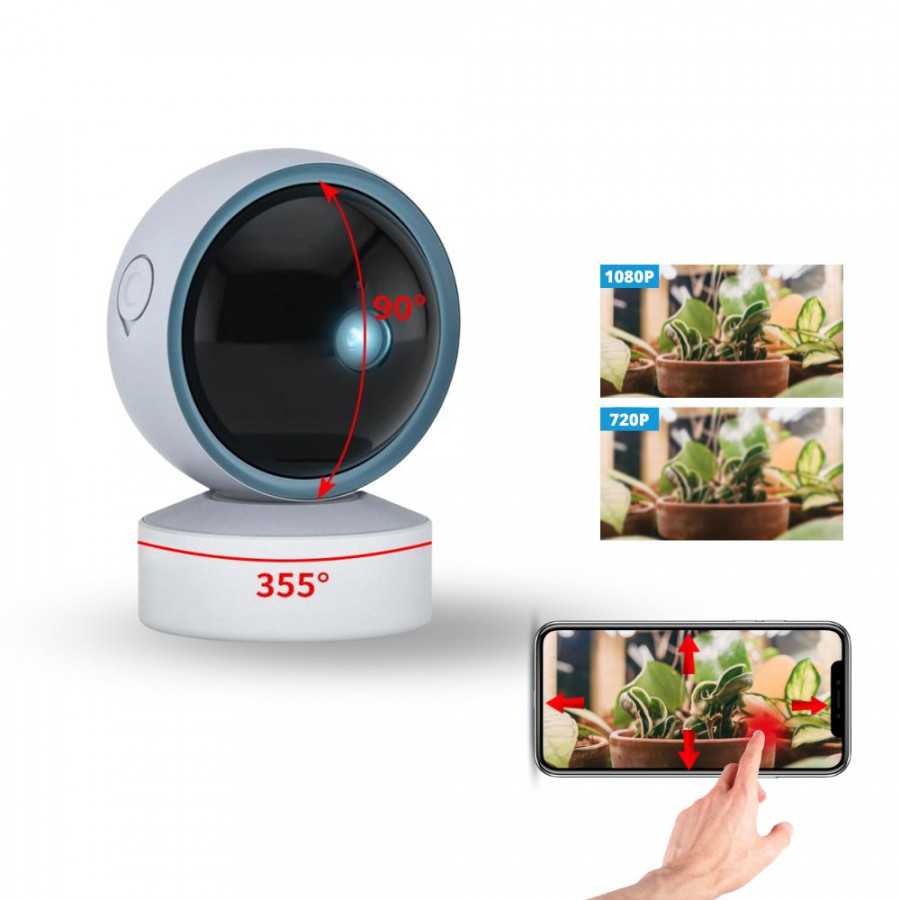
- Pan and tilt camera: Horizontal (355°), vertical (90°) rotation angle.
- Controllable with your smartphone using the Smart Life application.
- Sleek, intuitive and easy to install: The camera and app are simple, easy and quick to install and control.
- Compatible with 2.4GHz.
- Compatible with IOS and ANDROID.
Description of the Tuya IP video surveillance camera
| Features | Description |
|---|---|
| 360 degree monitoring | Allows you to monitor the entire room with multi-angle rotation. (Video accessible via your smartphone 24/7). |
| Smart alarm | Detects movements and triggers an alarm on your smartphone to report any anomalies. |
| Quality night vision | Professional infrared fill light system. Automatic night mode. |
| Optimal image quality (HD) | 110‑220V 1080P camera resolution and enhanced night vision function . High resolution 3 mpx image, fine texture. |
| Allows you to monitor a wide area | Focal length of 3.6mm , visible distance of 50 meters during the day, night vision distance of 30 meters. |
| Intelligent QOS Algorithm | Automatically adjusts code flow and frame rate. |
| Control | Allows you to view images in real time from different devices using the Smart Life application. |
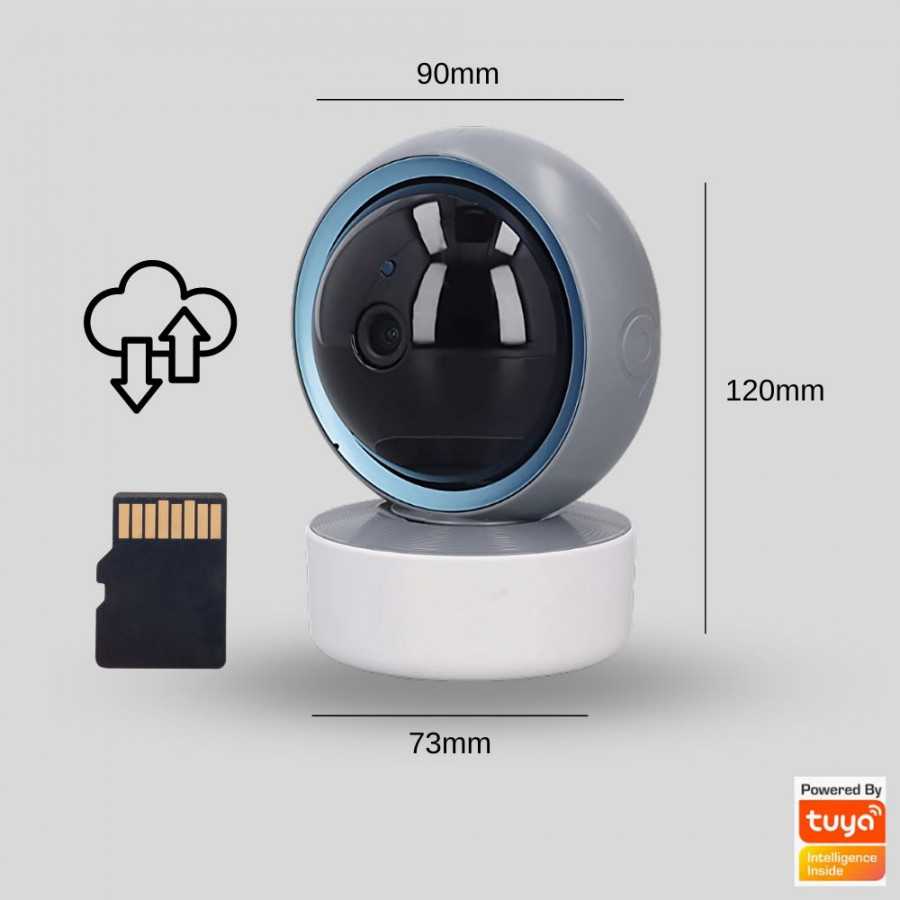
| Storage | The Wifi monitor supports TF card and Cloud storage. Maximum memory expansion to 128 GB. |
| Active noise reduction function | Filters background noise, removes unwanted sounds from air purifiers, air conditioners, humidifiers, etc. |
| Security | Thanks to the continuous recording option, your confidential data will be protected. |
Your product is sold with:
- 1 camera
- 1 user manual
- 1 socket
- 1 USB cable
- 1 base
- 1 reset needle
- 2 screws
- 2 ankles
Specification :
- Brand: DOMIZ
- Connectivity: Wifi
- Special Features: Waterproof
- Camera resolution: 5MP
- Lens (mm): 3.6mm
- Storage: 128G
- High Definition: 1080P (Full-HD)
- Weight: 100 grams
- Material: ABS
- Day/night conversion mode: automatic ICR infrared filter
- Noise reduction: yes
- Storage: TF card, Cloud
- Video compression: H.264 standard
- Power consumption(w): 5w
- Power supply(v): 5v
- Video compression rate: 32 Kbps-2 Mbps
- Power supply: DC5V power input interface
- Operating temperature: -20° + 55°
- Warranty: 3 years
- Certification: CE
Questions answers
Q : Can this camera be used to monitor indoor crops?
A : Yes, this camera helps monitor indoor crops using night vision and auto-tracking features to identify issues such as humidity, temperature or lighting that may affect plant growth.
Q : Does this camera support TF Micro sd card storage?
A : Yes, this camera supports TF card storage up to a maximum expansion of 128GB, which allows recordings to be stored and viewed at any time.
Q : Can this camera be viewed by multiple users in real time?
A : Yes, this camera is compatible with mobile phones, computers and platform applications, it can be viewed by multiple users in real time.
Q : Does this camera have a smart alarm?
A : Yes, this camera has motion detection and an intelligent alarm to report any anomalies.
Q : Does this camera have good image resolution?
A : Yes, this camera has an image resolution of 5Mp.
Technical data sheet
Features detailed
| Waterproof | Imperméable |
|---|---|
| Type | Caméra de surveillance |
| Compatibility | Smart Life, ONVIF |
| Included accessories | Socle, câble USB, prise, vis, aiguille de reset |
| Display | Connected (app) |
| Connected / App | WiFi 2.4GHz |
| Resolution | 5MP (1080P HD) |
| Data storage | 128G (microSD ou cloud) |
| Two-way audio | Oui |
| Automatic tracking | Oui |
Convinced? Shipped from France. Add to cart — 44,90 €
They've adopted it
Reviews customers
Soyez le premier à donner votre avis !
Partagez votre expérience avec ce produit.
Frequently asked questions
Your questions
Hello,This Wifi surveillance camera for the grow room looks very comprehensive, but I would like to know if it can really withstand a humid atmosphere and sometimes vapor-laden conditions in a greenhouse or an indoor growing space with high humidity levels? Do you have details about its waterproof rating or an IP index that would guarantee this protection?
Hello,
Regarding the wifi surveillance camera for the grow room, we do not have precise information on its waterproof rating (IP). For use in humid and vapor-laden environments like a greenhouse or an indoor grow room, it's important that a camera has an IP rating of at least IP65 to resist water jets, or even IP67 for enhanced protection.
Without this guarantee, the camera may not withstand high humidity. We therefore recommend opting for a model specifically designed with an IP rating suitable for these conditions to ensure durable and reliable protection.
Is the automatic tracking reliable enough to detect and track slow or very light movements, such as the gradual growth of plants, without generating false alerts due to lighting fluctuations or small insects?
The Wi-Fi surveillance camera for growing chambers, such as the Tapo C100 or C110 models, features motion detection primarily designed to spot human movements or intrusions, with technology intended to limit false alerts related to moderate or rapid movements.
In contrast, this detection is not specifically calibrated to follow very slow and light movements, such as the gradual growth of plants. Natural lighting fluctuations or small insects can easily generate irrelevant alerts, as the sensitivity and filtering are not suited for this type of usage in a horticultural environment.
For precise monitoring of the slow evolution of plants, a surveillance solution equipped with more advanced video analysis or specialized sensors would be more reliable. If you wish, we can recommend more specific equipment tailored to this issue.
In contrast, this detection is not specifically calibrated to follow very slow and light movements, such as the gradual growth of plants. Natural lighting fluctuations or small insects can easily generate irrelevant alerts, as the sensitivity and filtering are not suited for this type of usage in a horticultural environment.
For precise monitoring of the slow evolution of plants, a surveillance solution equipped with more advanced video analysis or specialized sensors would be more reliable. If you wish, we can recommend more specific equipment tailored to this issue.
WiFi camera compatible with local control without cloud possible for maximum security in a micro growing space?
For WiFi monitoring in a micro growing space with local control without cloud, the Tapo C110 and C100 cameras are excellent options. Both offer local storage on microSD card up to 512 GB, allowing you to keep full control of your images.
The Tapo C110 features a 3MP resolution with precise motion and person detection, plus a light and sound alarm system, while the C100 provides Full HD 1080p quality with similar features. Their application allows simple local management, without needing to go through a cloud, which optimizes security in a sensitive environment like a micro growing space.
However, it remains important to check the environmental compatibility (temperature, humidity) of these cameras with your space to ensure reliable operation. These models offer an excellent combination of performance and independence for effective monitoring.
What is the exact power consumption in standby mode and continuous operation of this 5MP wifi camera to calculate the actual cost with the EDF increase?
The 5MP Wifi camera for grow rooms consumes about 5 watts in continuous operation, which represents nearly 43.8 kWh per year. With the current EDF tariff at around €0.2016 per kWh, this incurs an annual cost of approximately €8.83.
In standby mode, the consumption is a bit more variable but generally estimated between 3 and 6 watts, resulting in an annual consumption between 26.3 and 52.6 kWh, equivalent to a cost between €5.3 and €10.6 per year. This gives a good idea of the electric budget to anticipate for continuous use in your grow room, even with the rise in EDF rates.
Can this Domiz wifi camera be integrated into an existing surveillance system, and does the Smart Life application allow for customizing alerts according to the growing hours?
For the Domiz Wifi camera intended for monitoring a grow room, integration into an existing system depends on the supported protocol. If it uses a standard protocol like ONVIF, its addition is possible; otherwise, it will function through its dedicated application.
Regarding the Smart Life application, if the camera is compatible, it generally allows for customizing alerts, particularly by scheduling time windows corresponding to growing hours. This optimizes notification management according to your specific needs.
It is advisable to check the exact compatibility of this camera with Smart Life to fully enjoy these features. Feel free to explore our products suitable for surveillance and indoor growing that often integrate advanced connected solutions.
Is this 5MP camera with night vision and automatic tracking reliable for early detection of humidity and temperature variations influencing growth under LED in an indoor SCROG or LST setup?
The 5MP camera with night vision and automatic tracking provides excellent image quality for accurate visual monitoring in an indoor grow room, especially under LED lighting in SCROG or LST. It allows for visually detecting apparent anomalies, such as signs of condensation or abnormal changes in foliage, thanks to its smart alert system.
However, this camera does not have built-in sensors to directly measure humidity or temperature, which are essential parameters to optimize growth. To ensure early and accurate detection of these variations, it is recommended to complement this device with dedicated sensors suitable for indoor growing.
Finally, be cautious of its unspecified protection rating: in a humid environment like a grow room, equipment resistant to condensation is preferable to ensure durability.
Can this camera be connected to an external timer to synchronize monitoring with the light periods of indoor cultivation?
It is possible to connect the power supply of the Wifi surveillance camera for culture chamber to an external timer to synchronize monitoring with the light periods. However, this method has limitations: the camera may require a manual restart after each power cut, and the startup delay may create a slight lag.
The best option remains to use, if the camera allows it, the built-in programming via the associated home automation app. This precise scheduling avoids interruptions and allows for perfect synchronization with your lighting cycles, ensuring smooth and continuous monitoring.
In summary, the external timer works but programming via the connected app is more reliable and convenient for your indoor crops.
Is the 2.4 GHz WiFi connection stable in a room with many connected devices like an indoor growing chamber?
The 2.4 GHz WiFi connection in an indoor growing chamber with many connected devices can suffer from instability due to interference and saturation of this heavily used frequency. This can cause drops or latency, especially with multiple equipment such as cameras, sensors, and horticultural lights.
To ensure a more stable connection to your wifi surveillance camera, we recommend exploring the 5 GHz band if the equipment supports it, installing a mesh network for better coverage, or opting for a wired Ethernet connection if possible. These solutions help avoid disruptions and ensure reliable control of your growing space.
Is the camera easy to integrate with other connected tools to monitor temperature and humidity in my grow room?
The Wifi surveillance camera for culture chamber easily connects via a smart home application like Smart Life, making remote video monitoring of your grow room simple. However, it does not have built-in sensors to measure temperature or humidity.
To monitor these essential parameters, you will need to add specific sensors compatible with your smart home system. Ensure that the camera and these sensors use the same platform or protocol to effectively centralize the data.
This solution allows you to keep an overall eye on your space while precisely controlling the climate and environment with complementary accessories.
Is it possible to connect this camera to an external battery for an installation without an electrical outlet nearby in a small grow room?
It is not guaranteed that the WiFi surveillance camera for grow rooms offered by GrowLED can be powered directly via an external battery, as this depends on the specific technical specifications of the device. Some cameras on the market, such as those from Reolink or Foscam, are designed to operate with rechargeable batteries or solar panels, allowing for an installation without an electrical outlet nearby. If your camera is not specifically designed for this, powering it via an external battery may require technical adaptation.
We recommend checking the precise characteristics of your camera or considering models designed for such use to ensure reliable and autonomous monitoring of your grow room.
What is the average video bitrate in Mbps to ensure optimal image quality without saturating the 2.4 GHz WiFi on this 5MP 1080p camera?
For a WiFi 5MP 1080p surveillance camera used in a grow room, an average video bitrate of 2 to 4 Mbps is ideal for 1080p resolution, ensuring clear image quality without saturating the 2.4 GHz WiFi network. If you choose to stream at the native 5MP resolution with H.265 compression, a bitrate between 4 and 6 Mbps will be necessary, while remaining compatible with limited use on the 2.4 GHz network.
This setting helps optimize visual quality while avoiding congestion on the WiFi network often required in an indoor growing environment.
Is it possible to automate the sending of notifications with the motion detection alarm to respond immediately to issues in the grow room?
Yes, it is entirely possible to automate the sending of notifications via the motion detection alarm on a Wi-Fi surveillance camera. These cameras, compatible with mobile applications like Smart Life or Tapo, allow you to receive instant alerts on your smartphone or tablet as soon as motion is detected in your grow room.
You can even set up automated actions, for example recording a video or triggering other smart home devices, which helps you respond promptly and effectively protect your plants.
For optimal monitoring, ensure you have a stable WiFi connection, ideally at 5 GHz or through a mesh network, to avoid any interruptions.
Can we connect multiple Domiz cameras via Wi-Fi on the same Smart Life application to monitor several growing spaces in parallel?
It is indeed possible to connect several Wi-Fi compatible Domiz cameras to the same Smart Life application. You can add each camera individually through the Wi-Fi pairing procedure and benefit from the Multi-Video Preview function that allows you to view multiple video feeds simultaneously on the same screen.
This means you can monitor several growing spaces independently and in real time from a single interface, even allowing multiple users to access the cameras simultaneously for shared and responsive monitoring.
This configuration is ideal for optimizing the surveillance of your indoor grow rooms while maintaining simple and centralized control.
What is the actual power consumption in standby and continuous operation of the 5MP Wifi camera for optimizing consumption in the grow room?
The power consumption of a 5MP Wifi camera for grow rooms typically ranges between 3 and 6 watts in continuous operation, with an average around 4.5 W. In standby mode, this consumption decreases significantly, often between 0.5 and 1.5 watts, depending on the model and activated features.
To optimize your setup, prefer a model with automatic standby mode and disable non-essential functions such as night vision if your room has permanent lighting. This helps to reduce consumption without compromising surveillance.
If you would like specific advice on a suitable model for your needs and the size of your grow room, feel free to reach out to me.
5MP WiFi camera ideal for indoor growing, how does the automatic tracking feature perform under low LED light intensity?
The automatic tracking feature of a 5MP WiFi camera in indoor gardening under low light with intense horticultural LEDs remains effective thanks to the quality of the CMOS sensor and the integrated night vision. However, the specific light spectrums of the LEDs (blue and red) can sometimes interfere with automatic detection and reduce tracking accuracy.
To optimize this tracking, it is important to choose a camera with a high-performance sensor in low light, possibly equipped with filters to limit LED glare, as well as a stable WiFi connection, ideally dual-band, to ensure optimal responsiveness.
In summary, under intense LED lighting, monitoring remains effective but requires good light and network management to guarantee smooth and precise automatic tracking.
What is the average daily electricity consumption of this 5MP Wifi camera running continuously at 5W?
The average daily electricity consumption of a 5MP Wifi surveillance camera running continuously at 5W is approximately 0.12 kWh per day. This corresponds to 24/7 use, which is 5W multiplied by 24 hours, converted into kilowatt-hours. Over a year, this amounts to about 43.8 kWh, which is quite reasonable for effective and continuous monitoring of your growing room.
Can we synchronize the camera with an existing home automation system to automate alerts based on the environmental parameters of the grow room?
It is certainly possible to synchronize a WiFi surveillance camera for a grow room with an existing home automation system to automate alerts based on environmental parameters. With a stable WiFi connection, particularly at 5 GHz or via a mesh network, the camera can integrate with platforms like Home Assistant, Somfy TaHoma, or Google Home. These systems allow for combining live video with sensors for temperature, humidity, or CO2 to automatically trigger notifications or actions, such as activating ventilation or recording in case of an alert. This integration provides precise and reactive monitoring, ideal for ensuring optimal and secure growing conditions without constant intervention.
What is the average latency of video streaming during real-time viewing via the smartphone application on a 2.4 GHz WiFi network for this indoor WiFi surveillance camera?
For an indoor WiFi surveillance camera like the WLAN-Überwachungskamera für Kulturkammer used on a local 2.4 GHz WiFi network, the average latency of real-time video streaming via a smartphone application is generally between 2 and 3 seconds. This delay reflects the time required for capturing, compressing, and transmitting the image in a typical home environment.
This latency can be optimized depending on the signal quality, the codec used (notably H.265/HEVC), and the efficiency of the camera's protocol, sometimes dropping below 2 seconds, even around 500 milliseconds on high-end models. In contrast, for remote access via the internet, latency is much higher (often over 10 seconds), which does not pertain to use on a local 2.4 GHz WiFi network.
Not seeing your question?
Your browsing
Viewed recently


