


































































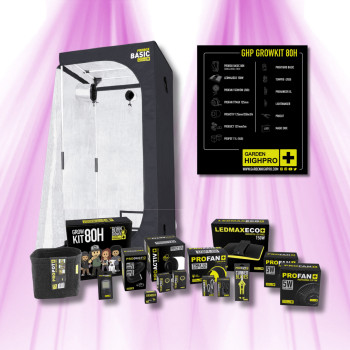


BloomLED
Night lighting for your plants - Led strip - 9W per meter - 1m
In stock · Shipped within 24 h
6,90 €

Product successfully added to your shopping cart
Ça pousse dans le bon sens

9 products
An 80cm x 80cm grow space offers far more possibilities than initially meets the eye. These 0.6m² can be used for special configurations, strain testing, or alternative uses that go beyond the usual. Whether for intensive cloning, mother plant cultivation, or technical experiments, this area is perfectly suited for creative projects.
Frankly, limiting an 80x80 space to classic cultivation means missing out on its full potential. This surface allows for setting up a cloning chamber with dozens of clones under gentle lighting, or maintaining compact mother plants for continuous genetic production. The advantage is that you can precisely control the parameters for each specific use.
Experienced growers often use these spaces to test new techniques: aeroponic cultivation, miniature NFT systems, or even phenohunting setups with several small plants. The reduced size facilitates quick adjustments and limits risks in case of a failed experiment.
For cloning, aim for LED lighting of 100-150W maximum with a blue-rich spectrum (6000-6500K). Humidity should be around 80-90% with a stable temperature of 22-24°C. A small ultrasonic humidifier works perfectly in this volume.
If you're going for mother plant cultivation, lighting can go up to 200W with an 18/6 cycle. The goal is to keep the plants in constant vegetative growth. Plan for 7-11L pots and prune regularly to maintain a manageable height.
For strain testing, the SOG (Sea of Green) technique with numerous small 3-5L pots allows for comparing several phenotypes simultaneously. This is where it gets really interesting for the amateur breeder.
For 0.6m², a 200W LED provides approximately 330W/m², which is perfect for flowering. Opt for a full spectrum model with Samsung LM301B diodes or equivalent, which guarantee an efficiency of 2.5-2.8 µmol/J minimum. The optimal distance will be 30-40cm from the canopy depending on the intensity. Check that the driver is dimmable to adjust according to growth phases.
In 80x80cm, 4 x 11L pots represent the optimal configuration for SCROG. This leaves 40cm x 40cm per plant, more than enough to develop a beautiful uniform canopy. With this density, you can install your net 20-25cm from the substrate and achieve homogeneous coverage. More pots would create root competition and complicate net management.
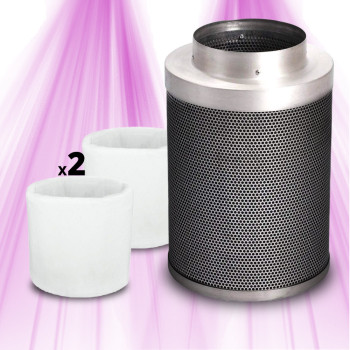
For 0.6m², a 150-200 m³/h extractor is more than sufficient with a 125mm diameter carbon filter. Position the filter at the top of the tent, opposite the fresh air intake. The extractor should be placed outside to reduce noise and internal heat. Plan for a 125mm acoustic ducting to limit noise pollution, especially if the box is in a living area.
During growth, maintain 60-70% relative humidity with a temperature of 24-26°C. For flowering, gradually reduce to 40-50% RH to prevent mold, especially in a confined space like 0.6m². A small 500ml/day dehumidifier may be necessary at the end of flowering. Monitor the VPD (Vapor Pressure Deficit): 0.8-1.2 kPa during growth, 1.2-1.6 kPa during flowering for optimal transpiration.
Clean the Mylar every 2-3 weeks with a slightly damp microfiber cloth and a few drops of 70% isopropyl alcohol. Avoid harsh chemicals that can damage the reflective surface. Regularly check corners and zippers where moisture accumulates. If stains appear, treat immediately with a 3% diluted hydrogen peroxide solution. Good air circulation remains the best prevention against humidity problems.
Available in 3 models
Available in 2 models
Available in 2 models
Available in 2 models
Available in 2 models
Available in 3 models
Available in 3 models
Help & advice
About Other Uses — click a question to see the answer.
For intensive cloning, I recommend an installation that ensures homogeneous and gentle light. The ideal is to position your LED lamp at a higher distance than for adult plants, often between 30 and 45 cm, to avoid stressing young shoots. I prefer LEDs with a blue-oriented spectrum to promote root development and compact growth. Consider an easily adjustable suspension system to follow the growth of your cuttings.
The number of hours of light really depends on the growth phase of your plants. For the vegetative phase, I generally recommend a cycle of 18 hours of light and 6 hours of darkness. If you are in flowering (which is less common for these specific uses but possible), a 12/12 cycle is appropriate. For cloning or mother plants, I often maintain 18/6 to stimulate continuous growth and good overall plant health.
For a 0.6m² space (80x80 cm), the necessary LED power varies depending on the use. For cloning or mother plants, I aim for an actual consumed power of about 80 to 150 Watts. What I often see is that beginner growers underestimate the necessary power. It is better to have a little more power and be able to dim it, rather than lacking light. Make sure to look at the actual consumed power and not the HPS equivalent power.
To know if your LED lamp is suitable, I look at several indicators. First, the response of your plants: healthy growth, green and vigorous leaves, no signs of burning or stretching. Second, the light spectrum: for cloning, I prefer a blue-rich spectrum; for a mother plant, a full spectrum is ideal. Finally, I check the actual power and the homogeneity of the coverage. If the plants in the center are well lit but those on the edges less so, it's a sign that the coverage is not optimal for your 80x80 cm space.
The cost of electricity consumption for an LED for 0.6m² is generally very reasonable. If I take the example of a 100W actual lamp operating 18 hours a day, that represents about 1.8 kWh per day. Over a month (30 days), that's 54 kWh. Depending on the price of electricity in your region (for example, €0.25/kWh), the monthly cost would be around €13.50. This is a very affordable budget, especially compared to older lighting technologies like HPS.
Cannot find your answer? 01 88 33 45 52 or by message.


