




































































Vanguard Hydroponics
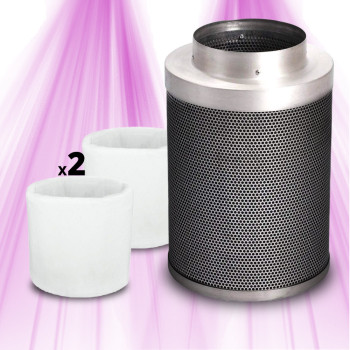
FALCON carbon filter - from 100mm to 315mm - Easy to install with clips
In stock · Shipped within 24 h
49,90 €

Product successfully added to your shopping cart
Ça pousse dans le bon sens

3 products
250mm carbon filters are the perfect intermediate size for medium-sized grow spaces. With their 25-centimeter diameter, they offer an excellent compromise between filtration capacity and footprint in your setup. These filters effectively neutralize odors thanks to their high-quality activated carbon, ensuring complete discretion for your grows.
The 250mm diameter is perfectly suited for grow tents ranging from 120x120cm to 150x150cm. Unlike 200mm models, which can be limiting for larger volumes, the 250mm easily handles flow rates from 800 to 1500 m³/h depending on the model. The Australian or European activated carbon used in these filters captures odor molecules with 99% efficiency when the system is properly sized.
The advantage of the 250mm format is its versatility. You can pair it with 8 to 12-inch extractors depending on your needs. The pressure drop remains reasonable compared to more compact filters, which preserves your ventilation performance. And frankly, in terms of longevity, a good 250mm filter easily lasts 18 to 24 months with intensive use.
First criterion: flow rate. Calculate the volume of your grow space and multiply by 60 to get the minimum air exchange per hour. A 1000 m³/h 250mm filter is suitable for a maximum space of 15-16 m³. Be careful not to oversize, as this creates unnecessary turbulence.
The length of the filter directly influences its capacity. A 50cm model will contain more carbon than a 35cm one, so it will last longer. Weight is also an indicator: a light filter often hides a low carbon density. Count on at least 8-10kg for a good 250mm.
Regarding brands, prioritize manufacturers who specify the origin of their activated carbon. Australian carbon remains the benchmark for its exceptional porosity. Also, check for the presence of a washable pre-filter, which extends the life of the main carbon.
For a 250mm filter, opt for a 10 or 12-inch extractor depending on the desired flow rate. A 1000 m³/h model pairs perfectly with a 1200 m³/h 10-inch extractor, with the difference compensating for the filter's pressure drop. Avoid undersizing the extractor, as it would strain and wear out prematurely. The rule: the extractor should be 20% more powerful than the filter's nominal flow rate to maintain efficiency.
A quality 250mm filter lasts between 18 and 24 months with continuous use. The first signs of wear appear when odors start to escape despite correct airflow. The carbon gradually saturates and loses its adsorption capacity. Replace the filter as soon as you detect any odors coming from the exhaust, even faint ones. Saturated carbon never regains its initial efficiency, contrary to popular belief.
Hang the filter horizontally or vertically depending on the available space, using suspension straps suitable for the weight (10-15kg). Connect it to the extractor via a flexible duct of the same diameter, avoiding tight bends that reduce airflow. Place the filter inside the grow space to draw in odor-laden air before extraction. Leave 20cm of space around the filter for uniform suction and ensure that the fixings can support the total weight.
Some models offer carbon refills, but the operation remains delicate and rarely economical. Disassembly risks damaging the seals, and replacement carbon often costs 60-70% of the price of a new filter. Moreover, the homogeneous distribution of new carbon is never guaranteed. It's better to invest in a new filter that ensures optimal efficiency from installation. Keep the old filter as a coarse pre-filter if needed.
Activated carbon does not tolerate excessive humidity well, as it reduces its porosity and thus its effectiveness. Beyond 70% relative humidity, performance drops significantly. Water condenses in the carbon pores and blocks the adsorption of odor molecules. Maintain humidity between 40 and 60% to preserve filter efficiency. If your space regularly exceeds 70%, install a dehumidifier or increase ventilation to protect your investment.
Available in 9 models
Available in 9 models
Help & advice
About 250mm — click a question to see the answer.
In indoor growing, a 250mm carbon filter is your best ally for neutralizing odors. I see it as an invisible shield that captures odor molecules thanks to its activated carbon. In practice, this means you can grow discreetly, without the aromas of your plants spreading outside your grow space. This is truly essential for maintaining good coexistence with your neighbors.
To choose your 250mm carbon filter well, I advise you to look at two main things: the maximum airflow it can handle and the quality of the activated carbon. The airflow should be at least equal to, or slightly greater than, that of your extractor. Good quality carbon, often virgin coconut shell carbon, will ensure better efficiency and a longer lifespan. I also recommend checking for the presence of a pre-filter, which protects the carbon from dust.
Installing a 250mm carbon filter is quite simple. I always advise placing it inside your grow space, just before the extractor. The stale air is thus drawn through the filter, then exhausted. You will connect it to your extractor using a ventilation duct of the same diameter. Make sure the connections are airtight to prevent any odor leaks. If I had to give one piece of advice, it would be to suspend the filter to prevent it from resting on the ground and to optimize air circulation.
The main difference between a 250mm carbon filter and other sizes lies in its connection diameter and treatment capacity. A 250mm is ideal for medium-sized grow spaces, offering a good balance between performance and footprint. Smaller filters (like 100mm carbon filters) are for small tents, while larger ones (for example, 315mm carbon filters) are reserved for large-scale installations requiring very high airflow. I often see sizing errors, so it's crucial to choose the right size for your extractor and your air volume.
You'll know it's time to change your 250mm carbon filter when you start to perceive odors coming from your grow space. Generally, the lifespan of a good filter is about 12 to 18 months of continuous use, but this can vary depending on humidity, temperature, and the intensity of the odors to be filtered. I advise noting the installation date to have an approximate idea of its replacement. A clean pre-filter also helps extend the life of your filter.
For a 250mm carbon filter, I recommend pairing it with an extractor that has an equivalent or slightly higher airflow than the filter's filtration capacity. For example, if your filter can handle 1000 m³/h, choose an extractor with a similar flow rate. The important thing is that the extractor is not undersized, as this would reduce filtration efficiency. I always advise checking the technical specifications of both devices to ensure perfect compatibility and optimal operation of your ventilation system.
Cannot find your answer? 01 88 33 45 52 or by message.


