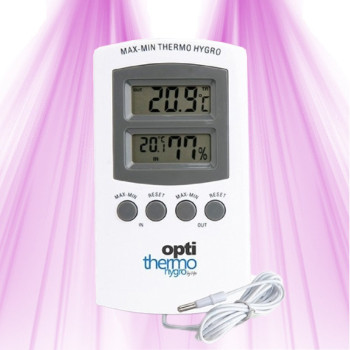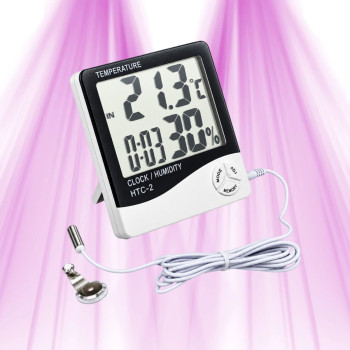







































































Hydro Digital Thermometer - Probe for temperature and humidity
In stock · Shipped within 24 h
21,89 €

Product successfully added to your shopping cart
Ça pousse dans le bon sens

4 products
A thermometer/hygrometer is the eye of your grow space. Without these instruments, it's impossible to know if your plants are thriving in optimal conditions. Temperature and relative humidity are two crucial parameters that determine the health, growth, and resilience of your plants. A deviation of a few degrees or 10% humidity can make the difference between an exceptional harvest and a dismal failure.
Accuracy is what separates amateur growers from the pros. A basic hygrometer can have a margin of error of ±5%, which is a lot when aiming for 60% relative humidity during flowering. Quality digital models go down to ±2% or even ±1% for the most advanced. This precision allows you to finely adjust your extractors, humidifiers, or dehumidifiers.
Min/max memory functions are a game-changer. Instead of constantly monitoring, you can see 24-hour variations at a glance. If your temperature climbs to 32°C at night when you thought you were maintaining 24°C, you'll know immediately. The same goes for humidity, which can drop drastically with winter heating.
Models with a remote probe offer enormous flexibility. You place the unit outside the tent to check data without opening it, while the probe remains at the heart of the canopy. The 1 to 3-meter cable, depending on the model, allows you to measure exactly where it matters.
Accuracy takes precedence over everything else. For temperature, ±1°C is more than sufficient, but for humidity, aim for a maximum of ±3%. Capacitive sensors are more stable over time than resistive sensors, even if they cost a little more upfront.
The screen makes all the difference in daily use. A large LCD display with big numbers is instantly readable, even in dim light. Backlit models are practical but consume more battery. Some simultaneously display temperature, humidity, min/max, and time – very useful for correlating with your lighting cycles.
The measurement range should cover your actual needs. For indoor growing, 0-50°C and 10-99% RH are more than enough. No need to pay more to measure -40°C if you're growing indoors! Display resolution also matters: 0.1°C and 1% RH allow for fine control of your climate.
Battery life varies greatly depending on the model. Basic versions last 6-12 months on an AAA battery, while connected or backlit models require changing every 2-3 months. Some offer a low battery indicator to anticipate.
For a 60x60cm or 80x80cm tent, a compact model with an integrated probe is perfectly sufficient. Opt for a digital hygrometer with min/max function and an accuracy of ±3% for humidity. The screen should be readable from outside the tent to avoid constantly opening it. Models under 20€ do very well for beginners, with sensors accurate enough to control ventilation and humidification.
Place the probe at canopy height, never directly under the light or against a wall. The ideal spot is in the center of the space, 20-30cm from the plants, in an area representative of the general microclimate. Avoid direct drafts from fans and dead zones without circulation. If you use a remote probe, secure it with Velcro or a small stand so it remains stable. Change its location if you modify the plant arrangement.
Most hygrometers display min/max values by pressing a dedicated button, often marked "MIN/MAX" or "MEM". The screen alternates between minimum temperature, maximum temperature, then minimum and maximum humidity. To reset, hold the button down for 3-5 seconds until the values return to current measurements. Some models have a separate "RESET" button. Consult the manual as the procedure varies by brand.
A simple hygrometer measures only where the unit is located, while a model with an external probe separates the display from the sensor. With a remote probe, you place the sensor among your plants and read the data from outside the tent, without disturbing the environment. The 1-3m cable offers enormous flexibility for precise measurement positioning. This is particularly useful in large spaces or when access is difficult.
Hygrometers naturally drift over time, especially in humid environments. Check accuracy every 6 months with a salt test: place the hygrometer in an airtight bag with a small dish of moist table salt; it should read 75% after 6 hours. If the deviation exceeds ±5%, either calibrate it (if possible) or mentally note the correction to apply. Clean the probe with a dry cloth; never use water or solvents, which could damage the sensor.
Help & advice
About Thermometer / Hygrometer — click a question to see the answer.
As an expert, I can tell you that a thermometer hygrometer is absolutely essential for indoor cultivation. It allows you to monitor the temperature and relative humidity of your grow space in real-time. These two parameters are crucial because they directly influence your plants' transpiration, nutrient absorption, photosynthesis, and resistance to diseases. Without this information, you would be, in a way, blind to the health of your crop.
That's an excellent question, and the answer varies a bit depending on your plants' growth stage. Generally, I recommend a daytime temperature between 20 and 28°C and a slightly lower nighttime temperature (18-24°C). For humidity, young seedlings and cuttings prefer high humidity (60-80%), while plants in vegetative growth do well between 50 and 70%. During flowering, it's best to keep it between 40 and 60% to avoid mold problems. It's a delicate balance to find, but your thermometer hygrometer will help you maintain it.
When I advise my clients, I emphasize a few key points. Firstly, accuracy is paramount; a difference of a few degrees or percentages can have an impact. Next, I look at the sensor's reliability and durability. A model with a min/max function is very practical for tracking 24-hour variations. Finally, ease of reading, whether digital with a large screen or analog for its simplicity, is an important criterion. If you have multiple areas to monitor, a model with a remote probe can be very useful.
This is a frequent and very important question! To get representative measurements, I advise placing your thermometer hygrometer at the canopy level of your plants, meaning at the height of the upper leaves. Avoid placing it directly under a light source or near an air intake/outlet, as this would skew the measurements. If you have a large tent, I even recommend having several to get a more complete picture of the ambient conditions.
If I had to choose for indoor cultivation, I would clearly lean towards a digital model. They are generally more accurate, easier to read thanks to their digital display, and many offer additional features such as min/max value memory, alerts, or even remote probes. Analog models are simpler and don't require batteries, but their readings are less precise and they don't offer as many features. For optimal control, digital is the way to go.
This is an excellent question to ensure the reliability of your data. For temperature, you can compare it with a trusted medical thermometer or place it in ice water (which should be at 0°C). For humidity, a simple method is the saturated salt test: place moistened table salt in a small sealed container with your hygrometer. After a few hours, the humidity should read approximately 75%. If your device is far from this value, it may require recalibration or replacement. I recommend checking the accuracy of your instruments regularly.
What I often see is a neglect of diurnal/nocturnal variations. It is crucial to maintain a good delta between day and night. Another mistake is allowing humidity to be too high during flowering, which promotes mold. Conversely, humidity that is too low can stress plants and slow their growth. Also, avoid 'hot spots' or 'cold spots' in your space by ensuring good air circulation. Your thermometer hygrometer will help you identify these problems before they become critical.
Cannot find your answer? 01 88 33 45 52 or by message.