



































































Lumatek
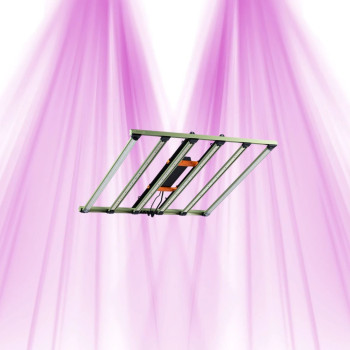
Lumatek Zeus 600W PRO 3.1 - Multi-Bar System by Lumatek - Sold complete
Available in 5 models
In stock · Shipped within 24 h
1 089,00 € or 3× 363,00 €

Product successfully added to your shopping cart
Ça pousse dans le bon sens

25 products
Intensive cultivation in a 150x150cm space is the sweet spot for growers who want to optimize their yields without breaking the bank on electricity. With a well-arranged 2.25m², you can easily aim for 600-800g per cycle by mastering lighting, ventilation, and planting density. It's the perfect space to test advanced techniques like SCROG or SOG while maintaining total control over your parameters.
Honestly, 2.25m² is the ideal size to get serious about growing. You have enough space for 9 to 16 plants depending on your technique, while keeping equipment investment reasonable. The major advantage? You can install 400-600W LED lighting that perfectly covers the surface, with manageable electricity consumption. Ventilation is easily sized with a 400-600m3/h extractor, and you can even integrate an activated carbon filtration system without space issues.
The big plus of this dimension is that it allows you to experiment with different strains simultaneously. You can divide your space into zones with different nutrient requirements, or test several phenotypes of the same variety. It's also the minimum area to make an automatic drip irrigation system profitable.
For lighting, aim for 27-35W per m² of full-spectrum LED, totaling 400-600W. Quantum board panels are perfect for this area as they distribute light uniformly across the entire canopy. For ventilation, calculate your air volume (height x 2.25m²) and multiply by 60 to get the minimum flow rate of your extractor in m3/h.
For planting density, it all depends on your technique: 9 plants in 11L pots for classic LST, or up to 25 plants in 3L pots for express SOG. The important thing is to maintain 30-40cm between each plant for air circulation. For substrate, plan for 150-200L of quality potting soil for a complete cycle.
Regarding budget, expect 800-1200€ for a complete setup: tent, LED lighting, ventilation, filtration, timers, and accessories. This is an investment that pays for itself from the second cycle if you optimize your parameters well.
For 2.25m², a 480-600W quantum board LED is the most efficient option with a PPFD of 800-1000 µmol/m²/s. Samsung LM301B or LM301H offer the best energy efficiency with 2.7-3.0 µmol/J. If you prefer HPS, a 600W covers perfectly but generates more heat and consumes more. The LED advantage: full spectrum 3000K-4000K, less heat generated, and a lifespan of 50,000h compared to 10,000h for HPS.
It completely depends on your method: 9 plants in 11L pots for LST with 8-10 weeks of growth, 16 plants in 7L pots for SCROG, or 20-25 cuttings in 3L pots for SOG with a maximum of 2-3 weeks of growth. In hydroponics, you can go up to 36 sites on an NFT or DWC system. The essential thing is to maintain a minimum of 30cm between each plant to prevent mold and ensure good light penetration.
Mount your 400-600m3/h extractor at the top of the tent with a 125mm or 150mm soundproof duct depending on the model. Use 45° elbows rather than 90° to limit pressure losses. For light sealing, install backdraft dampers and surround the aluminum duct connections. Passive intake is done through low openings with light-proof socks. Adjust your extractor with a dimmer to maintain slight negative pressure: the tent walls should be slightly sucked inwards.
Maintain 22-26°C during the light period and 18-22°C during the dark period, with a maximum 5°C difference between day and night. Humidity varies by stage: 60-70% during growth, 45-55% during flowering, and drop to 40% in the last two weeks to prevent mold. For a 2.25m² space, a 12L/day dehumidifier is more than sufficient. Install a thermo-hygrometer with a remote probe at canopy level for accurate measurements, not near the tent walls.
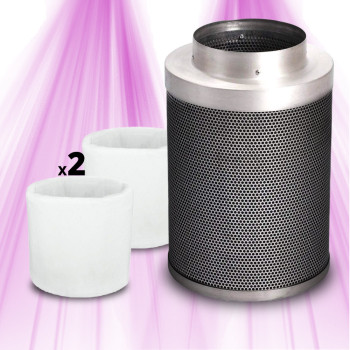
Disassemble all equipment and vacuum plant residues, then clean the walls with 3% hydrogen peroxide or 70% alcohol. Let dry for 24 hours before reassembling. Change the carbon filter every 12-18 months depending on usage intensity. Clean LED reflectors with a slightly damp microfiber cloth; never use chemicals on the diodes. Check the condition of the ventilation ducts and replace them if they are dirty. Thorough cleaning between each cycle prevents 90% of pest and disease problems.
Available in 5 models
Available in 7 models
Available in 3 models
Available in 7 models
Available in 3 models
Help & advice
About Intensive Culture — click a question to see the answer.
For intensive cultivation on 150x150cm, I generally aim for an LED power of around 600W to 800W actual draw. This is the sweet spot for achieving optimal light penetration and maximizing yields over this 2.25m² area. Below this, you risk lacking power, and above, you increase electricity consumption without necessarily a proportional gain in yield.
The main difference is efficiency and spectrum. LEDs are much more energy-efficient, generate less heat, and allow for precise control of the light spectrum, which is ideal for each growth phase. HPS, although powerful, consume much more, emit a lot of heat, and have a less adaptable spectrum. If you want to reduce your electricity consumption, I invite you to read this article.
Full spectrum LED lighting is crucial because it most accurately reproduces sunlight, providing your plants with all the wavelengths they need. This promotes balanced growth, healthy root development, abundant flowering, and better production of terpenes and cannabinoids. It's a key factor for successful intensive cultivation.
The ideal distance between your LEDs and your plants depends on the power of your light and the growth phase. Generally, I start at 60-70 cm at the beginning of growth and gradually reduce to 30-45 cm during peak flowering for a power of 600-800W. The important thing is to observe your plants: if the leaves yellow or curl, the light is too intense or too close.
The first mistake is underestimating the power of LEDs and placing them too close, which can cause light stress. Next, you must avoid poor ventilation, because even if LEDs heat up less than HPS, good air circulation remains essential for plant transpiration. Finally, don't neglect watering and nutrients, as intense light demands more from your plants.
For a 150x150cm space, I advise you to suspend your LED light so that the light is uniformly distributed over the entire surface. Use adjustable pulleys or hangers to easily modify the height. Make sure your suspension system is robust and that the cables are neatly arranged and secured to avoid any accidents. A good installation is the basis of a worry-free cultivation.
To maximize yields on 150x150cm, I would turn to modular LED bars or high-performance panels, offering a real power of at least 600W and excellent PPF/W. Models with Samsung LM301H or LM301B diodes are often a guarantee of quality and efficiency. The key is homogeneous light distribution so that each plant receives its dose of light.
LED panels are generally compact blocks with a centralized light source, while LED bars are elongated modules that allow for better light distribution over large areas. For intensive cultivation on 150x150cm, I often prefer LED bars because they offer better light uniformity, reducing hot and cold spots and promoting more homogeneous development of all plants under the canopy.
Cannot find your answer? 01 88 33 45 52 or by message.