








































































Cli-mate
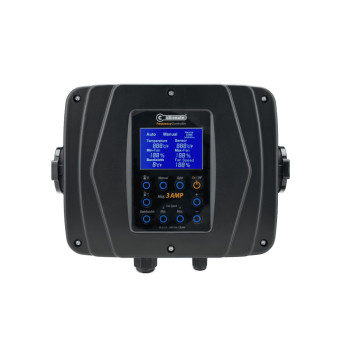
Cli-mate Frequency Controller – continuous adjustment, 3 to 15 A
Ships within 2 weeks
381,90 € or 3× 127,30 €

Product successfully added to your shopping cart
Ça pousse dans le bon sens

1 product
A frequency controller sets extractor speed by acting on the frequency of its supply, hertz by hertz, rather than simply cutting the voltage. Adjustment is continuous, with no steps, and power draw genuinely follows the speed you ask for.
A conventional controller lowers motor voltage, which often makes it hum and heat up at low speed. Frequency control acts on the quantity that actually determines rotation speed: the motor runs smoothly across the whole range, more quietly, and energy use falls with the speed.
Where a stepped controller forces a choice between two speeds — one too strong, the other too weak — continuous adjustment lets you target exactly the airflow you need. That matters most at the end of the dark period or early in a cycle, when extraction demand is low but not zero.
These units suit installations where noise and the electricity bill weigh as much as performance: growing in a lived-in room, continuous operation, or high-power extractors whose low-speed efficiency makes a real difference.


