



































































Vanguard Hydroponics
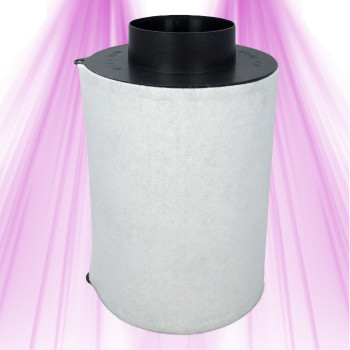
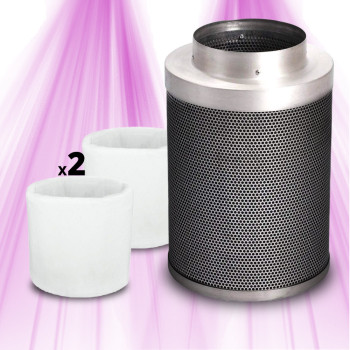
FALCON carbon filter - from 100mm to 315mm - Easy to install with clips
In stock · Shipped within 24 h
49,90 €

Product successfully added to your shopping cart
Ça pousse dans le bon sens

7 products
150mm carbon filters are designed for indoor grow setups requiring high extraction airflows, typically between 400 and 800 m³/h. With their 150mm diameter, they perfectly fit high-power centrifugal extractors and ensure effective odor neutralization in grow spaces ranging from 2 to 6 m².
The 150mm diameter strikes the right balance between filtration capacity and footprint for medium to large installations. These filters typically contain 1.5 to 2.5 kg of Australian or European activated carbon, with an optimized granule size between 2 and 4mm to maximize surface contact. The air passage speed remains ideal (around 2.5 m/s), allowing for optimal absorption of odor molecules without creating excessive pressure drop.
The main advantage of the 150mm over smaller diameters is its ability to process large volumes of air while maintaining sufficient contact time with the carbon. Where a 125mm filter starts to show its limits beyond 400 m³/h, the 150mm remains effective up to 800 m³/h depending on its length.
The choice is primarily based on three criteria: your extractor's airflow, the filter's length, and the carbon quality. For a 400 m³/h extractor, opt for a 150mm filter of at least 40cm. Beyond 600 m³/h, prefer 60cm models which offer more carbon and thus better longevity.
The quality of the carbon makes all the difference. Australian carbon remains the benchmark with its high porosity and low dust content. Also, check for the presence of a washable pre-filter, which significantly extends the carbon's lifespan by retaining large particles. Finally, ensure that the flanges are well-sealed and reinforced to prevent air leaks that would reduce efficiency.
The basic rule is never to exceed 80% of the filter's advertised maximum airflow to maintain optimal efficiency. For a standard 150mm 40cm filter (max airflow 500 m³/h), limit yourself to a real 400 m³/h. If your extractor produces 600 m³/h, opt for a 150mm 60cm model that can handle this airflow. Remember that ducting system pressure drops reduce the actual airflow by 15 to 25% compared to the extractor's specifications. An extractor advertised at 500 m³/h will deliver closer to 380-420 m³/h once installed with ducts and filter.
The main difference lies in the quantity of activated carbon and therefore the processing capacity. A 40cm filter generally contains 1.5 kg of carbon compared to 2.2 to 2.5 kg for a 60cm one. This difference translates into a higher maximum supported airflow (500 vs 750 m³/h) and, more importantly, a prolonged lifespan of 30 to 40%. The 60cm model also offers longer contact time with the carbon, improving filtration efficiency even at high airflow. However, it is heavier (8-10 kg vs 6 kg) and requires reinforced mounting.
The lifespan varies between 12 and 18 months depending on usage and carbon quality. A filter used 12h/day with a well-maintained pre-filter will easily last 15 months. Factors that reduce longevity are: excessive airflow (more than 80% of maximum), absence of a pre-filter, high humidity in the extracted air (more than 70%), and the presence of dust. You'll know it's time to change it when odors start to pass through despite normal extraction operation. Saturated carbon does not regenerate, contrary to popular belief.
Optimal installation places the filter on the intake side, meaning before the extractor in the direction of airflow. Securely fix it to the ceiling or a dedicated support, as its weight (6 to 10 kg) generates vibrations. Use rigid or semi-rigid 150mm ducts; flexible ducts create turbulence that reduces efficiency. The connection must be perfectly airtight with appropriate clamps. Leave 20cm of free space around the filter to facilitate suction and avoid tight bends within 50cm of the filter's outlet.
Loss of efficiency generally comes from the pre-filter clogging or the gradual saturation of the carbon. Clean the external pre-filter every 3-4 weeks with lukewarm water and let it dry completely before reassembly. Check the seals of the connections, as a parasitic air intake drastically reduces performance. If odors pass through despite a clean pre-filter and airtight connections, it means the carbon is reaching the end of its life. Unlike HEPA filters, carbon filters cannot be cleaned: saturated carbon must be replaced. Regular maintenance can extend the lifespan by 20 to 30%.
Available in 6 models
Available in 2 models
Available in 6 models
Available in 6 models
Help & advice
About 150mm — click a question to see the answer.
As an expert, I can tell you that a 150mm carbon filter is your best ally for effectively neutralizing odors generated by your indoor crops. It is designed to be integrated into your air extraction system, thus ensuring that the air discharged outside is odorless and discreet. It is an essential element for maintaining good discretion.
To choose your 150mm carbon filter well, I advise you to base your decision on the flow rate of your extractor. The filter must be able to handle an air volume at least equal to, or slightly greater than, that of your extractor for optimal efficiency. Also, consider the quality of the activated carbon used, as it does all the work. I often recommend checking the estimated lifespan provided by the manufacturer.
In practice, a 150mm carbon filter is ideally paired with extractors having a flow rate between 400 and 800 m³/h. The goal is to ensure sufficient air exchange while allowing the activated carbon to effectively capture odor molecules. If your extractor is too powerful for the filter, the air will not be filtered enough; if it is too weak, you will not have effective extraction.
From my experience, a 150mm carbon filter is perfectly suited for growing spaces ranging from 2 to 6 m². This is a fairly wide range that covers most medium-sized installations. Beyond this area, I would start to consider a larger diameter or a more substantial extraction system to ensure impeccable odor management.
The most obvious sign that a 150mm carbon filter is saturated is the return of odors in your growing space or outdoors. Activated carbon has a limited absorption capacity, and once it is saturated, it can no longer retain odor molecules. This is when you need to think about replacing it to maintain the efficiency of your system. The lifespan varies, but I often see replacements every 12 to 18 months depending on the intensity of use.
The most common mistake I see is not matching the filter to the extractor's power. Another mistake is letting it operate in an overly humid environment, which can significantly reduce its lifespan. Finally, not replacing it when it's saturated is a mistake that can compromise the discretion of your grow. Always remember to protect it from dust with a pre-filter.
Maintaining a 150mm carbon filter is relatively simple. The first thing to do is to regularly clean the pre-filter sleeve that surrounds the filter. This prevents dust and larger particles from reaching the activated carbon, thus extending its efficiency. I recommend hand washing it with lukewarm water and mild soap, then letting it dry completely before putting it back in place. The filter itself is not cleaned; it is replaced.
Cannot find your answer? 01 88 33 45 52 or by message.