





































































HomeBox
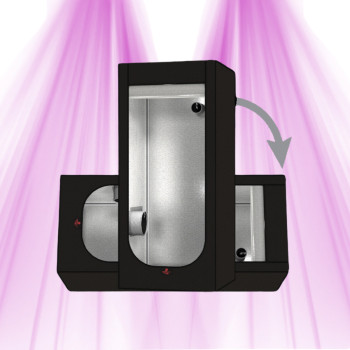
Homebox Vista TRIANGLE grow room -120x85x160 cm
Available in 3 models
In stock · Shipped within 24 h
173,37 € 216,71 € or 3× 57,79 €

Product successfully added to your shopping cart
Ça pousse dans le bon sens

3 products
Triangular grow tents transform unused corners of your room into productive growing spaces. Unlike classic rectangular tents, these models fit perfectly into corners, allowing you to optimize every available square meter without sacrificing the efficiency of your indoor setup.
With their triangular design, these tents intelligently leverage the geometry of your spaces. No more wasted corners collecting dust – make way for an organized grow that takes advantage of every available surface.
The main advantage of a triangular tent is space optimization. Where a rectangular tent leaves dead zones in the corners of your room, the triangular shape fits in naturally. You can easily gain 20 to 30% more usable space compared to a poorly positioned classic setup.
Air circulation also significantly improves. The sloped walls create a natural flow that prevents stagnant areas. Hot air rises along the walls to be more efficiently expelled by the ventilation system placed at the top. This particular geometry reduces the risk of mold and maintains consistent humidity.
In terms of discretion, it's a real plus. A triangular tent in a corner is much less noticeable than a large rectangular tent in the middle of a room. It integrates naturally into the decor, especially if you choose a model with a refined finish.
The size depends directly on the available corner. Carefully measure your two walls: for a 1m x 1m corner, an 80cm side tent leaves enough space to move around. If you have 1.5m x 1.5m, you can easily go up to a 120cm side.
The material matters greatly. Mylar models reflect light better (up to 95% reflectivity) but require more careful cleaning. 600D Oxford fabric is more resistant to daily handling and can be cleaned with a sponge, but reflectivity drops to 85-90%.
For the structure, prioritize steel tubes of at least 19mm. Plastic connectors are fine for tents up to 100cm, but beyond that, metal connectors ensure better stability. Check that the zippers are reinforced – this is often the weak point of these setups.
The standard height of 200cm is suitable for most grows, but if your ceiling allows, 220cm or 240cm models offer more flexibility for hanging your lighting and ventilation equipment.
For a 1m x 1m corner, opt for a tent with a maximum side length of 80cm. This dimension leaves you 10cm on each side for air circulation and equipment access. An 80cm tent offers approximately 0.28m² of growing surface, sufficient for 2 to 4 plants depending on the technique used. Don't forget to allow space for opening the doors – count at least 40cm in front of the tent for comfortable access.
First, position the tent exactly in the corner, with both sides against the walls. Attach hooks to the ceiling to hang your fan and lighting before fully assembling the structure. Utilize vertical space: install your ballasts and controllers on wall shelves above the tent. For ventilation ducts, drill directly into the wall closest to your extractor – it's more discreet than routing through the ceiling.
Calculate 3 to 5 times the volume of your tent per hour. For an 80cm triangular tent (approximately 90L), a 300m³/h extractor is more than sufficient. Place the exhaust at the top center of the front face, and the intake at the bottom on one side. The triangular shape naturally creates a chimney effect that improves air circulation. Add a 15cm oscillating fan to homogenize the temperature – the particular geometry can create warmer micro-zones in the corners.
Mylar reflects better (95% vs. 85% for Oxford) but scratches easily and requires delicate cleaning with a damp microfiber cloth. 600D Oxford fabric is more resistant to impacts and can be cleaned with a sponge and soapy water, but it accumulates more dust in its texture. For a beginner, Oxford is more practical for daily use. Mylar is better suited if you are already experienced and seeking maximum light performance.
A 120cm side triangular tent offers approximately 0.62m² of surface. In SOG (Sea of Green), you can place 16 to 20 small 11cm pots. In SCROG (Screen of Green), 4 plants are sufficient with a net at 40cm height. For classic cultivation in 18cm pots, count a maximum of 6 to 8 plants. The triangular shape requires careful plant distribution: place the taller plants in the center and the smaller ones towards the corners to optimize light exposure.
Available in 3 models
Available in 5 models
Available in 3 models
Help & advice
About Triangle — click a question to see the answer.
A triangular grow tent is primarily used to optimize space. I particularly recommend it for transforming an unused corner of your room into a productive growing area. It's an ingenious solution for those who lack space and don't want to sacrifice the efficiency of their indoor setup.
The main difference lies in their shape and their adaptation to space. A rectangular tent is more versatile for large, open areas, while a triangular tent is specifically designed to fit perfectly into the corners of a room. In practice, the triangular tent allows you to utilize areas that rectangular tents could not, thus offering better optimization of square footage.
To choose a triangular tent, I advise you to consider several criteria. First, precisely measure the corner where you want to install it to ensure it fits perfectly. Then, consider the internal volume needed for your plants and the type of cultivation you are planning. Finally, check the quality of the materials, light impermeability, and ease of access for maintenance.
The LED lighting power for a triangular grow tent will depend on its size and the needs of your plants. In general, I recommend aiming for homogeneous light density over the entire surface. For a small triangular tent (less than 0.5 m² of floor space), a 100 to 150W actual LED panel may be sufficient. For larger models, you will need to increase the power, favoring full-spectrum LEDs for optimal growth. Don't forget that energy efficiency is key, as I discuss in this article on reducing electricity consumption.
Installing a triangular tent is quite similar to a classic tent, but with particular attention to its positioning. I always start by assembling the structure in the chosen corner, making sure it is well braced against the walls. Then, I attach the outer fabric and install the equipment (lighting, ventilation). Access to the zippers must be practical for daily maintenance. Think about the location of the extraction and intake ducts for good air circulation.
The most common mistake is to underestimate the actual usable volume. Although the tent fits perfectly into a corner, the floor area is smaller than a rectangular tent of similar dimensions. I often see growers overloading their tents, which harms air circulation and light penetration. Another mistake is neglecting the uniformity of lighting, as the shape can create shaded areas if the lighting is not well positioned. Finally, make sure you have a suitable substrate, like those I explain in this article.
If you have an unused corner in a room and you want to set up an indoor grow there without encroaching on living space, then yes, a triangular tent is perfectly suitable. I particularly recommend it for small apartments or rooms where every square meter counts. It's a discreet and effective solution to maximize your growing area.
Cannot find your answer? 01 88 33 45 52 or by message.


