

































































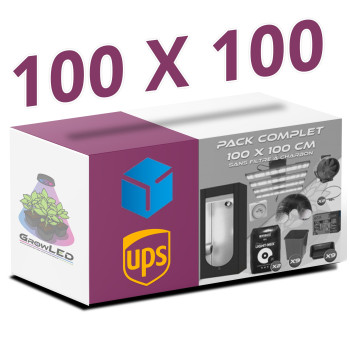

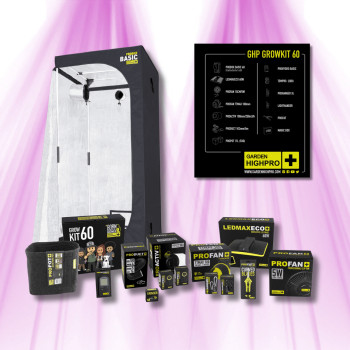
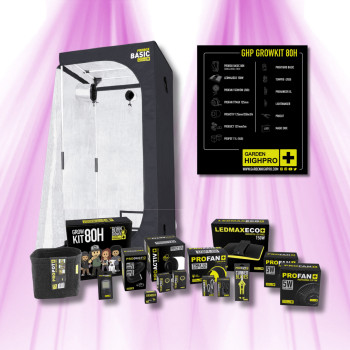

Complete pack 100x100cm – SpectraWild S320 - Hydoshoot 100 - Ventilation kit…
Ships within 2 weeks
1 084,64 € 1 205,15 € or 3× 361,55 €

Product successfully added to your shopping cart
Ça pousse dans le bon sens

5 products
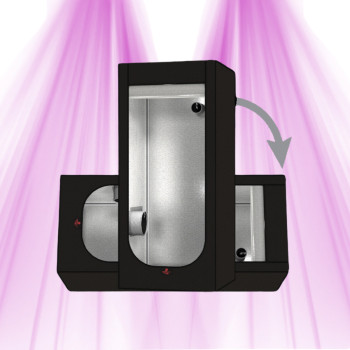
Complete kits without a carbon filter 100x100cm - 1m² are the perfect solution for beginners in indoor growing who want to keep things simple. These kits include all the essential equipment: grow tent, powerful LED lighting, and a basic ventilation system. The absence of a carbon filter makes these kits more affordable while still being perfectly suited for crops that don't emit strong odors, such as vegetables, herbs, or ornamental plants.
With a growing area of 1m², these setups offer enough space to cultivate 4 to 6 medium-sized plants or about fifteen small aromatic plants. It's the perfect balance between productivity and footprint for an apartment or house.
Simplified ventilation is the primary advantage of these kits. Without a carbon filter, air circulates more freely, and the fan works less, which reduces noise and power consumption. For growing vegetables like cherry tomatoes, basil, or radishes, this configuration is more than sufficient to maintain a healthy atmosphere.
The economic aspect also plays an important role. By eliminating the carbon filter, these kits cost 80 to 120€ less than their filtered equivalents. For a beginner who wants to try indoor growing, it's a more reasonable investment. Plus, there's no need to change the activated carbon every 12-18 months, which represents continuous savings.
The ease of installation also appeals to novices. Fewer components mean fewer connections, fewer chances of error, and faster assembly. Generally, it takes a maximum of 2 hours to fully assemble a 100x100cm kit without a filter.
The power of the LED lighting remains the number one criterion. For 1m², aim for 200W to 300W of full spectrum LED. This power guarantees a light density of 500 to 750 µmol/m²/s, perfect for most crops. Make sure the LED covers the entire space without shaded areas.
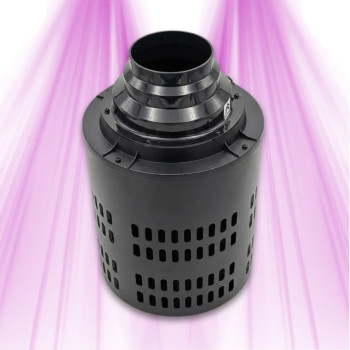
The ventilation flow rate must match the volume of your tent. A 100x100x200cm box is 200L, so an extractor of 150 to 250 m³/h is perfectly suitable. This capacity renews the air 45 to 75 times per hour, which maintains temperature and humidity within the correct ranges.
The quality of the tent directly influences the durability of your setup. Opt for at least 600D polyester fabric with a 95% reflective Mylar coating. Steel tube frames with a 16mm diameter support the weight of the lighting better than entry-level 11mm tubes.
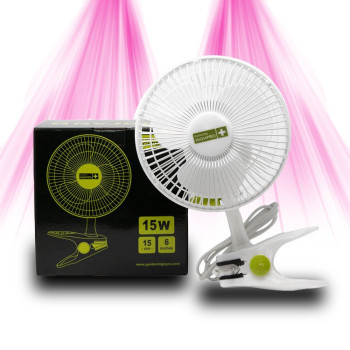
Don't forget the included accessories: hanging straps for the LED, ventilation ducts, clamps, and a timer to automate lighting. A complete kit should truly contain everything to avoid additional purchases.
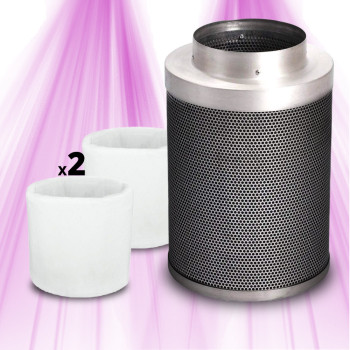
Absolutely, but it depends on what you're growing. For vegetables, herbs, ornamental flowers, or young plants, basic ventilation is more than enough. The extractor expels hot, humid air while renewing oxygen, which maintains a healthy climate. However, if you're growing very odorous plants during flowering, odors will indeed escape the tent. In this case, you'll need to add a carbon filter separately or choose a kit with integrated filtration directly.
For a 240W LED like the Pureled Q240, maintain a distance of 60-80cm during vegetative growth and 40-50cm during flowering. In vegetative growth, young plants are more sensitive to intense light, hence the greater distance. During flowering, you can bring the LED closer to maximize light density and boost production. Always monitor for signs of light stress: yellowing, curling, or bleaching leaves at the top. If this happens, move the LED back 10-15cm. A lux meter can help measure intensity precisely.
Start by assembling the tent frame according to the provided diagram. Then, slide on the fabric and secure it with the Velcro fasteners. Once the tent is assembled, install the extractor at the top rear, connect the exhaust duct, and direct the air out of the room. Hang the LED in the center of the tent with the provided straps, initially about 60cm from the floor. Plug everything into the timer to automate lighting (18h/day during vegetative growth, 12h/day during flowering). Test the operation before installing your plants.
For tomatoes, it's actually more suitable than a kit with a filter. Tomatoes don't emit bothersome odors, so a carbon filter is unnecessary and more expensive. Furthermore, without a filter, ventilation is more efficient, which helps prevent fungal diseases to which tomatoes are susceptible. The 1m² space allows you to grow 2 to 4 cherry tomato plants or 1 to 2 large tomato plants. However, if you plan to grow other more odorous plants later, a kit with a filter will be more versatile in the long run.
Clean the fan every 3-4 months by disassembling the casing and vacuuming the blades with a soft brush. Avoid water on the motor. For the tent, wipe the interior walls with a damp sponge and a little mild soap between each cycle, especially if you've had mold problems. Let it dry completely before replanting. Also, check the condition of zippers and Velcro fasteners, and replace them if necessary. Regular maintenance extends the life of your equipment and prevents the spread of diseases from one cycle to the next.
Available in 3 models
Available in 2 models
Help & advice
About 100cm x 100cm - 1m² — click a question to see the answer.
For a 100x100cm tent, I generally recommend an LED power of around 250W to 350W actual draw. This is ideal for effectively covering the entire surface and ensuring good light penetration, whether for vegetative growth or flowering. Too little power would limit your plants' potential, while excessive power would be unnecessarily costly and could even stress your crops if poorly managed.
Installing a complete 100x100cm kit is quite simple. I always start by assembling the tent according to the provided instructions; that's the foundation. Then, I install the LED lighting by hanging it with the provided attachments, followed by the ventilation system. I advise positioning the extractor fan at the top of the tent to remove hot air. Don't forget to connect everything to a timer to manage the light cycles. I actually explain how to assemble similar kits in this video.
The ideal distance between your LED light and the plants varies depending on your lighting's power and the plants' development stage. Generally, I recommend starting at about 40 to 60 cm from young seedlings and gradually reducing this distance to 30-40 cm during flowering to optimize light intensity. The important thing is to observe your plants: if the leaves yellow or curl, the light is too intense; if they stretch, it's too weak.
A complete 1m² kit without a carbon filter is an economical and simplified solution for starting indoor cultivation. Its primary role is to provide all the essential equipment – tent, LED, ventilation – to grow in a controlled space. The absence of a carbon filter means it's ideal if you don't have odor constraints or if you're growing low-odor species. It's an excellent entry point into the world of indoor cultivation without too heavy an initial investment. We also have some very interesting options, as I mention in this article.
The main difference between horticultural LED and HPS lies in their energy efficiency and light spectrum. LEDs are much more energy-efficient, produce less heat, and offer a customizable light spectrum, often better suited to the specific needs of plants. HPS, on the other hand, are discharge lamps that generate a lot of heat and consume more, but they were the standard for a long time. Today, I mostly recommend LEDs for their performance, durability, and their ability to be adjusted for each growth phase.
To know if an LED light is suitable for 1m², I primarily check its actual power (in Watts) and the manufacturer's recommended coverage area. As I mentioned, for 1m², an actual power of 250W to 350W is a good indicator. I also look at the light distribution (uniformity) and the light spectrum. A good LED panel for 1m² should cover the surface uniformly without excessive hot spots and offer a full or adjustable spectrum for different growth phases. If you have any doubts, don't hesitate to consult the detailed technical specifications.
For growth, I favor a spectrum with a dominant blue light, which promotes robust vegetative development and short internodes. For flowering, a spectrum with a dominant red light is essential to stimulate the production of flowers and fruits. Many modern horticultural LEDs offer 'full-spectrum' options that cover both blue and red, sometimes with added UV or infrared to further optimize results. Some panels even allow you to adjust the intensity of each color, which I find very practical.
Cannot find your answer? 01 88 33 45 52 or by message.


