




































































Domiz
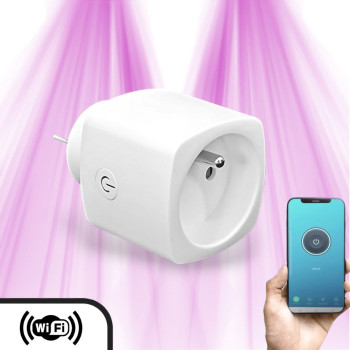
WIFI timer/timer connected socket with consumption control - 16A LED compatible
In stock · Shipped within 24 h
22,90 €

Product successfully added to your shopping cart
Ça pousse dans le bon sens

9 products
Lighting accessories radically transform the efficiency of your LED lamps and other indoor plant lighting systems. Reflectors, timers, adjustable supports, hanging chains... every element counts to create the perfect lighting conditions in your growing space. These small pieces of equipment often make the difference between decent growth and truly impressive results.
Whether you're growing a few green plants in an apartment or managing a full-fledged indoor garden, these accessories allow you to precisely control the intensity, duration, and distribution of light. This is where it changes everything: instead of being limited by your setup, you're in control.
A well-chosen reflector can increase light intensity by 30 to 50% without consuming an extra watt. Hammered aluminum models redistribute light evenly across the entire growing surface, avoiding shadow areas that slow down photosynthesis. Frankly, it's one of the most cost-effective investments for improving your results.
Programmable timers revolutionize the management of your light cycle. No more forgetting to turn lights on or off: your plants receive exactly 12, 14, or 16 hours of light according to their needs. Digital models even allow you to program intensity variations to simulate sunrise and sunset.
Adjustable suspension systems (chains, pulleys, yo-yos) give you total flexibility to adapt the height according to your plants' growth. You can maintain the optimal distance between 20 and 40 cm depending on the power of your lamp, without complicated DIY.
For reflectors, opt for food-grade aluminum with a reflection rate greater than 95%. "Wing" models are suitable for rectangular spaces, while parabolas concentrate light better on square areas. Check compatibility with your socket: E27, E40, or specific connection depending on your lamp.
For timers, choose models supporting at least 1000W to be safe, even with high-power LEDs. Mechanical timers remain reliable for basic use, but digital ones offer more programs (up to 8 cycles per day on some models).
For suspension, calculate the total weight of your setup. Stainless steel chains easily support 15-20 kg, which is more than enough for most configurations. Pulley systems facilitate daily adjustments, especially with heavy lamps.
The optimal height depends on your lamp's power and your plants' growth stage. For 100-200W LEDs, maintain a distance of 30-40 cm for adult plants, and closer to 20-25 cm for young seedlings that need more intensity. With more powerful lamps (300W+), keep at least 40-50 cm to avoid light stress. The trick: if the top leaves yellow or curl, it's too close. Use your chains or pulleys to easily adjust based on your plants' reaction.
For a reflector, fix it securely above your lamp, ensuring the socket fits perfectly into the designated opening. Orientation matters: the concave part should direct light towards your plants, not the ceiling. For an electronic ballast, place it outside your growing space to avoid additional heat, and connect it to your lamp with the provided cable. Always check that the ballast's wattage exactly matches your bulb's: a 250W ballast with a 400W bulb won't work. Remember to ensure ventilation around the ballast, as these devices can get quite hot.
Yes, timers are universal as long as you respect the maximum supported power. A 1500W timer can easily handle any grow LED, even the most power-hungry models. The only pitfall: some LEDs with integrated drivers may have a power surge at startup, so allow a safety margin of 20-30%. Mechanical timers work with everything, but digital ones can sometimes struggle with very low power consumption (below 10W). For multi-lamp setups, add up the wattages and choose a timer suitable for the total.
Clean your reflector every 2-3 weeks with a slightly damp microfiber cloth and a mild degreasing product. Absolutely avoid abrasive products that scratch aluminum and reduce reflection. For stubborn stains, use 70% isopropyl alcohol. Dry immediately to prevent streaks. A dirty reflector can lose up to 20% of its efficiency due to accumulated dust and residue. Also, regularly check the fasteners: vibrations can loosen screws over time.
Stainless steel chains remain the most stable and economical solution for most setups. They easily support 15-20 kg and stay in place once adjusted. Adjustable supports like yo-yos or pulleys are more practical for frequent adjustments, especially if you often change the height according to growth. For a grow tent, opt for chains with quality carabiners: it's safer and prevents accidental falls. Ratchet systems are better suited for fixed installations where you don't often adjust the height. In any case, check that your tent's hanging points support the total weight of your setup.
Help & advice
About Lighting accessories — click a question to see the answer.
To choose your accessories, I advise you to start with the specific needs of your plants and your existing setup. For example, if you have fast-growing plants, adjustable hangers will be essential. If you are looking to optimize light uniformity, a good reflector is key. Also, consider ease of use and material durability.
Reflectors for LED grow lights have a primary function: they serve to direct and concentrate the light emitted by your lamp towards your plants. This prevents light loss on the sides and ensures better light penetration into the canopy, thereby increasing the efficiency of your lighting and promoting more homogeneous growth. I often see a clear improvement in light coverage with a well-suited reflector.
Installing a timer for your horticultural lighting is very simple. You just need to plug the timer into the wall outlet, then plug your LED lamp into the timer. Then, you program the desired light and dark cycles. This is an essential accessory to faithfully reproduce the natural rhythms of your plants and ensure their proper development, especially if you have a grow tent.
The ideal distance for placing your adjustable hangers depends heavily on the power of your LED lamp and the growth stage of your plants. Generally, I recommend starting with a greater distance for young seedlings (around 45-60 cm) and gradually moving the lamp closer as the plant grows, always monitoring for signs of light stress. The advantage of adjustable hangers is precisely this flexibility!
The main difference lies in the flexibility of height adjustment. Suspension chains, often combined with pulleys, allow you to easily raise and lower your LED lamp to adapt it to the growth of your plants. Fixed supports, as their name suggests, keep the lamp at a constant height, which is less practical for progressive cultivation but can be sufficient for slow-growing plants or permanent installations where the height is already optimized.
The most common mistake I see is neglecting the maintenance of reflectors, which can accumulate dust and reduce their efficiency. Another mistake is not adjusting the height of the lamps as they grow, which can lead to etiolation or burns. Finally, never underestimate the importance of a reliable timer for a precise light/dark cycle; it is fundamental for the health of your plants.
To know if a reflector is suitable, you must first check its compatibility with the model and size of your LED lamp. Manufacturers generally indicate compatible dimensions and lamp types. Then, I look at the quality of the reflective material and its shape: some are designed for wide diffusion, others for more intense concentration. The goal is to optimize the light coverage of your grow space.
To optimize light intensity, I mainly recommend two types of accessories. First, a good quality reflector is essential to direct maximum light towards your plants. Second, adjustable hangers will allow you to bring the lamp closer to the canopy without burning the leaves, thus increasing the intensity perceived by the plant. This is a winning combination for better photosynthesis.
Cannot find your answer? 01 88 33 45 52 or by message.


