



































































The Pure Factory
Grow box - PURE TENT LITE - 60x60x160 cm - 400D Mylar
Available in 5 models
In stock · Shipped within 24 h
79,90 € or 3× 26,63 €

Product successfully added to your shopping cart
Ça pousse dans le bon sens

21 products
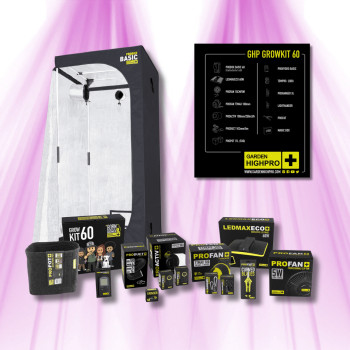
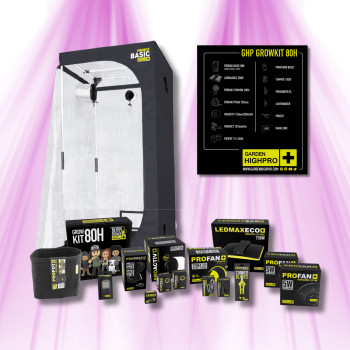
60x60cm grow tents are the perfect entry-level size for anyone looking to start indoor cultivation without taking up too much space. With their compact dimensions of 60 centimeters per side, these grow tents easily fit into a closet, a spare room, or even a corner of a living room. It's the ideal size to test, learn, and master the basics before moving on to something larger.
Frankly, when you're starting out in indoor cultivation, there's no need to go too big. A 60x60cm grow tent offers a space of 0.36 m² that allows you to comfortably grow 1 to 4 plants depending on the technique used. This is sufficient to get a feel for managing lighting, ventilation, and growth cycles. The advantage is that the initial investment remains reasonable: less electricity consumed, a less powerful extractor needed, and a controlled lighting budget.
These dimensions also allow for simpler environmental management. With a volume of approximately 0.6 m³ (for a standard height of 160cm), it's easier to maintain stable temperature and humidity. Variations are less significant than in larger volumes, which is more forgiving of beginner mistakes. And in terms of discretion, it's hard to do better: these tents go unnoticed even in a small apartment.
Height is the first criterion to consider. Standard models are 160cm tall, but you can also find 140cm or 180cm. For varieties that stretch a lot, opt for 180cm. Remember that you need to deduct space for lighting (30-40cm from the ceiling) and maintain a safe distance from the plants (20-30cm minimum).
The thickness of the fabric also matters. 210D minimum is decent for beginners. 600D or more is sturdy and will last for years. Check that the seams are reinforced and the zippers are strong – they will be used often. Openings for ducts are essential: at least one at the top for extraction and one at the bottom for passive intake.
Regarding the structure, metal bars with a minimum diameter of 16mm ensure good stability. Some models offer 19mm, which is even better for supporting the weight of lighting and accessories. Reinforced plastic connectors hold up better over time than basic connectors.
It completely depends on your cultivation technique. In SOG (Sea of Green), you can easily fit 9 to 16 small plants in 3-6 liter pots. In SCROG (Screen of Green), 1 to 4 plants are sufficient with 11-15 liter pots and a trellising net. For classic LST, count a maximum of 2 to 4 plants in 7-11 liter pots. The important thing is to allow air to circulate between the plants and avoid overcrowding, which promotes stagnant humidity.
For a 60x60cm grow tent, 7 to 11 liter pots represent the best compromise. 7L pots are perfect for 4 plants with a short cycle. 11L pots allow for optimal root development for 2-3 plants with longer cycles. Avoid pots that are too large (15L and more) which waste space, or too small (less than 5L) which limit the plants' potential. Square pots optimize space better than round ones in this compact size.
For a 100-150W LED (typical power for this size), maintain a distance of 30-40cm during growth and 20-30cm during flowering. With a 160cm high tent, this leaves 120-130cm of usable space for the plants. Use a lux meter or the PPFD Meter app to ensure you are between 200-400 µmol/m²/s during growth and 400-600 µmol/m²/s during flowering. Adjust the height according to the plants' reaction: if they stretch, move the LED closer; if the leaves yellow or curl, move it further away.
For a 60x60cm grow tent, an extractor of 150-250 m³/h is more than sufficient. Place it at the top of the tent, opposite the passive intake which is at the bottom. Use 100 or 125mm diameter ducts depending on your extractor. Avoid 90° elbows which reduce airflow; prefer gentle curves. Passive intake is done through an opening at the bottom, on the opposite side, with a surface area of approximately 1.5 times that of the extraction. Add a carbon filter if necessary, but be mindful of the weight in this compact size.
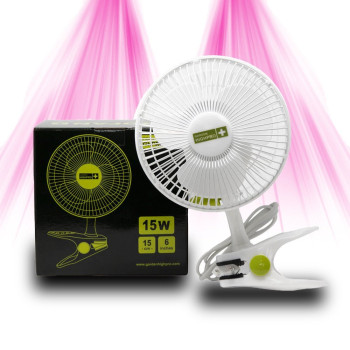
A 150-200 m³/h extractor coupled with a carbon filter of the same flow rate is perfectly suitable. For this reduced volume (0.6 m³), air renewal happens quickly. Choose a compact filter of 100-125mm in diameter so as not to overload the structure. An oscillating fan of 15-20cm ensures essential internal air circulation. For acoustic discretion, opt for EC extractors or those with a dimmer to reduce noise, especially at night. A soundproofing box can be useful in an apartment.
Available in 5 models
Available in 7 models
Available in 2 models
Available in 4 models
Available in 4 models
Available in 4 models
Available in 5 models
Available in 3 models
Available in 6 models
Available in 6 models
Available in 19 models
Available in 3 models
Help & advice
About 60cm x 60cm — click a question to see the answer.
For a 60x60cm tent, I generally recommend an LED power output of between 100W and 150W actual draw. This ensures homogeneous and sufficient light coverage for the full cycle of your plants, from growth to flowering. Below this, you risk insufficient light, and above, you might waste energy and generate too much heat for such a compact space.
The ideal distance largely depends on your LED light model and your plants' growth stage. Generally, I advise starting at 40-50 cm from young seedlings and gradually reducing this distance to 25-35 cm during flowering. Observing your plants is essential: if leaves yellow or curl, the light is too intense; if they stretch, it's too weak or too far away.
For a 60x60cm grow tent, I favor Quantum Board LED panels or LED bars. These technologies offer excellent light distribution and a full spectrum suitable for all plant phases. I recommend looking for models with quality chips (Samsung, Osram) and good PPFD (Photosynthetic Photon Flux Density) for this surface area. It's an investment that's worth it for the quality of your harvest.
The difference is significant, especially for a small tent like the 60x60cm. LEDs are much more energy-efficient, produce less heat, and have a much longer lifespan than HPS. For a compact space, the low heat emission of LEDs is an undeniable advantage, making temperature management easier. HPS, although powerful, would be too hot and energy-intensive for this size, making climate control very difficult. I discuss electricity consumption in more detail in this article on reducing electricity consumption.
Good ventilation is crucial, even in a small tent. For a 60x60cm, I recommend an air extractor with a flow rate of about 100-150 m³/h, coupled with a passive intake (a simple opening) or active intake (a small fan) if temperature is an issue. Don't forget a small clip-on fan to circulate air inside the tent; this strengthens stems and prevents humidity pockets. It's an often underestimated but vital element for your plants' health.
The most common mistake I see is neglecting environmental management. A 60x60cm tent is a small ecosystem that can quickly become unstable. Avoid underestimating ventilation and extraction, even if LEDs generate less heat than HPS. Also, don't overcrowd the tent with too many plants; for this size, 1 to 2 plants (or even 3 small ones) is the maximum to optimize space and light. Finally, don't overlook the quality of your substrate, a crucial aspect I discuss in this article on ecological substrates.
Cannot find your answer? 01 88 33 45 52 or by message.


