



































































CannaLED
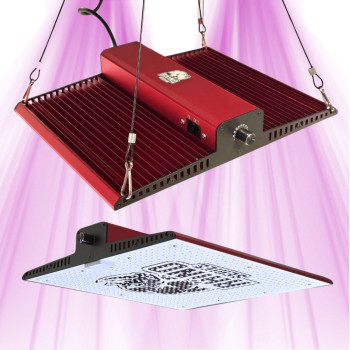
Rhino Series 130 V4 - New generation LED horticultural panel
In stock · Shipped within 24 h
219,90 € or 3× 73,30 €

Product successfully added to your shopping cart
Ça pousse dans le bon sens

23 products
An 80cm x 80cm - 0.6m² lighting area is the perfect grow space for beginners or for a compact setup. This dimension, found in most entry-level grow tents, requires well-calibrated lighting to utilize every square centimeter. Unlike larger areas where some approximations are acceptable, on 0.6m² every watt counts and light distribution must be homogeneous.
In a small area like 80x80cm, lighting becomes critical. With only 0.6m², it's impossible to compensate for a poor lamp with space – each plant must receive its optimal dose of photons. Modern LEDs excel in this format: their low heat emission allows them to be placed closer to plants (30-40cm compared to 60-80cm for an HPS), thus maximizing the received light intensity. A good LED of 150-200W actual power is more than enough to saturate this surface, whereas a 250W HPS would generate too much heat in such a confined space.
Thermal management also becomes crucial on 0.6m². In an 80x80cm tent, the temperature rises quickly. Old 250W HPS lamps can easily raise the ambient temperature to 35-40°C without robust extraction, while an equivalent LED stays below 28-30°C. This difference changes everything for ventilation: less heat = simpler extraction = less noise = happy neighbors.
For an 80x80cm area, aim for between 250 and 400 watts per square meter for HPS, which means 150-240W for your surface. For LED, count 30-40W actual power per m², so 180-240W is ample. The trick? Prioritize diode quality over raw power. A 200W Samsung LM301B LED will illuminate better than a no-name 300W one.
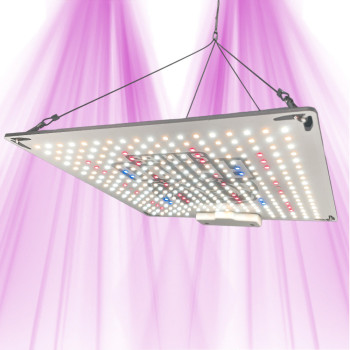
Light distribution matters immensely at this size. Forget concentrated spots: on 80x80cm, you need a lamp that diffuses uniformly. Rectangular or square LED panels are perfectly suited to this geometry. Check that the PPFD (photon density) remains homogeneous across the entire surface – the edges should not be sacrificed.
Regarding height, an LED is placed between 30 and 50cm from the plants depending on its power. The more powerful it is, the higher it goes. A simple rule: if the top leaves start to yellow or curl, it's too close. If the internodes stretch too much, it's too far.
To uniformly cover 0.6m², count on between 180 and 240W actual power for a full spectrum LED. The important thing is not just the total power, but its distribution: prefer a panel with many diodes rather than a concentrated spot. A 200W LED with Samsung LM301B or Osram diodes will provide a homogeneous PPFD between 400-600 µmol/m²/s across the entire surface. Avoid "1000W" LEDs at 50€ that only consume 100W actual power – they create dark spots on the edges.
For 80x80cm, LED clearly wins. A 250W HPS heats up enormously in such a confined space – you'll spend your time managing the temperature with oversized extraction. A 200W LED produces as much usable light with 3 times less heat. In terms of efficiency, a good LED reaches 2.5-3 µmol/J compared to 1.7 µmol/J for an HPS. In the long run, electricity savings and ease of management tip the scales in favor of LED, especially for this small surface.
Start at 50cm and adjust according to the plants' reaction. For a 150-200W LED, the optimal distance is between 30-40cm during flowering, 40-50cm during growth. Monitor for signs: leaves curling upwards = too close, internodes stretching = too far. Use a lux meter or a smartphone app to aim for 30,000-50,000 lux during growth, 50,000-70,000 lux during flowering. On 80x80cm, the height must be uniform – no tilted lamp favoring one side.
The 18/6 cycle (18h light, 6h darkness) is standard for vegetative growth. Program the light to turn on around 6-7 AM to take advantage of off-peak electricity hours if you have a suitable subscription. Turning it off around midnight-1 AM avoids evening consumption peaks. On 0.6m², a 200W LED on an 18/6 cycle consumes about 3.6 kWh per day. Check that your timer supports the power of your lamp – some low-end timers burn out with heavy loads. A robust mechanical timer remains more reliable than a fancy digital one.
Absolutely, dust reduces light efficiency by 10-15% in a few months. On a small surface like 80x80cm where every photon counts, this is significant. Clean the diodes and protective glass once a month with a slightly damp microfiber cloth, with the lamp off and cooled. Avoid chemical products that could damage the coatings. Also, check that the heat sinks do not get clogged – blocked fins cause LEDs to overheat and reduce their lifespan. A soft brush is sufficient to dust the radiators.
Available in 3 models
Available in 2 models
Available in 7 models
Available in 7 models
Available in 4 models
Available in 4 models
Available in 2 models
Available in 7 models
Available in 3 models
Available in 2 models
Help & advice
About 80cm x 80cm - 0.6m² — click a question to see the answer.
For a 0.6m² area like 80x80cm, I generally recommend an LED power of around 150 to 200 real Watts. This is a good starting point to ensure sufficient light coverage without overheating your space. The goal is to achieve an optimal PPFD (photosynthetic photon flux density) for your plants, and this power range is often ideal for effectively achieving that.
The installation distance is crucial and depends heavily on your LED's power and your plants' growth stage. As a general rule, for an 80x80cm area, I often start with 40 to 60 cm during vegetative growth and can lower it to 30 to 40 cm during flowering, or even less for very high-performance LEDs. It's essential to observe your plants: if the leaves yellow or curl, the light is too intense, and you need to raise the lamp. Conversely, if they stretch, you need to move it closer.
For versatile cultivation in 0.6m², I strongly recommend a full spectrum. These lights emit light that covers all necessary wavelengths, from blue for vegetative growth to red for flowering. It's the simplest and most effective solution for growers who don't want to change lamps between cycles. Some models even offer spectrum adjustments to optimize each phase, which is a real plus.
The light cycle depends on your plants' life stage. For vegetative growth, I recommend a cycle of 18 hours of light and 6 hours of darkness. Once you want to initiate flowering, you need to switch to a cycle of 12 hours of light and 12 hours of darkness. This is a crucial signal for the plant, telling it to start producing flowers. Respecting these cycles is fundamental for the success of your cultivation.
The 'best' light is subjective, but for an 80x80 tent, I favor 'bar' or 'quantum board' type LED panels with good light distribution. The important thing is to have a real power between 150 and 200W, a full spectrum, and high luminous efficacy (measured in µmol/J). I also look at the quality of the diodes and heat dissipation. If I had to choose, I would lean towards models known for their reliability and performance in this compact area.
For a 0.6m² area, I clearly lean towards LED. HPS, although effective, generates much more heat, which is difficult to manage in such a compact space. LED offers better energy efficiency, a longer lifespan, and more precise spectrum control, which is a significant advantage for optimizing your cultivation in a small area. Furthermore, electricity consumption is significantly lower with LED.
Cannot find your answer? 01 88 33 45 52 or by message.