



































































BloomLED
Night lighting for your plants - Led strip - 9W per meter - 1m
In stock · Shipped within 24 h
6,90 €

Product successfully added to your shopping cart
Ça pousse dans le bon sens

7 products
Horticultural lighting for a 140cm x 140cm - 2m² area for other uses opens up a world of possibilities beyond classic crops. Whether it's for growing cherry tomatoes in winter, cultivating an herb garden all year round, or experimenting with leafy greens, this 2m² surface requires specific lighting. Unlike standardized crops, these "other uses" often demand adapted light spectra and flexibility in intensity management.
Horticultural LEDs completely change the game for diversified crops on 140x140cm. Frankly, that's where it makes all the difference compared to older technologies. With a full spectrum 3000K-6500K, you can adapt the lighting according to the plant type: warmer spectrum (3000K) for tomato flowering, colder (6500K) for the growth of aromatic herbs like basil or coriander. Energy consumption remains controlled, generally between 200-400W for this area, compared to a minimum of 600W with equivalent HPS.
The major advantage? Modularity. You can easily create differentiated lighting zones on your 2m²: one zone dedicated to tomatoes with more intense lighting (800-1000 µmol/m²/s), another for herbs with softer lighting (400-600 µmol/m²/s). This flexibility is impossible with traditional HPS systems that uniformly flood the entire surface.
For a 2m² surface with varied crops, the recommended power ranges between 30-40W per m², or 240-320W in total. But be careful, this calculation changes depending on your crops. Light-hungry tomatoes require more like 40W/m², while aromatic herbs are content with 25-30W/m². The hanging height also varies: 30-40cm for powerful LEDs, 20-25cm for less intense panels.
The choice of spectrum remains crucial. A full spectrum panel with separate red/blue channel adjustment gives you total control. Some growers prefer to combine several small panels (e.g., 4x 100W) rather than one large one, to create micro-climates of light adapted to each type of plant. This modular approach costs a little more upfront but offers incomparable flexibility.
For uniform coverage on 140x140cm with mixed crops, opt for a 300-400W LED panel with a 120° beam angle. Samsung LM301B or Osram models offer excellent light uniformity. If you're mixing tomatoes and herbs, favor a full spectrum 3000K-6500K with a separate dimmer. An interesting alternative: 4x 100W panels placed at the four corners, allowing you to adjust the intensity per zone according to the specific needs of each crop.
The optimal distance depends on the power of your LED and the type of crop. For a 300W panel, maintain 35-45cm above tomatoes (which tolerate intensity well) and 25-30cm for more fragile aromatic herbs. Use a lux meter or the Photone app to measure: aim for 40000-50000 lux for tomatoes, 25000-35000 lux for basil or mint. If the upper leaves yellow or curl, you are too close. Adjust gradually and observe the plants' reaction over 2-3 days.
For varied crops on 2m², the 300W LED largely outperforms two 150W HPS. First, in terms of consumption: 300W actual vs. 340W for HPS (ballasts included). Second, thermal management: HPS generate a lot of heat, which is problematic for sensitive herbs like lettuce. With LEDs, you better control the temperature and can grow different species side by side. The LED spectrum is also more suitable for mixed crops, whereas HPS remain fixed on their orange-red spectrum. The only drawback: a higher initial investment, but amortized in 12-18 months through electricity savings.
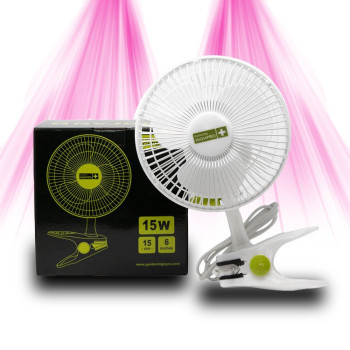
Installation in a 140x140cm tent requires adapted ventilation to avoid overheating. Plan for a minimum 200-250 m³/h extractor with a passive intake at the bottom of the tent. Suspend your LED with adjustable straps, never directly fixed to the tent ceiling. Create an airflow that passes over the lamp before being evacuated. An oscillating 15cm fan helps circulate the air and prevents hot spots. Monitor the temperature: it should not exceed 26-28°C during the day, 20-22°C at night. If it gets too hot, increase the lamp-to-plant distance or reinforce the extraction.
Cleaning LEDs is less critical than for HPS, but remains important to maintain light efficiency. Dust LED panels every 2-3 weeks with a slightly damp microfiber cloth, with the lamp off and cooled. Avoid chemical products that can damage the lenses. For reflectors (if you use them), monthly cleaning with isopropyl alcohol restores their full shine. A dirty LED can lose 10-15% of its light efficiency, which directly impacts your crops. Take advantage of cleaning to check the condition of cables and connections, especially in the humid environment of indoor cultivation.
Available in 3 models
Available in 2 models
Available in 2 models
Available in 2 models
Available in 2 models
Help & advice
About Other Uses — click a question to see the answer.
For a 2m² surface (140cm x 140cm) and demanding crops like tomatoes or growing aromatic herbs, I recommend a true LED power of at least 600 to 800 Watts. This ensures sufficient light intensity for good canopy penetration and optimal development. For less demanding plants or maintenance use, you could go a bit lower, but for fruits and vegetables, you should not underestimate the necessary power.
Installing LED lighting for 2m² is quite simple. I advise suspending your LED panel or bars above the growing area using adjustable hangers. The goal is to be able to easily adjust the height. Make sure the light is uniformly distributed over the entire surface. If you are using multiple bars, make sure to space them well to avoid shaded areas. Don't forget ventilation systems to manage heat, even if LEDs produce less than other technologies.
For tomatoes and herbs, I favor a full spectrum. This means it contains all the wavelengths necessary for each growth phase, from germination to flowering and fruiting. In practice, I look for LEDs with a good balance between blue (for vegetative growth) and red (for flowering and fruiting), often supplemented with touches of green and white for better perception and efficient photosynthesis. Some panels even offer adjustable spectra, which is a plus.
The ideal distance depends heavily on the power of your fixture and the type of plant. For powerful LEDs on 2m², I generally start with a distance of 40 to 60 cm above the canopy for young plants or those in vegetative growth. For flowering and fruiting, especially for tomatoes, I can reduce this distance to 30-40 cm, carefully monitoring for signs of light stress (yellowing or curling leaves). The important thing is to observe your plants and adjust accordingly.
Absolutely! I can assure you that LEDs are perfectly suited for growing tomatoes indoors on 2m². They offer superior energy efficiency, longer lifespan, and precise control of the light spectrum, which is crucial for fruiting. With sufficient power and an adapted spectrum, you can achieve excellent yields. It's a much more efficient and economical long-term solution than older technologies like HPS for this type of cultivation.
For an LED panel with 600 to 800 Watts of true power, which I recommend for 2m², the electrical consumption will be directly proportional to this power. For example, a 700W panel will consume 0.7 kWh per hour. On a 12-hour lighting cycle per day, this represents 8.4 kWh per day. This is significant consumption, but much lower than HPS lamps for equivalent performance, not to mention the lower heat emitted which reduces ventilation needs.
For a 2m² surface and versatility of crops, I often lean towards modular LED bars. They offer better light distribution, reducing hot and cold spots, and allow for better light penetration into the canopy, which is beneficial for bushy plants like tomatoes or certain herbs. Panels are simpler to install as a single unit, but bars provide more flexibility to optimize coverage over a large area.
Cannot find your answer? 01 88 33 45 52 or by message.


