


































































BloomLED
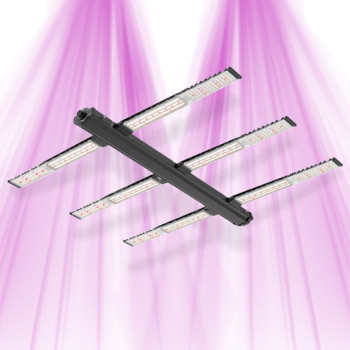
SpectraWILD M650 - Home automation compatible LED horticultural bars - Samsung…
Available in 7 models
In stock · Shipped within 24 h
899,00 € or 3× 299,67 €

Product successfully added to your shopping cart
Ça pousse dans le bon sens

18 products
Adjustable spectrum LED lighting revolutionizes indoor cultivation by giving you total control over the wavelengths emitted. Unlike traditional HPS lamps that emit a fixed spectrum, these systems allow you to independently modulate blue (400-500nm) and red (600-700nm) LEDs according to your plants' specific needs. This is the technology that makes the difference between basic cultivation and advanced yield optimization.
The main advantage lies in precise adaptation to development phases. During vegetative growth, you push the blue spectrum (6400K) to promote compact and vigorous stem development. During flowering, you switch to deep red (2700K) which stimulates resin production and bud formation. This flexibility allows for a 15 to 25% increase in yields compared to a fixed spectrum, while reducing electricity consumption by 40% compared to equivalent HPS.
Another strong point is durability. Quality LEDs easily last 50,000 hours compared to 10,000 for an HPS. That's several years of growing without changing bulbs. And in terms of heat, we go from 400W of heat dissipation with a 600W HPS to only 150W with an equivalent adjustable spectrum LED. Your ventilation system will thank you.
First criterion: actual power. Beware of marketing's "equivalent" watts. A good 240W actual adjustable spectrum LED effectively covers 80x80cm in flowering. For 120x120cm, aim for 400-500W actual. Also check the luminous efficacy expressed in µmol/J - count at least 2.5 µmol/J for recent equipment.
For control, prefer models with separate dimmers for each spectrum. Versions with remote control or smartphone control provide real ease of use. Pay attention to the quality of the drivers: Samsung, Meanwell or Osram are guarantees of reliability. For installation, check that the system includes adjustable hangers and that the wiring complies with European standards.
The optimal distance depends on the power and stage of development. For a 240W LED, maintain 40-50cm in growth and 30-35cm in flowering. With a 400W, count 50-60cm in growth and 40-45cm in flowering. The trick is to observe your plants: if the top leaves curl or whiten, you are too close. Use a lux meter if possible - aim for 35,000-45,000 lux in flowering.
During growth, push the blue spectrum to 80-100% and limit the red to 20-30%. This configuration promotes compact development with short internodes. Plants remain stocky and develop a robust root system. Avoid completely cutting off the red as it contributes to necessary cell elongation. After 3-4 weeks of growth, you can start gradually increasing the red to prepare for the flowering transition.
A 300W adjustable spectrum LED effectively replaces a 600W HPS, which is 50% direct savings. But that's without counting the reduction in the cooling system: a 600W HPS emits 600W of heat, compared to 180W for the equivalent LED. In the end, you easily save 60-70% on your electricity bill. Over a 4-month grow, that represents €200-€300 in savings depending on your kWh rate.
Installation is simpler than an HPS because there is no external ballast. First, fix the hanging hooks to the tent ceiling, then hang the LED with the adjustable straps provided. Electrically, plug directly into a 220V socket - the drivers are integrated. Check that your installation can handle the load and use a dedicated circuit breaker. For models with a remote controller, place it outside the tent to avoid humidity.
Monthly cleaning is more than enough. Use a slightly damp microfiber cloth to remove dust from the heat sinks and optics. Avoid chemical products that could damage the coatings. Dust reduces efficiency by 5-10% and can cause LEDs to overheat. Take advantage of cleaning to check the condition of cables and connections. A well-maintained LED retains 90% of its initial power after 5 years of use.
Available in 7 models
Available in 7 models
Available in 7 models
Available in 7 models
Available in 7 models
Available in 3 models
Available in 3 models
Available in 3 models
Available in 3 models
Available in 2 models
Help & advice
About Adjustable spectrum — click a question to see the answer.
Adjustable spectrum LED lighting is a real asset for indoor cultivation. It allows me to precisely control the light wavelengths my plants receive, depending on their development stage. I can thus optimize vegetative growth with more blue light, then promote flowering and fruiting by increasing red light. It's a technology that offers incredible flexibility to maximize yields and the quality of my crops.
The major difference is control. HPS (High-Pressure Sodium) lamps offer a fixed spectrum, generally very rich in orange/red, which is good for flowering but less optimal for vegetative growth. With adjustable spectrum LEDs, I can modulate this spectrum at will. In addition, LEDs are much more energy-efficient, emit less heat, and have a much longer lifespan than HPS. It's a much more advanced and efficient technology for modern cultivation.
When I choose an adjustable spectrum LED light, I look at several criteria. First, the quality of the LEDs and drivers is paramount for performance and durability. Then, I check the ease of spectrum adjustment (buttons, external controller, app). The power and light efficiency (PPF or PPFD) relative to my growing area are also essential points. Finally, I make sure the cooling system is efficient to prevent overheating. Feel free to consult our Lighting Type category to compare options.
That's a common question! For indoor cultivation, I recommend aiming for a PPFD (Photosynthetic Photon Flux Density) of approximately 600-900 µmol/m²/s for the flowering of light-hungry plants. In practice, for a 1m² area, this often corresponds to a real consumed power of 300 to 450W for a good quality LED. It's important not to rely solely on the advertised power, but rather on the PPFD measured at canopy height.
The first mistake I often see is placing the lamp too close or too far from the plants, which can cause burns or etiolation. Another mistake is neglecting spectrum adjustment: not taking advantage of your LED's adjustable capability is wasting its potential. Finally, poor ventilation is also a classic pitfall; even if LEDs heat up less than HPS, good air circulation remains essential for your plants' health and humidity management.
Absolutely! If you're looking to optimize your yields, reduce your energy consumption, and have precise control over your plants' development, then adjustable spectrum LED is for you. Whether you're growing vegetables, herbs, or flowering plants, this technology offers you unparalleled flexibility to adapt the light to the specific needs of each species and each growth stage. It's an investment that quickly pays for itself through the results it delivers.
Cannot find your answer? 01 88 33 45 52 or by message.