Ducting for 125mm Extractors: The Complete Guide for Your Ventilation
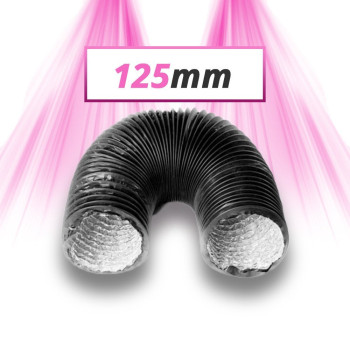
125mm extractor ducts are the backbone of your indoor ventilation system. With a diameter of 125mm (or 127mm depending on the manufacturer), they transport stale air from your grow space to the outside, while maintaining airtightness and reducing noise pollution. Choosing the right ducting determines the efficiency of your extraction and the discretion level of your setup.
Why choose specialized 125mm extractor ducting
Unlike standard HVAC ducts, indoor grow ducts must withstand high temperatures, constant humidity, and odors. The Combi Ducting in Alu/PVC 5m - 125mm diameter perfectly meets these requirements with its double wall that prevents any thermal or olfactory leakage. For installations where noise is an issue, acoustic ducts like the Phonic Trap Ducting 3 meters - Ø127mm Pre-cut drastically reduce vibrations transmitted by the extractor. Thermal insulation also prevents condensation that could damage your electronic equipment.
Simple aluminum ducts are suitable for short, straight runs, but as soon as you have bends or significant distances, opt for reinforced models. The Combi Ducting in Alu/PVC 10m - 127mm diameter offers this robustness over long distances without loss of airflow.
How to choose your 125mm extractor ducting
The 125mm diameter corresponds to extractors from approximately 190 to 400 m³/h, perfect for spaces from 0.8 to 2m². Check that your extractor and carbon filter have 125mm outlets - some models use 127mm, which is compatible but slightly wider. The length depends on your configuration: 3m is often sufficient indoors, but plan for 5 to 10m if you need to go through several rooms.
For noise level, this is where it makes all the difference. A standard duct transmits all the vibrations from the extractor. The Phonic PRO Wadding Ducting Ø127mm - 3 meters with its wadding insulation absorbs these vibrations and can halve the noise. Frankly essential in an apartment or if you want to sleep peacefully.
In terms of materials, aluminum resists heat well but is easily punctured. Mixed aluminum/PVC ducts combine thermal resistance and mechanical strength. For permanent installations, prefer pre-cut models that connect more easily to clamps.
Frequently Asked Questions
What's the difference between a 1-speed extractor like the Vents 190m³/h and a 2-speed one like the Prima Klima for a 1.2x1.2m grow tent?
A 1-speed extractor always runs at full power, which can create excessive air exchange and sudden temperature variations in a 1.44m² space. 2-speed models allow you to adapt the airflow according to needs: speed 1 to maintain gentle circulation during rest periods, speed 2 to quickly evacuate heat during intense lighting periods. This modularity improves climate stability and reduces electricity consumption. For a 1.2x1.2m tent, an airflow of 120-150 m³/h at low speed is often sufficient, compared to 250-300 m³/h at high speed.
How to install and wire a 125mm inline extractor in my indoor grow tent?
The extractor is generally mounted at the top of the tent, on the hot air outlet side. Use clamps to connect the 125mm ducting to the extractor outlet, then to the tent opening. Wiring is done via a speed controller or directly to the mains depending on the model. Respect the direction of rotation indicated on the extractor and ensure that the ducting does not have too tight bends that would reduce airflow. An anti-vibration support between the extractor and the structure prevents noise transmission. Always plan for a slightly longer duct than necessary to facilitate adjustments.
Which flexible ducting to choose for a 125mm extractor: simple aluminum or insulated EPS?
Simple aluminum is suitable if your ducting remains in a temperate environment and noise is not an issue. It is cheaper and easy to handle. Insulated EPS (expanded polystyrene) or double-wall aluminum/PVC ducting is essential when you cross cold areas (risk of condensation), want to reduce heat loss, or limit sound transmission. In indoor growing, thermal insulation prevents hot air from cooling in the duct, which maintains extraction efficiency and prevents condensation from returning to the extractor.
Do I need a carbon filter with this 125mm extractor for hot air extraction?
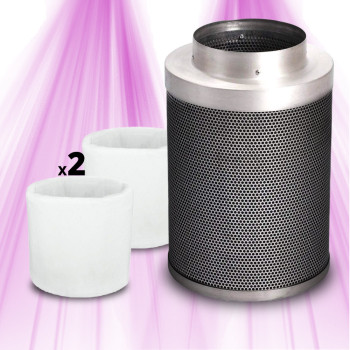
A carbon filter is not mandatory for evacuating hot air, but it becomes essential if your grow emits odors that you want to neutralize. A 125mm filter is placed before the extractor in the air circuit: grow air → carbon filter → extractor → ducting → outside. Be aware that the filter reduces airflow by 20 to 30%, so you need to choose a slightly oversized extractor. For a discreet installation, it is a key element that prevents olfactory nuisance to the outside or adjacent rooms.
How to maintain a 125mm inline extractor to keep it quiet and last a long time?
Clean the extractor blades every 3-4 months with a brush or damp cloth to prevent dust accumulation that unbalances rotation and generates vibrations. Check that the fixings remain tight as vibrations can gradually loosen them. Replace the ducting if it punctures or deforms, as air leaks force the extractor to run faster to maintain airflow. Grease the bearings once a year on models that allow it. A well-maintained extractor retains its original performance and noise level for at least 3-5 years.