



































































Sistema LED Titan 720W Pro - Solux - Éclairage horticole professionnel 720W…
In stock · Shipped within 24 h
399,00 € or 3× 133,00 €

Product successfully added to your shopping cart
Ça pousse dans le bon sens

18 products
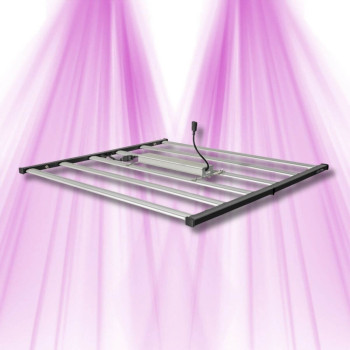
700W LEDs represent the high-end of horticultural lighting for indoor cultivation. With a power output of 700 watts, these LED panels offer exceptional light intensity capable of covering grow spaces of 1.5 to 2m² depending on the setup. Unlike traditional HPS lights, which consume more and generate significant heat, 700W LEDs deliver an optimized light spectrum while maintaining a controlled operating temperature.
This power category is perfectly suited for experienced growers looking to maximize their yields in medium to large areas. The energy efficiency/light output ratio of 700W LEDs makes them a top-tier technical choice for serious setups.
The 700W power places these LEDs in a league of their own. With a PPFD that can reach 1200-1500 µmol/m²/s at 30cm distance, we're talking about light intensity that rivals the best 1000W HPS, but with 30% less consumption. That's where it makes all the difference in your electricity bill.
The full-spectrum of 700W LEDs typically integrates Samsung LM301B diodes or equivalent, with wavelengths from 380nm to 780nm. This complete spectral coverage allows you to support your plants from germination to harvest without changing your lighting. The 660nm red and 730nm infrared diodes particularly boost flowering.
Thermally, a well-designed 700W LED generates approximately 40% less heat than an equivalent HPS. With a passive cooling system using aluminum heatsinks or an active system with fans, the temperature remains manageable even in confined spaces. No more summer overheating that scorches your plant's apexes.
First criterion: energy efficiency expressed in µmol/J. A good 700W LED should display a minimum of 2.5 µmol/J, with the best reaching 2.8-3.0 µmol/J. This ratio determines how many useful photons you get per watt consumed.
The distribution of diodes matters greatly. Prioritize models with Samsung, Osram, or Cree diodes evenly distributed across the entire panel surface. A 700W LED with 2000+ diodes will offer better penetration than a model with 500 high-power diodes, which risks creating hot spots.
The cooling system is crucial at this power. Check for oversized heatsinks and silent fans if it's an active model. A 700W LED that overheats will lose efficiency and lifespan. Passive models are quieter but require more powerful exhaust ventilation.
Finally, the dimming function is almost indispensable on a 700W light. Being able to reduce intensity to 25-50% during the vegetative phase prevents light stress and allows for progressive power increase. 0-10V controllers or integrated potentiometers offer this flexibility.
A 700W LED effectively covers 1.5 to 2m² depending on the desired intensity. For optimal flowering coverage, count on 1.5m² (120x120cm) with a PPFD of 800-1000 µmol/m²/s. Over 2m² (140x140cm), the intensity drops to 600-700 µmol/m²/s, which is still adequate for most varieties. During the vegetative phase, you can easily cover 2.5m² by reducing the intensity to 40-50%. The hanging height also influences coverage: higher means wider but less intense.
Most modern 700W LEDs are dimmable, either via an integrated potentiometer or an external 0-10V controller. During the vegetative phase, set the intensity between 25-40% of the maximum power, which is approximately 175-280W actual. This provides 200-400 µmol/m²/s, perfect for growth without light stress. Increase gradually: 50% in pre-flowering, then 80-100% in flowering depending on the plants' reaction. This gradual approach prevents light burn and optimizes photosynthesis at each stage.
Installing a 700W LED requires robust supports: adjustable straps or a hanging rail capable of supporting a minimum of 15-20kg. Check that your electrical installation can handle the load: 700W on 230V = approximately 3A, so a 10A circuit breaker is more than sufficient. Use a horticultural timer suitable for the power and ensure you have a grounded outlet. For ventilation, a minimum extraction of 400-600m3/h is recommended to dissipate residual heat. Observe safety distances: a minimum of 30cm from walls and 40-60cm from plants depending on intensity.
The optimal height varies depending on the phase and intensity used. In vegetation with dimming at 30-40%, hang the LED 60-80cm from young plants. In flowering at full power, 30-45cm is sufficient for most varieties. Monitor for signs: leaves curling upwards = too close, excessive stretching = too far. Use a lux meter or a PPFD app to measure: aim for 200-400 µmol/m²/s in veg, 600-1000 µmol/m²/s in flowering. Sativa varieties generally tolerate more intensity than indica.
Maintenance for a 700W LED is minimal but crucial. Clean the heatsinks every 2-3 months with a dry brush or compressed air to prevent dust accumulation, which reduces cooling. Regularly check the fans if present: a squeaky bearing indicates an impending failure. Avoid overly frequent on/off cycles that wear out LED drivers. Maintain an ambient temperature below 30°C in the grow space. With these simple precautions, a quality 700W LED retains 90% of its efficiency after 50,000 hours, which is over 10 years of intensive use.
Available in 4 models
Help & advice
About 700W — click a question to see the answer.
For a typical grow area of 1.5 to 2m², a 700W LED is an excellent choice. I always recommend carefully evaluating the size of your space before making your selection. If you have a smaller area, a lower wattage might be more suitable to avoid light stress on your plants.
This is a crucial question! Generally, for a 700W LED, I advise starting with a distance of approximately 60 to 90 cm above the canopy. Then, you need to observe your plants carefully and adjust gradually. The optimal distance will also depend on the specific model of your LED and the growth stage of your plants.
The difference is significant! A 700W LED offers an optimized light spectrum and much higher energy efficiency. Unlike HPS, which generate a lot of heat and consume a lot of energy, LEDs are cooler, reduce ventilation needs, and are more durable. I also explain why we buy back old HPS systems in this article.
If your grow area is between 1.5 and 2m², then yes, a 700W LED is perfectly suitable. It will provide the necessary light intensity for optimal growth and flowering. For larger spaces, you might consider multiple units or even higher wattage, and for smaller ones, a lower wattage LED would be more appropriate.
The number of lighting hours depends on the growth stage of your plants. For the vegetative phase, I generally recommend 18 hours of light and 6 hours of darkness. During flowering, you should switch to a cycle of 12 hours of light and 12 hours of darkness to stimulate flower production.
For flowering, I recommend prioritizing a light spectrum rich in red and orange, with a presence of blue and green. This is often referred to as a 'full-cycle' or 'flowering' spectrum. Some 700W LED models offer adjustable spectra, which is ideal for precisely adapting to your plants' needs at each stage.
Energy saving is one of the biggest advantages of 700W LEDs. They are much more efficient than traditional HPS, converting a larger portion of energy into useful light and less into heat. In practice, you will see a significant reduction in your electricity bill, not to mention savings on ventilation and bulb replacement.
The lifespan of a 700W LED light is one of its strong points. Generally, we talk about 50,000 to 100,000 hours of use, which represents several years of intensive cultivation. It's a larger initial investment, but the longevity and long-term performance make it a very cost-effective choice compared to older technologies.
Cannot find your answer? 01 88 33 45 52 or by message.