





































































When the thermometer climbs above 30 °C inside your tent, your plants aren't just "suffering" in some vague sense: they close their stomata, sharply slow down their photosynthesis and literally start to cook their own tissues. I've seen crops stall in 48 hours of poorly managed heat, and others sail through three weeks at 34 °C outside without losing a single gram of yield. The difference isn't down to luck, it comes down to five precise reflexes, applied in the right order and at the right moment. I'll walk you through them with the figures that matter: temperatures, VPD, extraction airflow, EC.
What really happens inside the plant when it gets too hot
A plant doesn't transpire for the fun of it, it transpires to cool itself down and to move water and nutrients from the roots up to the leaves. This mechanism is called stomatal transpiration: the stomata, those tiny pores on the underside of the leaves, open and release water vapour. As long as the surrounding air is drier than the inside of the leaf, the water evaporates and the plant cools down, much like sweat on your skin.
The trouble starts with the VPD, the vapour pressure deficit (expressed in kPa). It's the gap between the amount of water vapour the air could theoretically hold and the amount it actually holds. When the temperature climbs without the humidity keeping up, the VPD shoots up: at 25 °C and 60% RH you're around 1.2 kPa, which is fine. At 33 °C with the same relative humidity, you climb above 2 kPa. The plant then loses water far faster than it can pull it back up from the roots.
Faced with this stress, the plant defends itself by closing its stomata, the exact opposite of what it should be doing to cool down. Closing the stomata limits water loss, but it also blocks CO2 from getting in, so photosynthesis drops. Above 30 °C, the activity of Rubisco (the enzyme that fixes carbon) becomes less efficient, and above 35 °C some proteins start to denature: the plant diverts its energy towards producing heat shock proteins rather than towards growth or flower formation.
In practical terms, a poorly managed heatwave produces three typical symptoms: upper leaves that curl into a cupped, spoon shape (canoeing), leaf tips that burn even though the EC is correct, and a growth stall despite lighting and feeding that haven't changed. If you see this, the cause is almost always thermal, not nutritional.
1Shift the photoperiod onto the night
The first reflex, often overlooked, costs nothing: shift your lamp's switch-on time so that the light hours fall during the coolest part of the day, typically the night and early morning. If your outdoor heat peak is between 2pm and 7pm, whatever you do, don't let that peak coincide with your light hours, which are already adding heat inside the tent.
The total photoperiod length doesn't change, only where it sits in the day: an 18/6 stays an 18/6, a 12/12 stays a 12/12. For example, instead of switching on at 8am and off at 8pm on 12/12, you switch on at 10pm and off at 10am. Your light hours fall over the night and the morning, the coolest hours, and your dark phase covers the scorching afternoon.
The shift has to be gradual, 30 to 60 minutes per day at most over 2 to 3 days, never all at once. The photoperiod drives the plant's circadian clock and its flowering/fruiting transition in photoperiodic varieties: a sudden shift of several hours can disrupt this signal and, in rare cases, trigger a reversion to vegetative growth or flowering stress.
2Keep the air moving at all times
Stagnant air is enemy number one in high heat, even if the displayed temperature looks fine. Around every leaf there's a thin layer of still air, the boundary layer. Without air movement, this layer quickly becomes saturated with water vapour and heat: the leaf can no longer release its transpiration or its excess heat, much like a room with no window on a summer's day.
Air movement breaks up this boundary layer and does two things at once: it renews the CO2 available right at the leaf surface (photosynthesis consumes it locally faster than pure diffusion can replace it), and it speeds up evaporation, which cools the leaf by convection. A well placed fan can bring the temperature felt at the foliage down by 1 to 2 °C without changing anything else.
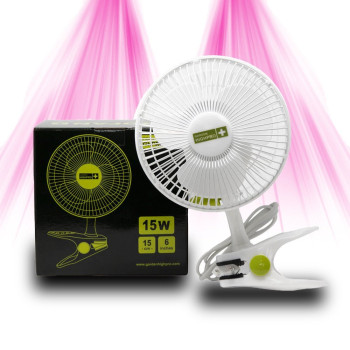
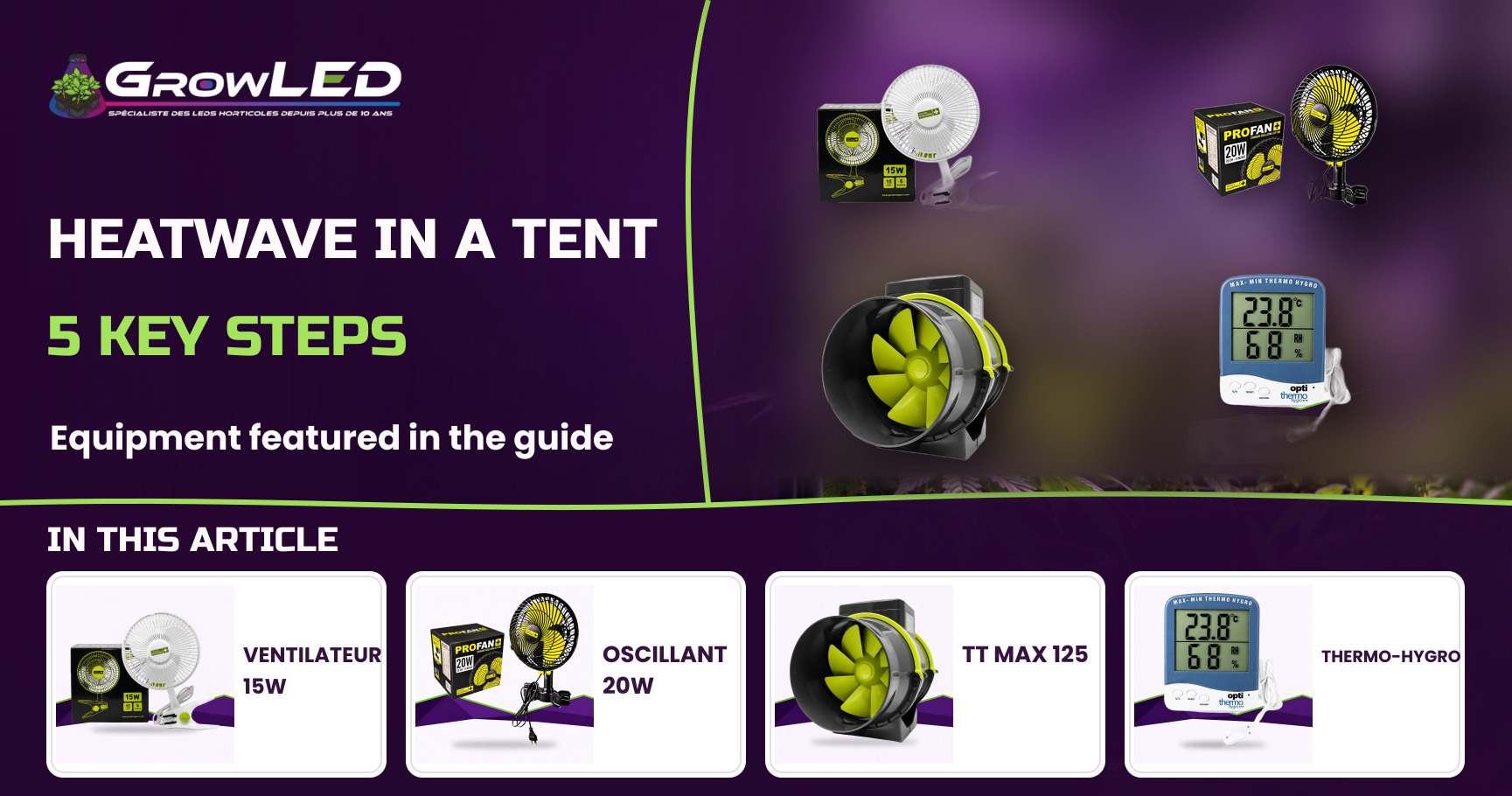
For a standard sized tent, I set up two clip fans in a staggered layout, never in a direct head-on flow onto the flowers but rather bounced off a wall or aimed at the lower foliage, with a gentle sweeping motion to cover the whole canopy. The Garden HighPro 15W clip fan works very well alongside extraction in a small space, and its oscillating 20W version gives more even coverage in a wider tent by sweeping across the full width of the canopy instead of concentrating the flow on a single spot.
🌱 Joseph's tip
Never aim a fan directly and steadily at the developing tops, it dries them out locally and weakens the stems. I always bounce the flow off a tent wall or aim at the lower foliage: the air stirs the whole plant mass without battering any single point.

3Size your extraction in m³/h
Extraction, unlike simple air circulation, actually pulls the hot, humid air out of the tent, and replaces it with fresh air from outside or from the room. It's the most effective reflex in a heatwave, but also the one people size worst.
The basic rule for calculating the airflow you need is simple: the tent's volume (in m³) multiplied by the number of air changes you want per hour. Under normal conditions, 20 to 40 air changes per hour are enough. In a heatwave, aim instead for a full air change every 1 to 2 minutes, so 30 to 60 times per hour.
| Tent volume | Target air change | Theoretical airflow needed |
|---|---|---|
| 1 m³ (e.g. 1×1×1 m) | every 2 min | ≈ 30 m³/h |
| 2 m³ (e.g. 1.2×1.2×1.4 m) | every 2 min | ≈ 60 m³/h |
| 3 m³ (e.g. 1.2×1.2×2 m) | every 1 min | ≈ 180 m³/h |
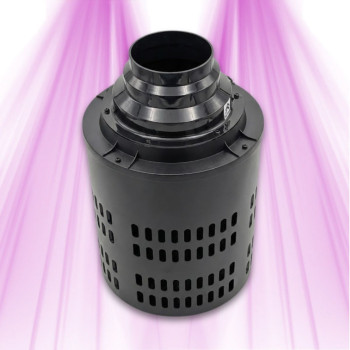
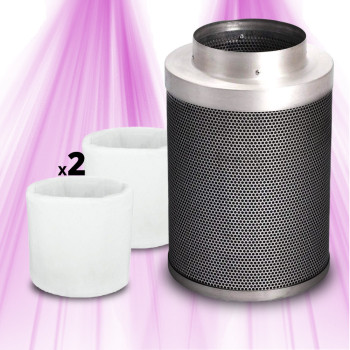
This theoretical airflow is only the starting point, because an active carbon filter, ducting bends and overly long ducting cut the real airflow by 30 to 50% compared with the extractor's rated output. That's why I always choose an extractor comfortably above the raw calculated need, with two speeds: the low speed runs continuously for baseline humidity, the high speed takes over during the hottest hours. The TT MAX 125mm 2-speed extractor works on exactly this principle and comfortably covers most home grow tents once the pressure losses are taken into account.
4Raise and dim the lamp
Even a LED, contrary to popular belief, gives off heat, far less than an HPS at equal output, but a significant part of the electricity it draws leaves as heat rather than light. In the middle of a heatwave, this added heat can tip a tent from 27 °C, tolerable, to 32 °C, dangerous.
Raising the lamp by an extra 10 to 15 cm reduces the heat load felt by the canopy, because light intensity (and the radiant heat that comes with it) falls off with the square of the distance: double the distance and you quarter the intensity. It's a quick, reversible lever that needs no tools.
Dimming is the other variable, often forgotten on modern drivers fitted with a potentiometer: dropping to 70-80% of the power during the hottest hours lowers both the heat emitted and the PPFD received, for example from 700-800 µmol/m²/s down to 450-500 µmol/m²/s for the duration of the peak. The DLI (daily light integral) drops slightly over the day, which is a far better compromise than a heat stress that flatly stops photosynthesis altogether.
5Watch the EC and the watering frequency
In high heat the plant drinks more, mechanically, because it's compensating for increased transpiration. The problem is that if you keep the same nutrient solution EC, it takes up proportionally more mineral salts than pure water: the substrate concentrates between waterings, and you end up with a nutrient lockout that looks exactly like a deficiency, when it's actually a relative excess.
I drop my EC by 15 to 20% as soon as the tent stays above 28-29 °C, and I water more often with smaller volumes rather than one big, spaced-out watering: it avoids the swings in concentration and keeps a more stable substrate moisture, which also helps regulate the root temperature. The pH, for its part, doesn't move with the heat: stick to 5.8-6.2 in hydro and 6.2-6.8 in soil/coco.
The temperature of the nutrient solution matters just as much as the air temperature, a point too often forgotten: above 24 °C, water holds less dissolved oxygen, the roots breathe less well and the risk of pythium (root rot) rises sharply. I aim for 18-20 °C for my watering water, even if that means storing it in the shade or dropping an ice pack into the buffer reservoir.
🌱 Joseph's tip
In high heat, I always test the temperature of my water before giving it. Water at 28 °C stored in a jerrycan in full sun often does more damage than a poorly set EC: get it to 18-20 °C before any watering.
The thresholds to remember, stage by stage
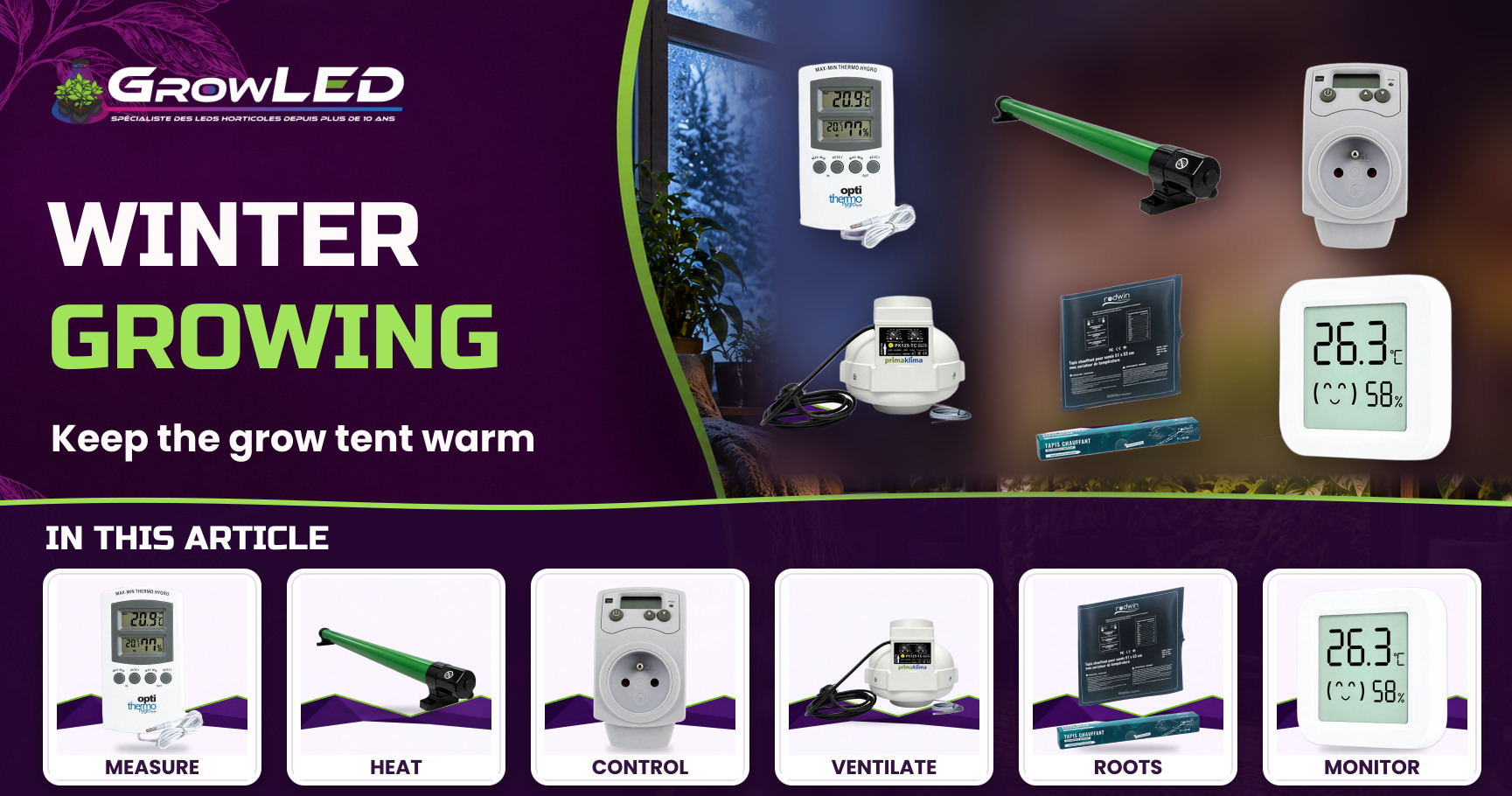
To steer without guessing, here are the benchmarks I use myself, valid for most tent grows under LED lighting. A reliable thermometer-hygrometer, placed at canopy level and not just at the bottom of the tent, changes everything: the digital hydro thermometer for temperature and humidity lets you track both values at once, where many people watch temperature alone.
| Stage | Day temp. | Night temp. | Humidity | Target VPD |
|---|---|---|---|---|
| Vegetative | 24-28 °C | 18-22 °C | 55-70% | 0.6-1.0 kPa |
| Flowering | 24-27 °C | 18-21 °C | 40-50% | 1.0-1.2 kPa |
| Late flowering | 22-26 °C | 17-20 °C | 35-40% | 1.2-1.5 kPa |
Above 30 °C, treat yourself as being in a genuine danger zone, whatever the stage: net photosynthesis drops, the plant burns more energy in night-time respiration than it stores during the day, and the risk of burn or lockout rises sharply. The day/night gap should never exceed 8-10 °C in one go: too sudden a drop at night is as stressful as excessive heat during the day.
The classic mistakes that make heatwaves worse
The first mistake, and the most common, is to switch off the extraction at night on the assumption that "it's cooler at night, no need". That's wrong in a closed tent: without air renewal, the humidity and the CO2 from the plants' night-time respiration build up, and the temperature doesn't come down as quickly as it does outside.
The second mistake is to mist the leaves in full heat to "cool them down", which pushes the humidity up without bringing the temperature down, worsens the VPD by another route and creates a perfect breeding ground for powdery mildew or grey mould, especially in late flowering.
- Putting ice directly in the tent: it creates a local humidity shock and condensation that encourages fungi.
- Keeping the same EC throughout the heatwave: it leads straight to the nutrient lockout described above.
- Shifting the photoperiod by several hours all at once: it disrupts the circadian clock instead of simply easing it along.
- Ignoring the nutrient solution temperature: lukewarm water starves the roots of oxygen even if the tent air is fine.
What I've taken away after several summers managing tents through full heatwaves is that heat doesn't forgive improvisation, but it's very manageable with simple, regular actions. Shifting the photoperiod, moving the air, sizing the extraction properly, adjusting the lamp and lowering the EC: none of these five reflexes is complicated in itself, it's their combination and their consistency that make the difference between a crop that rides out the shock and one that stalls. Anticipate before the peak, not during it: a well placed thermometer-hygrometer will always give you a few hours' head start on the problem.
Kit out your tent to get through summer with peace of mind
The TT MAX 125mm 2-speed extractor, the oscillating 20W clip fan and the digital hydro thermometer form the backbone of reliable climate management in a tent.
See climate management →