



































































Humidity is the parameter most growers discover far too late, once the leaves start crisping up or the first spots of mould appear on a tight bud. In this article I'll show you how to measure your tent's humidity properly, how to correct it one way or the other depending on what you're reading, and how to automate the whole thing so you never have to think about it every evening again.
1Understanding humidity in your tent
The first thing to take on board is that relative humidity isn't a fixed value: it depends directly on temperature. The very same volume of air, holding exactly the same amount of water, will show a lower humidity percentage as it warms up, and a higher one as it cools down. That's why a tent that seems dry during the day under the lights can climb in humidity at night, as soon as the lamps switch off and the temperature drops: it's the same air, but it's moving closer to its saturation point.
The direct consequence for the plant is that leaf transpiration, the mechanism by which it releases water vapour through its stomata, depends on that gap between the humidity of the air and its saturation capacity. If the air is already close to saturation, the plant transpires less, the sap moves more slowly, and the stomata partly close, which also limits CO2 uptake and slows down photosynthesis. Conversely, air that's too dry pushes the plant to over-transpire: it loses water faster than the roots can absorb it, the leaf edges crisp up, and a young cutting with no established root system can wilt within a few hours because it can't compensate.
In the field, I think in terms of growth stage rather than a single fixed figure. A cutting needs almost saturated air to limit its water loss for as long as it has no roots. A plant in growth, with an established root system, tolerates drier air. And in late flowering it's the opposite that becomes the priority: less ambient humidity, because dense buds that are poorly ventilated at their core hold on to moisture and become an ideal breeding ground for grey mould.
| Growth stage | Humidity priority | Why |
|---|---|---|
| Cuttings | Very humid air | No roots: the plant limits water loss through its tissues |
| Growth | Moderately humid air | Root system established, transpiration better tolerated |
| Early flowering | Air drying out gradually | The flowers start to form and tighten up |
| Late flowering | Driest air possible | Dense buds, poorly ventilated at the core: risk of grey mould |

2Measure before you act: the go-to thermo-hygrometer
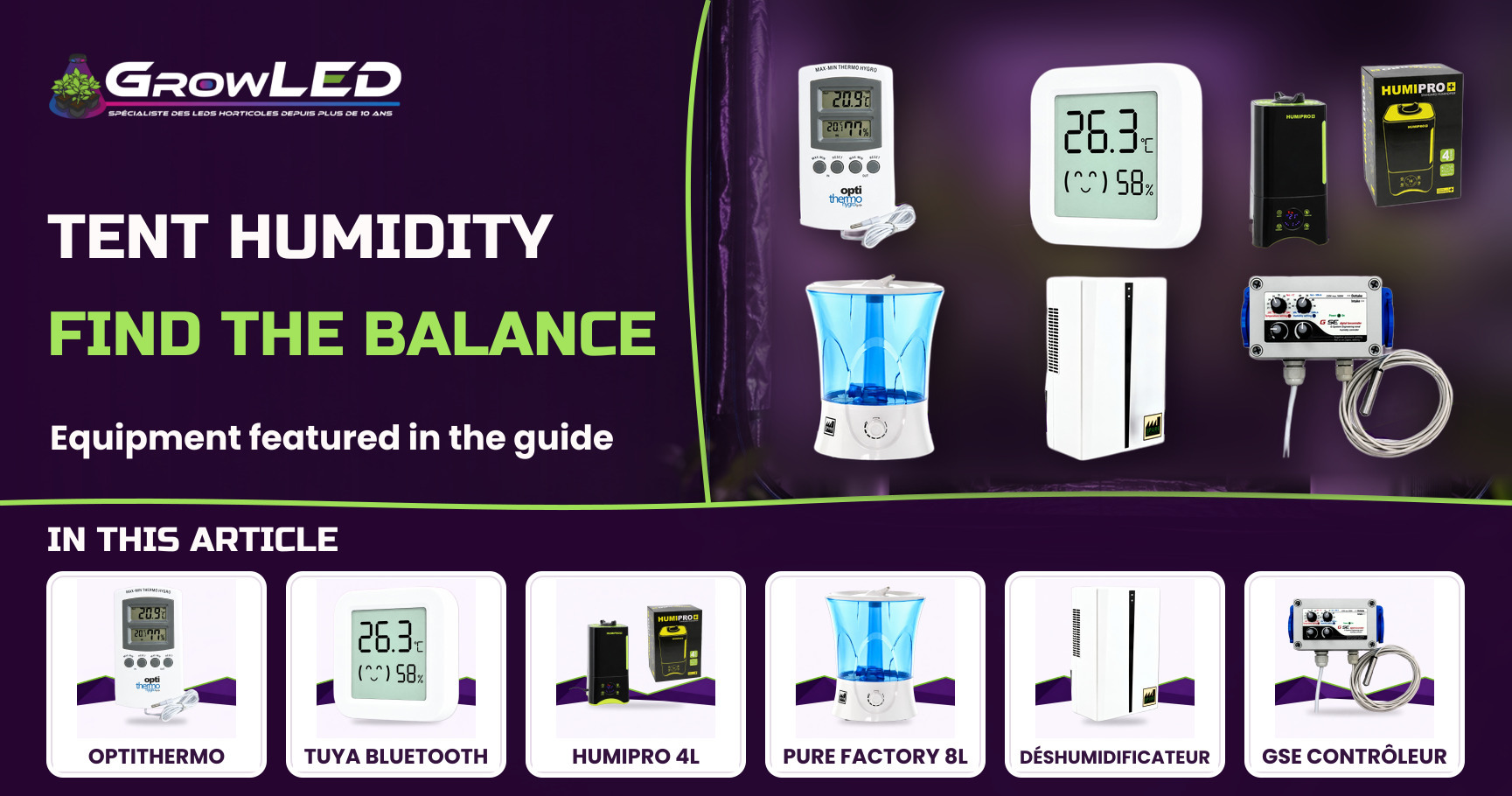
Before buying any humidifier or dehumidifier, you need a reliable figure. It sounds obvious, yet it's forgotten far too often: people buy the device that corrects the problem before they even know how much correcting is needed, and in which direction. The Optithermo Medium Digital Hygro Thermometer covers a measuring range from 25 to 98% RH, more than enough to follow a grow from a saturated cutting through to the driest late flowering, without ever leaving the readable range.
What really matters on this type of device is the min/max memory. An instant reading tells you where you stand at the moment you open the tent, but it says nothing about the humidity peak that hit at 4am, when the temperature drops after the lamps go off. That night-time peak is precisely what encourages mould, and it's exactly what you miss if you only check the device once a day. The min/max memory captures that moment without you having to be there, and it stops you buying a corrective device (humidifier or dehumidifier) on the basis of a mere impression.
- Works with a growbox, tent or greenhouse, the device isn't tied to a single type of structure, it can be set down or fixed anywhere a reading is useful.
- Direct reading with no calculation, temperature and humidity are shown together on one screen, so there's no need to cross-check two devices for this first level of monitoring.
3Going further: the triple probe to compare zones
A standard thermo-hygrometer gives a single measuring point, usually wherever it's placed, often at canopy height. But a tent isn't uniform: the air near the pot has nothing to do with the air near the extractor, and the substrate itself has its own moisture level, completely disconnected from the ambient air. That's where the Digital Hydro Thermometer with probe comes in: it measures to an accuracy of ±1°C and ±5% RH over a range of 10 to 99% RH, via three probes that can be used at the same time, one of which is amphibious and can be dropped straight into a coco substrate, a reservoir or a nutrient solution.
This exact point is what changes the way you make decisions, humidifying or dehumidifying isn't managed from the same spot in the tent. A waterlogged substrate with dry ambient air doesn't call for a humidifier, it calls for less frequent watering. Saturated ambient air with a substrate that's drying normally doesn't call for an aggressive dehumidifier, but rather a bit more extraction. Without a comparative probe, it's easy to confuse the two problems and correct in the wrong place, sometimes making the other one worse.
4Monitoring remotely: the connected option
Opening the tent to read a dial has a cost, and we don't think about it enough. Every time you open it in the middle of flowering, even for a few seconds in the dead of night, you can let in stray light and disrupt the photoperiodic cycle, not to mention that the outside air, drier or more humid depending on the season, temporarily throws off your microclimate until it settles again. The Tuya Bluetooth Thermometer and Hygrometer answers this problem with Bluetooth 5.0 BLE and WiFi, compatible with the Tuya Smart app as well as Alexa and Google Home.
The distinction between the two protocols matters, Bluetooth is enough to check the device from the living room or the next room along, whereas the WiFi link lets you receive an alert on your phone even when you're away from home if the humidity moves outside the set range. It's not a replacement for the probe thermometer covered above, more of a complement: the probe stays the precision tool placed inside the tent, while the connected sensor becomes your remote monitoring window, especially handy on days when you can't drop by to check in person.
5Humidifying: giving air back to a tent that's too dry
The symptoms of air that's too dry are fairly easy to spot, leaves that crack to the touch instead of bending, edges that yellow then brown starting from the tips, cuttings that wilt within a few hours despite a properly moist substrate. In that case, acting on the watering is pointless, since the problem is in the air, not in the pot.
Ultrasonic technology works through vibration, a piezoelectric membrane vibrates at high frequency and breaks the water into fine droplets projected as a cool mist, without heating the water. The benefit is twofold: no added heat load in a tent already warmed by the lamps, and modest power use compared with a heated evaporation system. The HUMIPRO 4L Ultrasonic Humidifier is built on this principle, with a built-in hygrostat that cuts the unit off and switches it back on automatically around the set point, 3 modes to adjust the mist intensity, a remote control to avoid opening the tent, and an output of 250 to 380 ml/h that gives it around 24h of autonomy.
When the tent is close to a living space, bedroom, office or living room, the noise of a humidifier running all night quickly becomes a problem in its own right. That's where the PURE FACTORY 8 L Air Humidifier makes sense: an 8-litre tank with a level indicator to cut down on refills, a quoted operation under 36 dB that makes it virtually silent at rest, for an autonomy of 15h at full tilt. It isn't the same use case as the HUMIPRO 4L, it's the option you choose when quiet running and tank capacity matter more than raw output.
🌱 Joseph's tip
Don't use the hardest tap water you've got to hand, an ultrasonic humidifier projects the minerals dissolved in the water along with the vapour, and you'll find them again as a fine white dust on the nearest leaves. Softer or filtered water limits that deposit and extends the life of the membrane.
6Dehumidifying: the blind spot of late flowering
This is the moment when most growers get caught out, in late flowering the buds tighten up, air circulation inside the flower cluster drops to a minimum, and the humidity that stagnates locally no longer comes back down as easily, even with decent extraction at tent level. Add a cool night that pushes relative humidity back up, as we saw in the first part, and you've got the ideal conditions for grey mould or powdery mildew, often discovered too late, at the heart of a bud you thought was healthy from the outside. The spores are already present before the spot becomes visible, which makes prevention far more effective than reaction.
On this particular segment, I've only got one product to offer you, and I'd rather be honest than present it as something already widely acclaimed: the Intelligent Dehumidifier with Peltier Technology remains a little-known reference at our shop, few growers have come across it yet. That takes nothing away from its technical relevance: it's currently the only device in our range designed specifically to pull moisture out of a tent's air, and from the angle of this article's title, it's quite simply irreplaceable.
Peltier technology works without a compressor, a thermoelectric module creates a cold face on which the ambient air's moisture condenses into droplets, collected in a reservoir, while the dried air returns to the tent. The absence of a compressor makes it quieter and lighter than a conventional dehumidifier, a real advantage in a closed grow cabinet where every watt and every decibel gets noticed. Its compact 22x35x18 cm format is designed precisely for this kind of tight space, and the automatic shut-off when the reservoir fills up prevents overflow if you're not there to empty it in time.
🌱 Joseph's tip
Don't try to offset excess humidity through more extraction alone, an extractor moves air around but won't necessarily remove enough water if the outside air being drawn in is itself humid, in a cellar, a basement or during a rainy spell. A dehumidifier, on the other hand, removes water regardless of the outside humidity: the two functions don't replace each other, they complement each other.
7Automating: driving the extraction rather than reacting
Up to now, each device answers an isolated problem, you humidify when it's too dry, you dehumidify when it's too humid, reacting after the fact to a reading. The final step, the one I recommend as soon as you're running several tents or you can't keep an eye on things morning and evening, is to have the extraction driven directly by the measurements rather than by a fixed timer or manual intervention.
The GSE Digital Controller for temperature, humidity and negative pressure does exactly that, it drives an extractor up to 2300W and 5A by combining three readings at once: temperature, humidity, and negative pressure, that slight vacuum you aim to maintain in a tent so that the air, and therefore the smells, don't escape through the seams. The external probe is quoted at an accuracy of ±0.5°C, enough for fine-tuned decisions rather than a simple all-or-nothing.
The technical point to understand is hysteresis, without it, a controller that triggers and cuts the extractor exactly at the set value would have it starting and stopping in a rapid loop the moment the reading swings by a few tenths around the threshold, which prematurely wears the motor and creates an unstable, saw-tooth microclimate. With a hysteresis band, the extractor starts at one threshold and only stops once it has dropped clearly below it, which smooths out the operation and genuinely stabilises the air in the tent.
- A single control logic, no more manually choosing between humidifying and dehumidifying, the extraction adjusts continuously according to what the probes actually read.
- Controlled negative pressure, useful both for containing smells and for preventing unfiltered air from getting in through the seams of the tent.
- A simple retrofit, the unit sits between your existing extractor and the socket, without changing the rest of your setup.
Kit out your tent to stop guessing
Whether your air is too dry or too humid, the right decision always starts with a reliable measurement. For humidifying, the HUMIPRO 4L Ultrasonic Humidifier is still my starting reference, and for late flowering the Intelligent Dehumidifier with Peltier Technology is the only dedicated answer in the catalogue. Find all the climate control gear on the growshop.
See the growshop →If I had to sum up years spent with my hands in the substrate, I'd say humidity is the parameter most underestimated by growers who are just starting out, and the first one experienced growers really keep an eye on. We invest in the lamps, in the extraction, in the nutrients, and we neglect the simplest device, the one that spares you half the nasty surprises: a good thermo-hygrometer. Once that foundation is in place, humidifying or dehumidifying becomes an obvious choice rather than a gamble. And the day you want to stop thinking about it every evening, a controller that combines temperature, humidity and negative pressure does that job for you, continuously, with no lapses or wrong moves.