





































































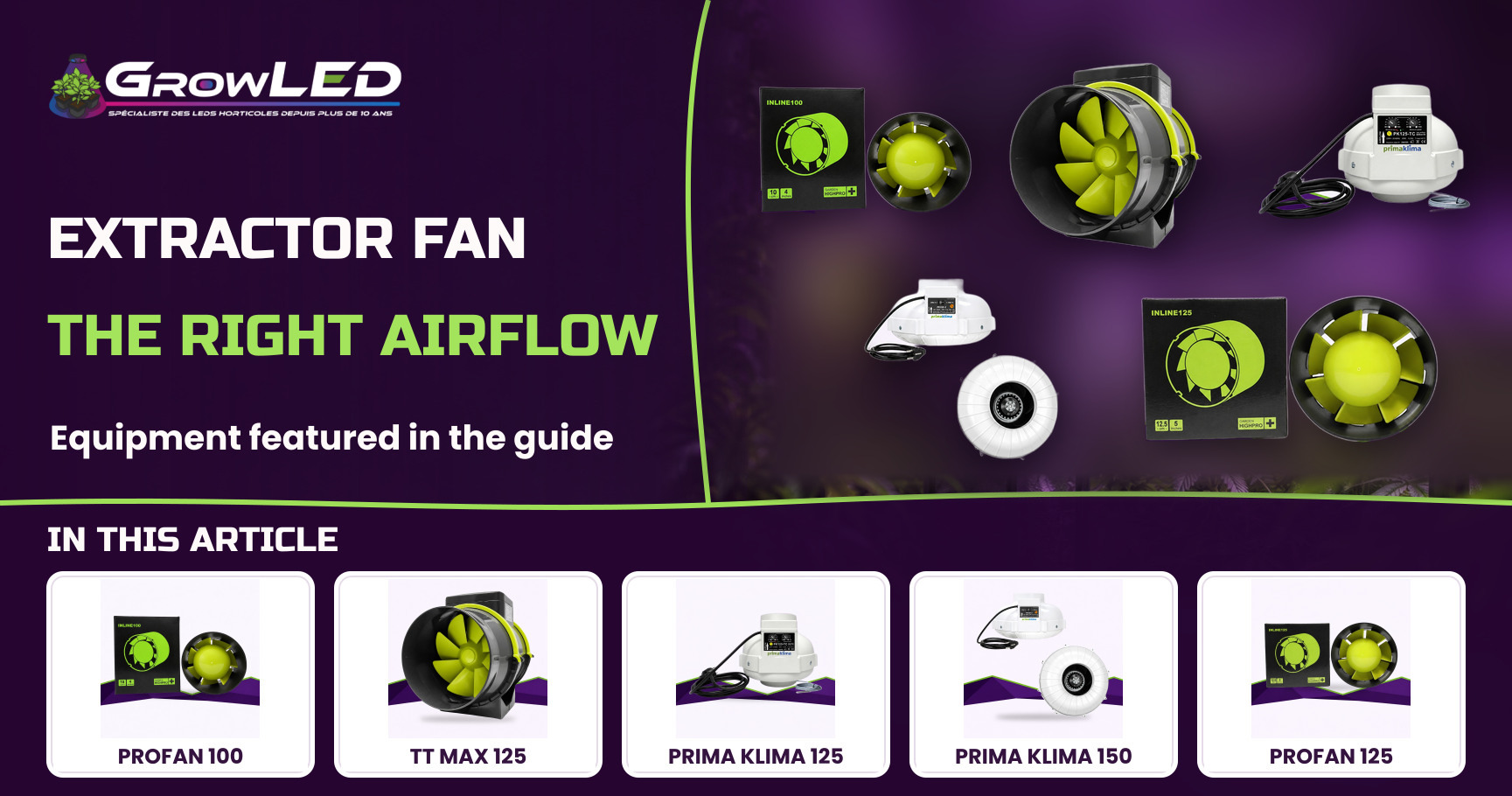
Get an extractor fan that's slightly too weak and heat builds up inside the tent; oversize it and your humidity collapses within a few hours. I'll walk you through the exact calculation I use in the field, volume by volume, along with the three traps that skew the result once the unit is actually running in real conditions.
1The basic calculation: small space, mini-tent
Before choosing anything, I measure the real volume of the room or tent: length times width times height, in metres. A 60x60x140cm mini-tent works out to roughly 0.5 m³. That figure, and that figure alone, is the basis for the calculation. Not the floor area, not the wattage of the lamp.
The rule I apply in the field is to aim for a full air change every one to three minutes depending on the thermal load: number of lamps, whether the ballast sits inside the tent or not, and the season. In a small volume, one minute is plenty to clear out the excess heat and moisture without drying the culture out in the process.
By multiplying the volume by the number of air changes you're targeting, you get a minimum theoretical airflow, often very low for a mini-tent. In practice, I never stop at that floor figure: the ducting, the bends and a future carbon filter always nibble away at part of the airflow quoted on the spec sheet.
For this kind of small volume, I always give the same reference point: the PROFAN 100mm inline duct fan - Garden HighPro - 107 m3/h. Its airflow comfortably exceeds the theoretical need of a mini-tent, which gives you exactly the headroom you need to absorb the losses from the ducting and a filter fitted in series.
- The volume, always in m³, never in m² of floor area.
- The air change, one to three minutes depending on the thermal load and the season.
- The headroom, the airflow on the spec sheet is measured with bare ducting, no filter or added bends.
🌱 Joseph's tip
Ducting that's too long or full of bends loses airflow at every turn. I always keep the run between the fan and the outlet as short and as straight as possible, and I make up for the unavoidable length by aiming for a model slightly above the calculation rather than dead on it.

2How to read a two-speed airflow range
A lot of growers fixate on the highest figure on a product sheet, and that's the most common mistake I correct. A two-speed fan shows a range, not a single figure, and that range has to be read in a specific order to be useful for the calculation.
The TT MAX 125mm 220-280 m3/h - 2-speed extractor fan - Wired illustrates the principle well: its low speed, 220 m³/h, should be treated as the guaranteed airflow you base your sizing calculation on. Its high speed, 280 m³/h, is only an occasional margin to switch on during a heat spike, not the reference value for choosing the unit.
In concrete terms, if my volume x air change calculation lands on a need close to 220 m³/h, this model works provided it runs mostly on low speed. If it lands on 250 m³/h, I'd rather find my headroom elsewhere than have the unit running permanently at high speed.
| Extractor fan | Diameter | Airflow | Carbon filter | Key feature |
|---|---|---|---|---|
| PROFAN Garden HighPro | 100mm | 107 m³/h | No | Small volume |
| PROFAN Garden HighPro | 125mm | 190 m³/h | No | Not filter-optimised |
| QuietLINE WINFLEX | 125mm | 197 m³/h | - | Quiet, 29-32dB |
| TT MAX 2-speed | 125mm | 220-280 m³/h | - | 2-speed range |
| Prima Klima Thermo Controller | 125mm | 0-400 m³/h | - | Built-in controller |
| Prima Klima 2-speed | 150mm | 390-760 m³/h | Yes | Large volume |
3Leave yourself headroom rather than aiming for the exact figure
The calculation gives you a figure, but I never go hunting for an extractor fan that matches that figure exactly. The season changes, a lamp might be added mid-culture, a carbon filter might get fitted in series later on: the real need shifts constantly, and the airflow you buy needs to keep up without swapping out the kit.
That's exactly the job of the Prima Klima Thermo Controller extractor fan Ø125mm – 400m³/h – Wired. Its built-in controller works like a speed regulator paired with a thermostat: you pick a model able to cover a wide range up to 400 m³/h, then dial the actual speed down below that, day by day, based on the temperature measured inside the tent.
The good practice I recommend is to flip the buying logic relative to the raw calculation: aim for a model capable of exceeding the calculated need, then bring the speed down with a regulator or a thermostat, rather than buying exactly the calculated value and running flat out permanently with no margin for error.
- The safety margin, a model that can do more than the calculation, never the other way around.
- The modulation, a regulator or a thermostat lets you drop the airflow without changing the unit.
- The scalability, a growing culture or an added lamp doesn't call your sizing into question.
4The calculation for a large volume or a multi-tent setup
For a large volume, a 120x120x200cm tent and up, or several tents connected to the same extraction, the volume x air change calculation climbs fast and moves out of the range of Ø100 or Ø125mm fans. At that point you need to change the diameter, not just the power.
The Prima Klima extractor fan Ø150mm – 760m³/h – 2-speed marks this upper tier: its 390-760 m³/h range in a 150mm diameter covers a volume well above a standard tent, while staying optimised for a carbon filter fitted in series, which matters when the volume to handle grows and the filter becomes mandatory.
Stepping up to the larger diameter isn't a cosmetic detail, it's a genuine lever in the calculation: for the same target airflow, a wider diameter moves the air at a lower speed through the ducting, which cuts both the noise and the pressure loss. It's especially useful on a multi-tent setup where the extraction centralises several volumes onto a single main duct.
🌱 Joseph's tip
On a multi-tent culture, I always calculate the total volume of all the tents connected to the same extraction combined, not tent by tent. It's that total that has to serve as the basis for the calculation, otherwise you undersize the central unit without realising it.
5The carbon filter trap that drops your airflow
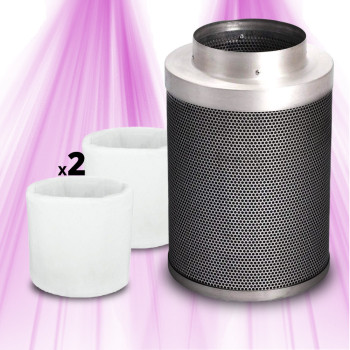
Here's the number-one mistake I keep seeing, doing the sizing with the airflow quoted on the spec sheet, then adding a carbon filter in series without revisiting the calculation. A carbon filter adds resistance to the air passing through, what's called a pressure loss, and not every fan motor is built to handle it.
The PROFAN 125mm inline duct fan - Garden HighPro - 190 m3/h is a black-and-white example of this trap: its spec sheet clearly states "optimised for carbon filter: no". The 190 m³/h airflow quoted is a bare-ducting figure, it no longer holds once a filter is fitted behind it, unlike the Prima Klima models in the selection, which are designed for that arrangement.
What this changes in practice for the calculation is that a fan not designed for a filter sees its real airflow drop sharply the moment you add the resistance of the activated carbon. The figure from your starting calculation no longer matches what actually comes out of the ducting, and that's where a lot of cultures end up under-ventilated without understanding why.
- Check the carbon filter mention, it's stated explicitly on the product sheet, yes or no.
- Never calculate on the bare-ducting airflow, if a filter is planned from the start or later on.
- Prefer a model marked as compatible, when the carbon filter is part of the project.
6The ducting diameter trap that doesn't tell the whole story
The second classic mistake, relying on the connection diameter to estimate a fan's airflow. The diameter only tells you which ducting the unit connects to, it says absolutely nothing about the real airflow the motor pushes inside.
The clearest proof in the selection is the QuietLINE silent extractor fan Ø125mm 197m3/h - WINFLEX compared with the TT MAX seen earlier. Same diameter, 125mm, but an airflow capped at 197 m³/h versus 220-280 m³/h for the TT MAX. Two fans of identical diameter, two different airflows.
What the QuietLINE reveals by contrast is a genuine design trade-off: its 13W power draw and its documented noise level between 29 and 32dB explain its more modest airflow. It's a coherent choice when quiet operation matters more than maximum airflow, but it stays a choice, not an inevitability of the 125mm diameter.
The consequence for the calculation is that you should always base it on the m³/h figure from the product sheet, never on the diameter quoted in the title. Two units of the same diameter can meet two completely different sizing needs.
🌱 Joseph's tip
When I compare two extractor fans, I note the m³/h first, and only then the diameter. The diameter is only there to check compatibility with the ducting and the filter already in place, not to estimate ventilation capacity.
7The diameter reduction trap at the connection point
The third mistake, and not the least of them: a perfectly sized extractor fan can lose a good part of its real airflow at the connection point, if the ducting diameter doesn't exactly match the unit's.
The Plastic ventilation reducer - Ø 150 / 125mm makes this trap very concrete: it's a transition piece that lets you connect a Ø150mm fan to Ø125mm ducting, or the other way around. Without this piece, or with an improvised join, the abrupt jump from one diameter to another creates a pressure loss at the connection point.
The mechanism is simple to understand, the air speeds up locally as it passes through the reduced section, which increases the noise and the resistance, and drops the real airflow available at the duct outlet below the figure calculated at the start. A fan chosen right on the calculation can end up underperforming solely because of a poor connection.
The good practice is to use a dedicated reducer, with a gradual transition, rather than forcing ducting onto a diameter it wasn't meant for. It's a detail of a few centimetres that can make the difference between the airflow calculated on paper and the airflow actually available in the tent.
- Check the diameter compatibility, between the fan, the filter and the ducting, before buying.
- Use a dedicated reducer, rather than an improvised or forced connection.
- Remember that a good calculation badly connected, never delivers the airflow quoted on the spec sheet.
Need a hand finalising your calculation
Whether you're starting from a mini-tent with the PROFAN 100mm inline duct fan - Garden HighPro - 107 m3/h or a large volume with the Prima Klima extractor fan Ø150mm – 760m³/h – 2-speed, you'll find the full extraction range and the connection accessories on the growshop.
Visit the growshop →Sizing an extractor fan properly is never a single figure lifted from a product sheet. It's a volume calculation, a correct reading of the airflow range, and above all a check on everything that nibbles away at that airflow once the unit is fitted: the carbon filter, the length of ducting, and the connection at the right diameter. I always prefer to take a bit of headroom and modulate with a regulator rather than buy exactly the calculated value, because in the field it's always the real airflow that counts, not the one on the spec sheet.