













































































The light-dependent phase of photosynthesis is the mechanism directly driven by your lighting. It's in the chloroplast's thylakoids that photons captured by chlorophyll are converted into ATP and NADPH — the chemical energy that fuels all your plants' growth in indoor growing. Understanding these steps lets you choose the right LED spectrum to maximize this natural process and your yields.
We're going to explore the steps of the light-dependent phase of photosynthesis from a grower's perspective: which wavelengths to activate during the vegetative stage, which ones during flowering, and how a full-spectrum LED grow light optimizes each of these photochemical reactions.
How do pigments capture light during photosynthesis?
Picture millions of tiny antennas on the surface of leaves, ready to capture every photon of light. This is the essential role of the photosynthetic pigments, which convert this light into energy to power the plant's machinery. Without this crucial light-absorption step, plant life would simply be impossible.

Structure and role of LHCII light-harvesting antennas
LHCII light-harvesting antennas are remarkable biological systems, each grouping together about 300 molecules of chlorophyll. They act like a huge net capable of trapping hundreds of photons every second. This clever mechanism considerably increases the surface area for light absorption without the leaf needing to grow physically.
These structures let plants capture even the smallest amount of available light in their environment. Like microscopic solar panels, they gradually channel light energy toward the essential reaction centers. To fully understand this process, it helps to study the light-dependent phase of photosynthesis, which converts this raw energy.
- Increased absorption surface area: Thanks to the roughly 300 molecules of chlorophyll per antenna, capture capacity is massively increased without changing the plant's shape.
- Ultra-fast energy transfer: Energy travels from the pigment on the periphery to the reaction center in the tiny span of 10⁻¹⁵ seconds.
- Increased efficiency: Thanks to these antennas, a cell can absorb hundreds of photons per second to optimize its energy production.
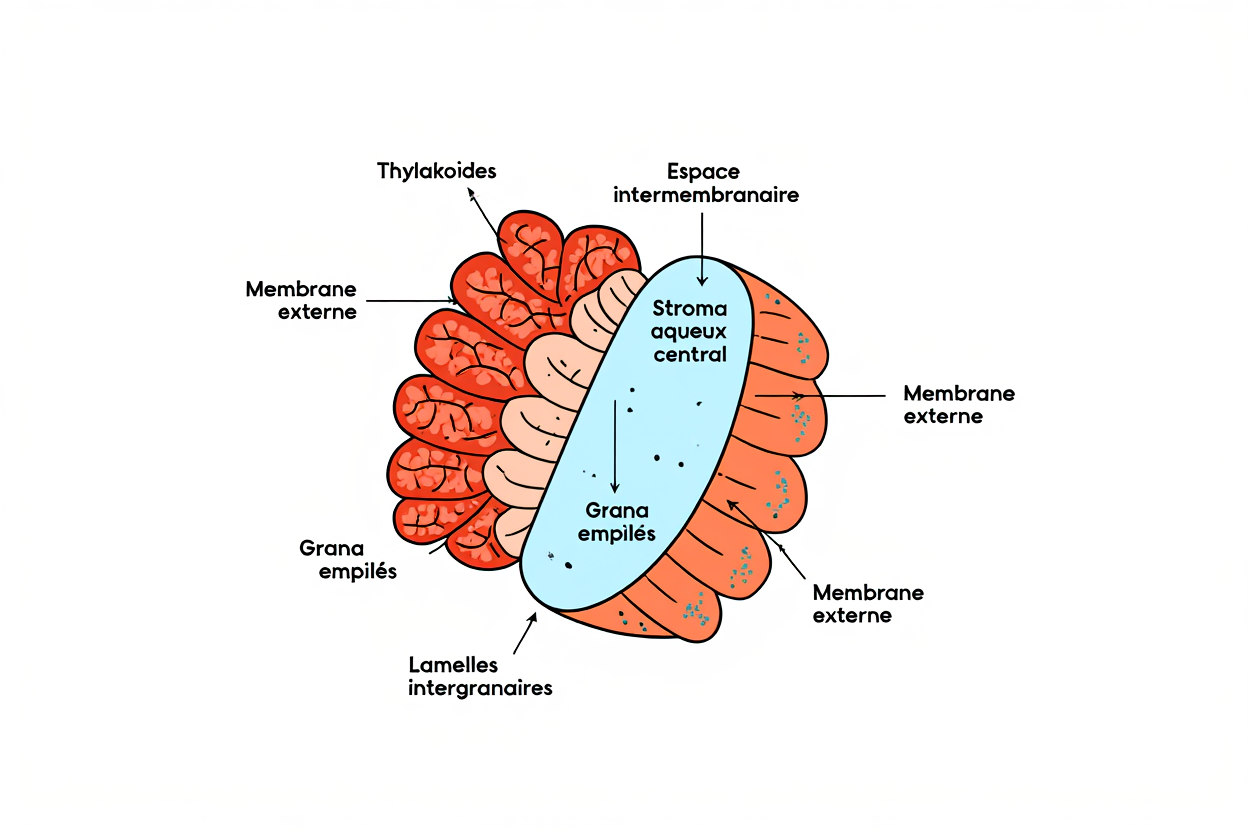
If you look at a spinach leaf under a microscope, the chloroplasts often reveal a very characteristic red-orange fluorescence. This glow comes directly from the thylakoids, where the active photosystems are located. It's visual proof that intense light absorption is underway.
Absorption spectra of chlorophylls and carotenoids
The secret to plant efficiency lies in diversity: each pigment targets a specific part of the light spectrum! light absorptionLight absorption varies greatly depending on whether it's chlorophyll or other compounds. Chlorophylls a and b favor the blue and red areas of the spectrum, while carotenoids capture green light.
Why such diversity in nature? It's a vital strategy to exploit almost every available wavelength. Besides capturing green energy, carotenoids protect the plant against excess light that could damage the precious machinery of photosynthesis.
In cyanobacteria, this strategy goes even further thanks to phycobilins, which capture green and yellow hues. This system complements the action of other photosynthetic pigments so that nothing goes to waste. It considerably widens the usable light spectrum, even in challenging environments.
Energy transfer to the reaction centers
Once light is captured, the energy must reach the P680 and P700 reaction centers. This transfer is like a smooth cascade, passing from one molecule to the next in a fraction of a second. Upon arrival at the photosystem, an electron is excited by energy from water, which triggers the rest of the reactions.
Water photolysis and oxygen release at PSII
This is where the real show begins with water photolysis. Although this reaction may seem simple, it forms the foundation of nearly all life on Earth. Without it, our atmosphere would lack oxygen, plants would have no chemical fuel, and we simply wouldn't exist.

How the P680 reaction center of photosystem II works
Photosystem II (PSII) contains a unique reaction center called P680, made up of a pair of chlorophyll a molecules. These specialized pigments capture light, specifically around 680 nanometers, to trigger the reaction. To optimize this crucial process, choosing the right LED grow lighting for photosynthesis is essential to provide the light energy needed for the conversion.
When a photon hits P680, an electron gains considerable energy and is literally ejected from the molecule. This pivotal step creates an electronic gap that must be filled, kicking off the entire biochemical cascade of photosynthesis.
- Light absorption at 680 nm: P680 captures red photons and transfers this energy to an electron that escapes toward the transport chain.
- Excited state P680*: After being excited, P680 becomes a very powerful oxidant and immediately seeks a new electron to regain stability.
- Initial electron transfer: The released electron begins its journey via the electron carriers, gradually releasing its excess energy.
But how does P680 replace this lost electron? The answer lies in the involvement of water, a groundbreaking mechanism essential to understanding photosynthesis.
Mechanism of water splitting by the OEC complex
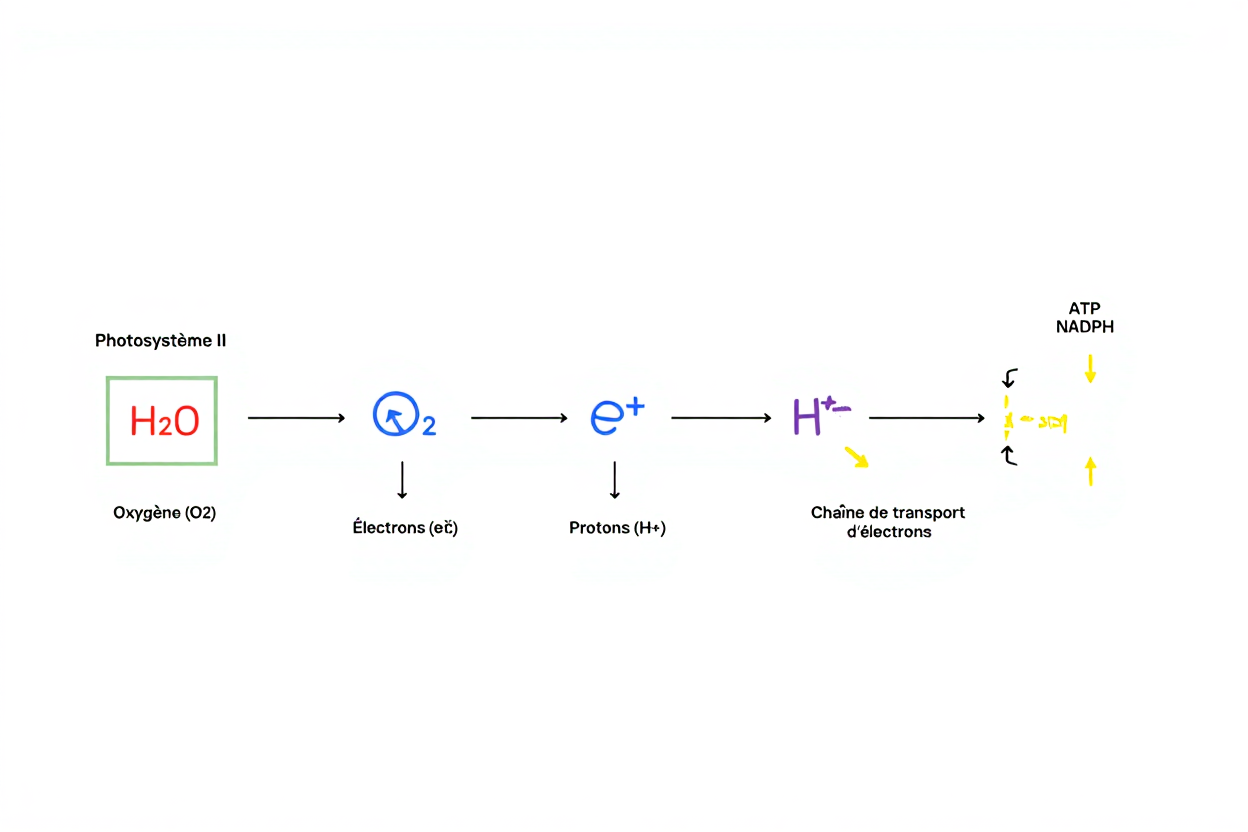
The oxygen-evolving complex (OEC), located on photosystem II, is a fascinating molecular machine. It catalyzes the reaction that converts two water molecules into molecular oxygen, four protons and four electrons. Water is literally split to supply the electrons P680 needs, keeping up a constant flow.
This phenomenon can even be observed, as shown by the oxygen bubbles released by a submerged Elodea leaf. This visible release is direct proof of photolysis activity at PSII. What's more, oxygen production begins almost instantly under red light, highlighting the incredible speed of this reaction.
The protons (H⁺) from water photolysis then build up in the thylakoid lumen. This concentration quickly creates a significant proton gradient relative to the surrounding stroma. This difference in potential turns the whole system into a powerful chemical battery, ready to fuel ATP production.
Electron transport and proton gradient formation
The electrons released during photolysis of water don't stay idle. They begin a complex journey through various carriers. This electron transport is essential for converting light energy into a usable proton gradient. At every stage of the process, protons are actively pumped, storing up precious chemical energy.

Path of electrons from plastoquinone to PSI
Once ejected from photosystem P680, the excited electron is first captured by pheophytin before reaching plastoquinone (PQ). This carrier has the unique feature of transporting both electrons and protons across the membrane. It moves through the thylakoids to transfer its charge to the cytochrome b6f complex, acting like a true molecular pump.
This transfer requires energy: at each step, part of the electron's energy is gradually released. This energy is used to pump more protons, reinforcing the proton gradient needed for ATP synthase to function. Nature shows all its efficiency here, turning every movement into a useful resource for the plant.
| Carrier molecule | Main role | Location |
| Plastoquinone (PQ) | Electron and proton transport | Thylakoid membrane |
| Cytochrome b6f complex | Proton pumping and electron transfer | Embedded in the thylakoid membrane |
| Plastocyanin (PC) | Final transfer to PSI | Thylakoid lumen |
Role of cytochrome b6f in proton pumping
The cytochrome b6f complex plays a central role by actively pumping protons from the stroma into the lumen. For every pair of electrons that pass through it, it adds about two additional protons into the thylakoid lumen. This mechanism ensures a continuous buildup of potential energy, essential to photosynthesis.
This phenomenon can be compared to a hydraulic pump that raises water to build up strong pressure. This accumulated tension, called the proton-motive force, becomes the fuel needed to activate ATP synthase. Next, plastocyanin takes over to carry the electrons toward photosystem photosystem I, completing this stage of the circuit.
Establishing the transmembrane electrochemical gradient
Under intense LED lighting, the proton gradient in a tomato leaf intensifies very quickly. Within a few minutes, the difference in protons concentration between the lumen and the stroma becomes considerable, multiplying acidity by 10,000. This imbalance literally converts the thylakoid into a powerful, fully-charged biological battery.
This buildup also generates an electric charge, making the lumen positively charged relative to the negative stroma. This difference in potential pushes protons through ATP synthase to produce ATP. Like water held back by a dam, this stored energy is just waiting to be released in force.
ATP and NADPH production for the Calvin cycle
We now reach the decisive step of the process: converting the accumulated energy into ATP and NADPH molecules. These two compounds act as the true « energy currency » essential to the Calvin cycle, enabling carbon fixation. Thanks to them, the plant manages to convert carbon dioxide into sugars essential to its development.
NADP⁺ reduction at photosystem I
The photosystem I (PSI) picks up the electrons transferred from the cytochrome b6f complex via plastocyanin. Its reaction center, P700, reactivates them by absorbing light energy. These electrons thus regain their energy potential and are carried to ferredoxin.
The enzyme ferredoxin-NADP⁺ reductase (FNR) then uses these electrons to reduce NADP⁺ to NADPH. The reaction is written: NADP⁺ + 2 e⁻ + H⁺ → NADPH.
- Absorption at 700 nm by P700: PSI specifically captures near-infrared photons to re-excite the electrons.
- Transfer via ferredoxin: This protein carries the energized electrons to the reducing enzyme.
- NADPH production: This step is crucial: it generates NADPH, the main electron donor for the reduction.
NADPH is a concentrated form of chemical electricity, directly usable to reduce other compounds. It powers the biosynthesis reactions taking place in the stroma during the Calvin cycle. About eight photons are needed to reduce one NADP⁺ molecule, reflecting remarkable efficiency.
How ATP synthase and photophosphorylation work
The ATP synthase is one of evolution's most sophisticated molecular machines. Installed in the thylakoid membrane, it functions like a micro-turbine. When the accumulated protons pass through it, they drive a rotary mechanism that produces chemical energy.
. This motion drives the phosphorylation of ADP into ATP, a process called photophosphorylation. All the energy the plant uses for its growth comes from this extraordinary mechanism.
- Rapid ATP production: A single ATP synthase can produce up to a hundred ATP molecules per second.
- Energy ratio: The passage of one electron pair typically produces about three ATP molecules.
- Proton efficiency: Forming one ATP molecule requires the passage of about three to four protons.
- Cyclic photophosphorylation: Sometimes PSI operates in a closed loop to increase the proton gradient without producing NADPH, finely adjusting resources.
Under standard lighting, a soybean leaf produces on average five nanomoles of ATP per minute per milligram of chlorophyll. Although this figure may seem modest, it becomes considerable across all active thylakoids, giving the plant impressive energy power.
Energy balance and use in the Calvin cycle
To fix one molecule of carbon dioxide, the plant needs three ATP and two NADPH. Fortunately, the light-dependent phase produces these resources in perfectly matched proportions. This overall process requires the absorption of eight photons, split between the two photosystems.
ATP provides the energy needed for the phosphorylation of RuBP and its regeneration. NADPH, for its part, supplies the electrons essential for reducing carbon intermediates into sugars. These carriers migrate to the stroma and are immediately consumed for organic synthesis.
Under optimal light conditions, a plant can generate significant amounts of ATP and NADPH per square centimeter. This data directly reflects the efficiency of carbon fixation and crop productivity. Ultimately, this mechanism converts light energy into chemical energy, using water and light to sustain life.
Which LED spectrum should you choose to optimize the light-dependent phase of your crops?
The light-dependent phase specifically uses wavelengths between 400 and 700 nm (PAR). For it to be maximally effective in your indoor growing, your LED grow light needs to cover both photosystems:
- 430-450 nm (blue): activates Photosystem II (P680), triggering water photolysis and the release of free oxygen.
- 650-680 nm (red): activates Photosystem I (P700), producing the NADPH needed for the Calvin cycle.
- Full spectrum: maximizes absorption by carotenoids and LHCII light-harvesting antennas for an optimal DLI.
The SpectraWILD LED bars from BloomLED are designed to reproduce a balanced solar spectrum, simultaneously activating photosystems I and II for an ultra-efficient light-dependent phase. Check out our guide to choosing LED grow lights to find the model suited to your grow space.