









































































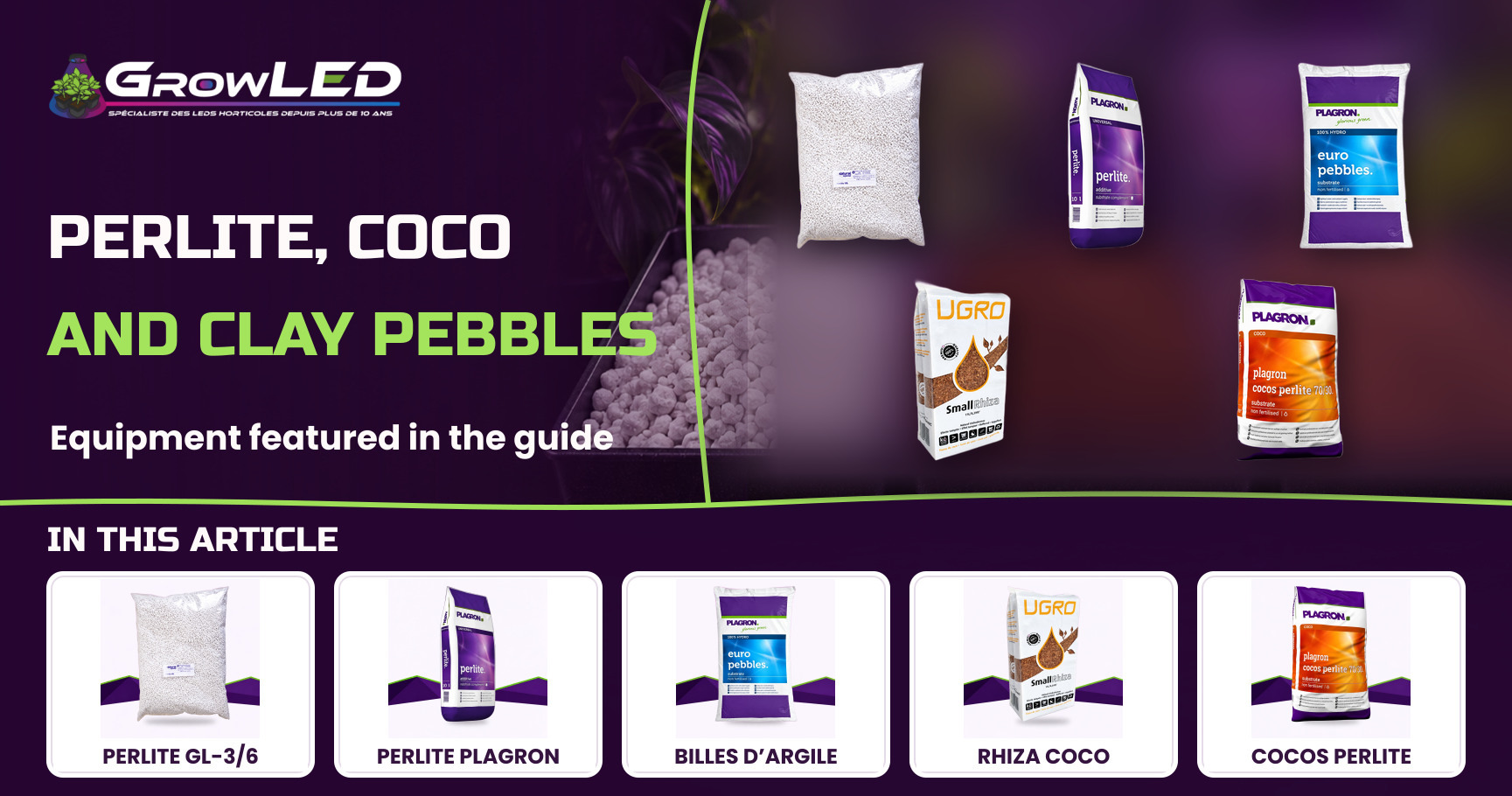
A growing medium that breathes gives you a root system that asks for nothing more than to thrive. Perlite, coco, clay pebbles: I'll show you how and why blending these three amendments makes a real, tangible difference to how your plants behave, from the very first watering right through to harvest.
1Why structuring your medium changes everything
A medium that packs down means a plant that suffocates. Out in the field, nine root problems out of ten that I come across don't stem from a lack of fertiliser but from a poorly thought-out soil structure: too compact, too retentive, or on the contrary too free-draining with no retention at all. The physical structure of the medium is the balance between air-filled pores and water-filled pores. Without that balance, even the best fertiliser in the world will never reach the roots properly.
Porosity is the variable that few growers really look at. Fresh compost always feels loose when you buy it, but over successive waterings the fine particles of peat or compost rearrange themselves and close up the air spaces. The result: the fine roots, the ones that actually absorb water and nutrients, run short of oxygen and stop developing. This is where structuring amendments come in: perlite, coco and clay pebbles don't feed the plant, they give it room to breathe.
Even professional composts already build in this logic. The BIOBIZZ Light-Mix 20L Compost, our most popular choice at the growshop, states in black and white that it offers optimised drainage thanks to the perlite already worked into its formula. This isn't a marketing detail: it's proof that a well-established manufacturer treats perlite as a basic ingredient, not as an option reserved for experts. If Light-Mix already contains it, then no compost, however ready to use, is ever entirely self-sufficient over the full length of a grow.
- A compost that packs down holds excess water around the roots, which encourages root rot and pythium-type fungi.
- A medium that drains too fast dries out too quickly and forces you to water more often, with the risk of washing out nutrients before they can be taken up.
- A poor air/water balance slows growth with no immediately visible symptom, which makes diagnosis difficult for a beginner grower.
- A fresh medium is not a permanent medium: its structure changes with every watering, which is exactly why durable amendments that resist compaction over time are so valuable.

2Perlite: aeration and drainage
Perlite is volcanic rock heated until it pops like popcorn. That expansion creates a mass of tiny cavities that make each grain both very light and rigid. Unlike a sponge, perlite doesn't compress under the weight of the medium: it mechanically maintains permanent air spaces, even after months of watering. That's what makes it the go-to amendment against compaction.
Dosage makes all the difference, and the growshop's two perlites aren't positioned the same way. The Perlite GL-3/6 lists a recommended dose of 30% of the volume to achieve good drainage and good aeration, with a 3/6mm grain size that's explicitly compatible with coco fibre and soil. That's the benchmark I give growers who want a simple rule that works every time. The Plagron Perlite, for its part, offers a wider range, from 10 to 35% of the total volume, with an almost nil electrical conductivity (0.0 to 0.1 mS/cm). That near-zero EC is no small detail: with drip feeding or recirculation, a salt-neutral amendment stops your nutrient solution from being gradually thrown off over successive watering cycles.
- For a first, no-fuss blend, go for 30% perlite as the GL-3/6 datasheet indicates: it's a proven ratio that aerates without going overboard.
- For a recirculating system, favour the lower end of the Plagron range (around 10 to 15%) so as to keep enough retention while benefiting from its near-nil EC.
- For an already heavy medium (clay soil, old recycled compost), move towards the top of the range, up to 35%, to give the structure back.
- The GL-3/6 is explicitly compatible with coco fibre and soil, which makes it a safe choice if you're not yet sure what base you'll build your blend on.
🌱 Joseph's tip
Always dampen your perlite before mixing it in. When dry, it rises to the surface at the first watering and ends up floating instead of staying spread through the medium. A quick run under water before you incorporate it is enough to settle it durably into the blend.
3Clay pebbles: drainage and root oxygenation
Clay pebbles play a different role from perlite: they create large air gaps, not small pockets. Fired at high temperature until they swell into round pebbles, they stack up leaving wide spaces between them. Placed as a layer at the bottom of the pot, they stop water from sitting against the roots and force the excess to drain away, while letting air circulate up through the base of the root system.
The format that comes up most often in our orders is the Euro Pebbles Clay Pebbles in a 10-litre bag from Plagron. Their 8 to 16mm grain size is noticeably larger than that of perlite (3/6mm), which confirms their use: they don't replace perlite within the body of the medium, they complement it as a bottom layer or as support for passive hydroponic systems. Their EC of 0.5 to 0.8 mS/cm is higher than that of the two perlites, which explains why a rinse before first use remains essential: this removes the clay dust and the mineral manufacturing residues that would otherwise slightly skew your starting EC.
In a passive hydroponic system, clay pebbles aren't just an additive, they make up the entire medium. Packed into a net pot, they support the plant while letting water and air move freely around the roots, a principle applied on a smaller scale when you use them as a drainage layer in a conventional pot filled with compost or coco.
It's an amendment you get value from across several grows. Unlike compost, which you renew each cycle, clay pebbles rinse off and get reused: a good soak followed by a rinse in clean water is enough to remove the salt deposits built up between two grows.
🌱 Joseph's tip
Never skip rinsing fresh clay pebbles. Even straight out of the bag, they carry a fine clay dust that clouds the water and can slightly push up the EC of your first watering. Two or three rinses in clean water before potting up, and you start on a clean footing.
4Coco fibre: structure and retention
Coco does the opposite of perlite: it holds water while keeping air. Its fibrous structure, made of filaments of varying sizes, creates a network of capillaries that captures moisture without compacting the way pure soil would. It's this dual ability, to retain and aerate at the same time, that makes it a structural medium in its own right and not merely a supplementary amendment.
The format that clearly dominates our sales in this segment is the Small Rhiza Coco Block 11L. Compressed for transport, this brick rehydrates and swells on contact with water until it reveals its true fibrous texture. Its datasheet lists a water retention of 910%, a figure that shows just how big the gap with perlite is: where perlite holds almost nothing, coco stores several times its own volume in water. Its pH of 5.5 to 6.5 matches the classic range sought for most grows, which makes it a healthy base before any adjustment.
One technical point is worth knowing before using raw coco. Naturally rich in potassium and poor in available calcium and magnesium, coco fibre tends to lock up these elements in the nutrient solution before the plant can absorb them. It's a phenomenon familiar to any grower used to this medium, and it's also what explains the appeal of the ready-made blends I go into just after.
Used on its own, coco does still have a limitation: it ends up packing down over a long cycle. Its finest fibres migrate downwards with repeated watering and gradually close off the air spaces it offered at the start. That's precisely the problem perlite comes in to fix when you pair the two together.
5Going further: ready-to-use blends
Reproducing a good coco/perlite ratio yourself takes discipline; a ready-to-use blend hands it to you straight away. The Plagron Cocos Perlite 70/30 lists an exact composition of 70% coco fibre to 30% expanded perlite. That's precisely the ratio I recommend when I'm asked for a reliable starting point: enough coco to hold water and nutrients, enough perlite to prevent compaction over time.
The pH buffered between 5.8 and 7.7 makes a real difference to your day-to-day management. A buffered medium copes better with the small variations in your watering water without the pH drifting sharply from one watering to the next. Its compatibility with recirculating systems also confirms what I was explaining about the EC of perlites: this blend was designed for growers who reuse their nutrient solution and can't afford a medium that releases salts unpredictably.
Even if you prefer to put together your own blend, keep this 70/30 as a reference. It's an excellent point of comparison: if your homemade blend starts out with very different proportions, 50/50 for example, expect noticeably more free-draining behaviour and more frequent watering.
6A word of caution: vermiculite vs perlite, don't mix them up
It's the most common confusion I put right in the shop: vermiculite and perlite look alike, but they do the opposite of one another. Visually, both are small pale granules that are easy to confuse at first glance. Functionally, though, they're opposites: perlite drains and aerates, vermiculite holds water.
The difference comes down to the raw material itself. Perlite is an expanded volcanic glass, rigid and non-compressible. Vermiculite is an expanded mica, which unfolds into fine layers able to absorb water between each leaf, a bit like an accordion soaking up liquid. It's this layered architecture, the opposite of perlite's rigid cavities, that explains why the two minerals, often sold side by side, play diametrically opposed roles.
The Vermiculite 10L is indeed billed for high water retention, with a recommended dose of one third vermiculite to two thirds compost. That's a legitimate role, but one that has nothing to do with perlite's. If you're trying to correct a medium that's too compact or too retentive, vermiculite won't fix anything; it may even make an already existing excess of moisture worse.
Save vermiculite for situations where retention is the priority, never during flowering on an already damp medium. Added by mistake in place of perlite in an already heavy blend, it prolongs water stagnation around the roots at exactly the moment you were trying to avoid it. Keep the two clearly identified in your workspace; grabbing the wrong bag is more common than you'd think.
7Dosage guidelines and mistakes to avoid
Here's the table I keep in mind when I advise on a blend, with the data exactly as it appears on each product datasheet. It sums up what to take away from each amendment before putting together your own medium.
| Amendment | Main function | Grain size / dose | EC data | Reusable |
|---|---|---|---|---|
| Perlite GL-3/6 | Aeration and drainage | 3/6mm, 30% of volume | Not specified | Yes |
| Plagron Perlite | Aeration and drainage | 10 to 35% of total volume | 0.0 to 0.1 mS/cm | Yes |
| Euro Pebbles clay pebbles | Drainage and oxygenation | 8-16mm | 0.5 to 0.8 mS/cm | Yes, after rinsing |
| Small Rhiza Coco 11L | Structure and retention | Water retention 910%, pH 5.5-6.5 | Not specified | No (organic material) |
| Vermiculite 10L | Water retention (counter-example) | 1/3 with 2/3 compost | Not specified | Not recommended |
- Doubling up on draining amendments without cutting back on watering is the most common mistake: the more you aerate, the more often you'll need to water, otherwise the plant dries out between sessions.
- Ignoring an amendment's EC in a recirculating system ends up unbalancing your nutrient solution over several weeks, which is why it pays to favour near-nil EC options like the Plagron Perlite in this particular context.
- Skipping the rinse for clay pebbles or any fresh mineral amendment means starting your grow with a skewed base EC from the very first watering.
- Confusing vermiculite and perlite in the bag or on the label remains the most costly mistake for a medium already in the flowering phase.
- Putting together a blend without factoring in the watering system (by hand, drip, recirculation) amounts to ignoring half the problem: the same medium doesn't behave identically depending on the frequency and method of irrigation.
Build your own tailored growing medium
Keen to fix the structure of your compost from your very next grow? Whether you start from the BIOBIZZ Light-Mix 20L Compost or from an already balanced blend like the Plagron Cocos Perlite 70/30, find the full range of amendments and media on the growshop.
See the growshop →After years of putting right drowned roots or plants that stall for no obvious reason, I remain convinced of one thing. A good fertiliser never makes up for poor drainage. Take the time to choose your amendments according to your watering system, not just your budget: you'll gain far more in consistent harvests than with any miracle additive.