01 — Description
Présentation du produit
What is the QB288 V2 RSPEC Quantum Board?
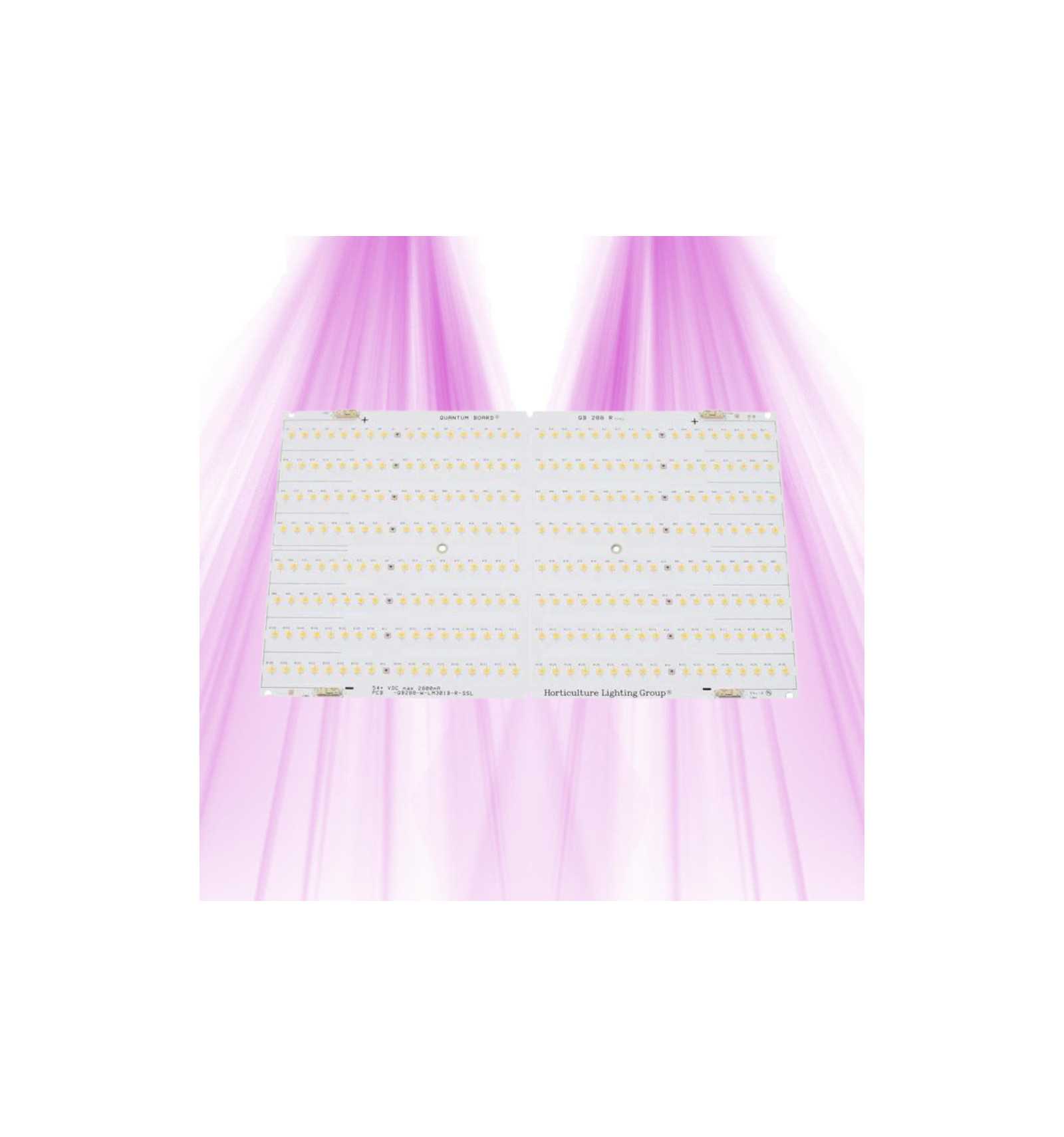
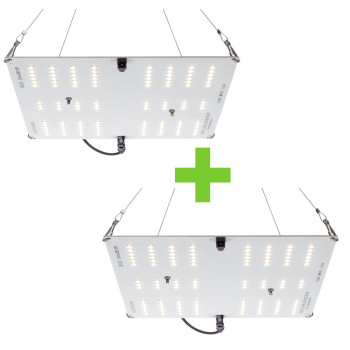
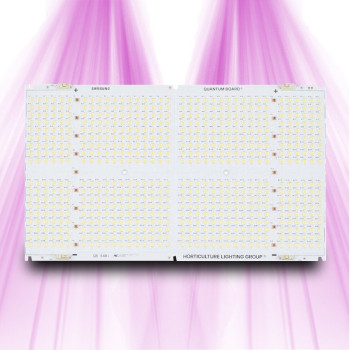
QB 288 V2 Rspec® are high quality indoor growing cards, manufactured in the USA by Horticulture Lighting Group , a company recognized in the industry for designing high-end LED lighting solutions for plants. Each board has 272 highest flux, lowest voltage LM301B full spectrum LEDs. 16 Deep Red 660nm LEDs improve spectrum and unbeatable performance.
What are the advantages of this product?
The QB288 V2 RSPEC offers many benefits for indoor growers, including:
- High power: with low energy consumption, it produces very powerful light intensity.
- Wide coverage: the LED card offers optimal light coverage.
- Quantum Board design for even light distribution across the entire growing surface
- High-efficiency Samsung LM301B LED chips and 660 nm red LED chips for a full light spectrum suitable for all phases of plant growth
- Average lifespan of 50,000 hours for a durable and profitable investment
Features
- 272pcs Samsung LM301B Superior Diodes, 16 Osram SSL Deep Red
- Connectors rated 240V
- Dimensions 17 x 27 cm
- Max current per card 3000mA @ 54VDC
- 1 year warranty
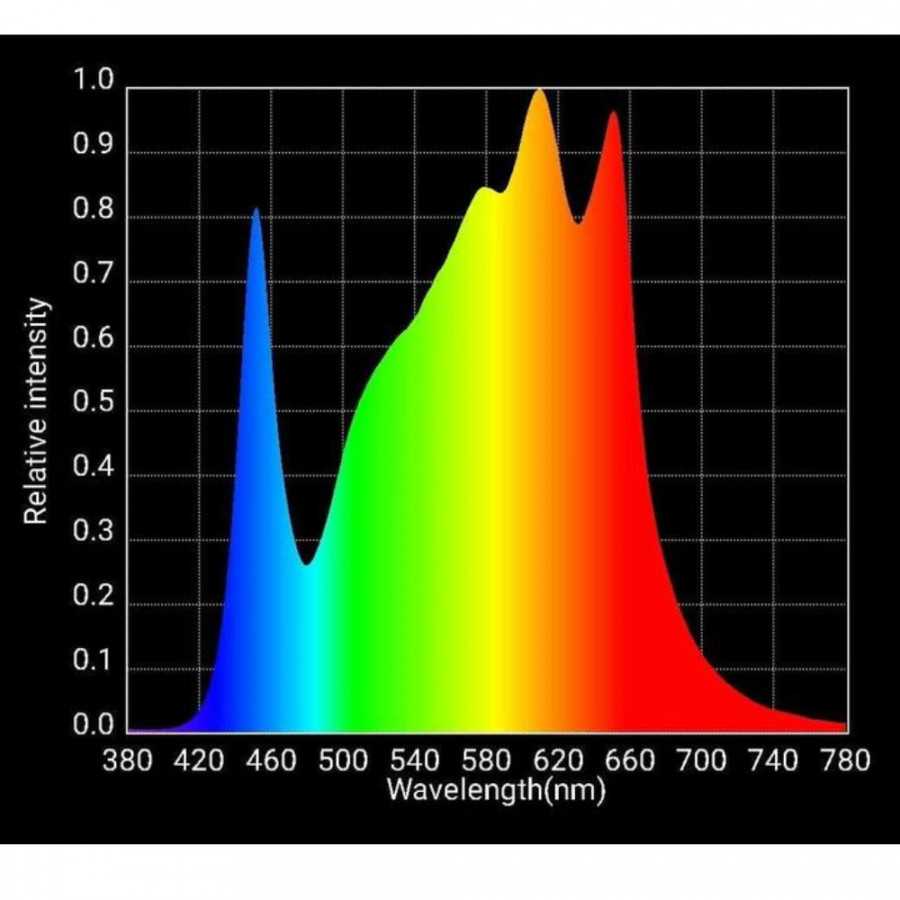
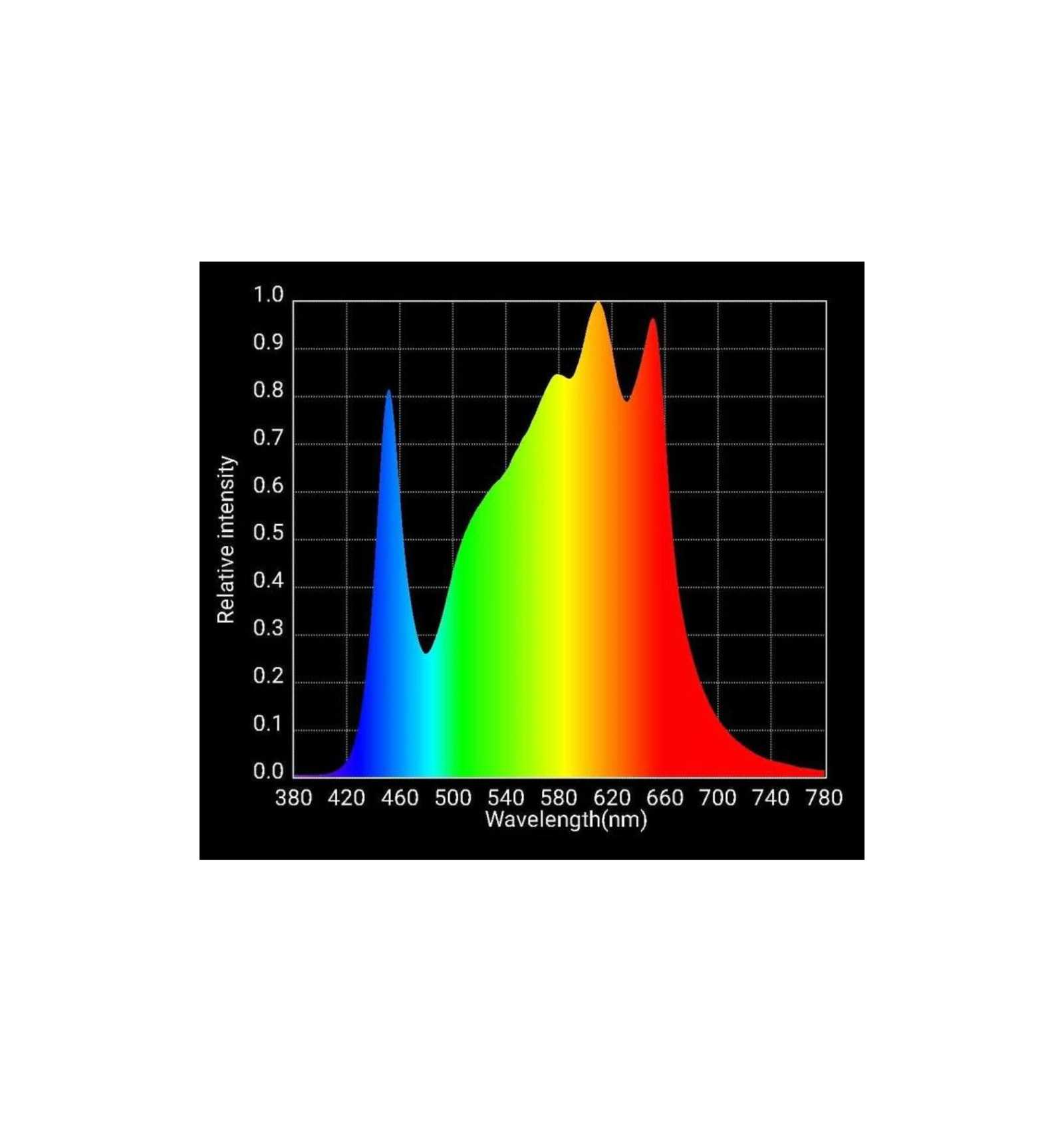
Spectrum
- Samsung LM301B 4000K Top Bin Diodes, Deep Red 660nm
- CCT 3150-3250
- CRI (Ra) 90
Requires aluminum plate or heatsink if operating over 55 watts or over 1050mA
The QB288 V2 Rspec offers a spectrum including wavelengths ranging from 400 to 700 nm. This means plants receive all the colors of light they need for optimal growth.
Advanced Features
Versatile use
It can be used for a wide variety of plants including vegetables, fruits, herbs and flowers. Growers can also use it for seed propagation or growing cuttings.
Quantum Board Design
The Quantum Board design of the QB288 V2 Rspec allows for even light distribution across the entire growing area. This means that each plant receives the same amount of light, which promotes uniform growth and a consistent harvest.
Samsung LM301B LED chips
The Rspec QB288 V2 is equipped with Samsung LM301B high-efficiency LED chips, which provide a luminous efficiency of 2.7 µmol/J. This means that each watt of power consumed by the card produces 2.7 µmol of photons.
660nm red LED chips
In addition to high-performance white LED chips, QB288 V2 Rspec is also equipped with 660nm red LED chips. These red LEDs are essential for flowering plants, as they stimulate flower and fruit production.
Warning: not suitable for a beginner grower
04 — Questions sur ce produit
Product questions
Your questions about this product
- Question about the QB288 V2 RSPEC Quantum Board: To optimize a rotation of 2 crops in parallel, is it recommended to use a specific heat sink with this model when operating at its maximum power of 54V and 3000mA, in order to ensure optimal lifespan and consistent light performance?

For using the QB288 V2 RSPEC at its maximum power (54V and 3000mA) in a rotation of 2 crops in parallel, it is essential to use a suitable heat sink. At this level of current and power, heat dissipation becomes crucial to maintain stable light performance and prolong the lifespan of the Samsung LM301H/B LEDs.
The QB288 V2 RSPEC far exceeds the threshold where passive cooling is sufficient (beyond 55W or 1050mA), hence the importance of a heat sink or an optimized aluminum plate. This solution ensures optimal operating temperature without requiring thermal paste between the board and the heat sink, thus facilitating installation.
In summary, to ensure constant light and longevity of your lighting in this demanding configuration, a specific heat sink is not only recommended but essential.
- What difference in results will I see between an installation with a single QB288 V2 Rspec and two cards in parallel for a surface area of 1m2 in hydroponics?
For a surface area of 1 m² in hydroponics, a single QB288 V2 Rspec panel provides about 150W and a light intensity suitable for moderate crops, sufficient for some leafy plants or less demanding vegetables.
By doubling with a second identical panel, you double the light output (~300W) and significantly improve the PPFD, which stimulates photosynthesis, accelerates growth, and can greatly increase the yield of light-demanding plants.
Technically, it is recommended to wire the two panels in series for better electrical and thermal management. It will also be necessary to provide enhanced thermal dissipation, as the thermal load will be higher.
In summary, a single QB288 is suitable for light cultivation, while two panels will optimize production over 1 m² of hydroponics due to more intense and homogeneous lighting.

- What thermal management do you recommend to maintain the optimal performance of the QB288 V2 RSpec board in indoor cultivation without reducing its lifespan?
To preserve the optimal performance of the QB288 V2 RSpec board in indoor cultivation and extend its lifespan, it is essential to master its thermal dissipation. We strongly recommend mounting the board on an aluminum plate or an appropriate heatsink once the power exceeds approximately 55 watts or a current of 1050 mA.
This solution effectively dissipates the heat generated by the Samsung LM301B/H and Osram SSL 660nm Deep Red LEDs, without the need to apply thermal paste, thus simplifying the assembly. Furthermore, it is crucial not to exceed the recommended maximum current of 3000 mA at 54 V DC, in order to avoid excessive thermal rise and premature aging of the components.
This thermal management ensures stable brightness, remarkable energy efficiency, and an extended lifespan of your horticultural lighting, which are essential for successful LED cultivation.
- What is the exact electrical consumption of QB288 V2 RSPEC at 3000mA@54VDC in realistic umol per watt?
The QB288 V2 RSPEC operates at approximately 162 W when driven at 3000 mA under 54 VDC (54 V × 3 A). Its realistic photon output is around 4.8 to 4.9 µmol/J, a remarkable performance for a high-end horticultural LED panel. This means that every watt consumed is converted into a very efficient amount of photons useful for plant growth.
- What is the practical difference in terms of growth and yield between using a single QB288 V2 RSpec and using multiple ones on a medium-sized hydroponic crop?
Using a single
QB288 V2 RSpec is ideal for a small hydroponic culture, providing a power of around 150W and good light uniformity over 1 m². This is suitable for low-demand plants, with moderate growth and limited yield.
Combining multiple panels significantly increases light power, extends coverage, and ensures better light penetration. This configuration promotes faster, more uniform growth and superior yield, particularly for more demanding crops or during flowering phases thanks to the Osram 660 nm red LEDs.
However, multiplying the panels requires more rigorous thermal management, necessitating the use of heatsinks or aluminum plates to avoid overheating and preserve the durability of the equipment.
In summary, multiple QB288 V2 RSpec provide a real performance boost for a medium hydroponic crop, at the cost of a reinforced thermal installation.
- Can the QB288 V2 RSPEC be used as a beginner's evolving kit, or do you prefer a complete configuration from the start?
The QB288 V2 RSPEC is perfectly suited for a beginner's evolving kit. Its modularity allows you to start with a single board and a suitable driver for a small area, then add identical modules as your needs grow. This offers a lighter initial investment and great flexibility.
However, if your area and power needs are already well defined, starting with a complete configuration from the beginning can save you from having to redo or complete your installation while ensuring optimal light coverage.
In summary, the QB288 V2 RSPEC adapts well to both a gradual approach and a complete solution, thanks to its design made for easy evolution, as long as the added boards remain the same version.
- QB288 V2 RSPEC luminous efficacy per watt at max power? precise electrical consumption at 3000mA? ideal covered area in m² for optimal cultivation? profitability with EDF rate at 0.22 euros/kWh? is a heat sink mandatory at max 54V 3A?
Luminous efficacy: The QB288 V2 RSPEC offers a luminous efficacy of about 2.7 µmol/J, which is excellent for LED horticultural lighting.
Electricity consumption: At 3000 mA and 54 V, it consumes about 162 W at full power.
Ideal covered area: One panel covers a moderate area, with two panels recommended for about 1 m² in optimal cultivation, especially in hydroponics.
Electrical profitability: With an EDF rate of 0.22 €/kWh, the cost is about 0.36 €/hour of operation, which remains interesting based on your cultivation yields.
Heat sink: It is highly advisable to use an efficient heat sink with this panel, especially at full power, to avoid overheating.
- Possible integration with Home Assistant home automation system for automatic management of intensity and lighting schedules QB288 V2 RSPEC?
The QB288 V2 RSPEC does not natively integrate with a connected system compatible with Home Assistant. Therefore, there is no direct control of intensity or schedules via this platform.
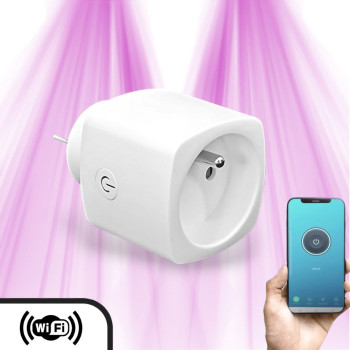
To automate your lighting, the simplest solution remains to use a Home Assistant compatible smart plug to manage turning it on and off according to your time slots.
A more advanced integration, such as intensity control driven by a microcontroller like ESP32 with ESPHome, is technically possible but requires knowledge in electronics and programming, as well as suitable hardware to interface with the LED driver.
In summary, the smart management of the QB288 V2 RSPEC with Home Assistant goes through a smart plug or custom development, with no currently available plug-and-play solution.
- What is the maximum recommended power for this quantum board before using a heat sink to prevent overheating and ensure optimal longevity of the LEDs?
For the Quantum Board QB288 V2 RSPEC, it is recommended not to exceed a power of 55W without a heat sink. Beyond this limit, an appropriate heat sink becomes essential to effectively dissipate heat, prevent overheating, and ensure optimal longevity of the Samsung LM301B LEDs. The maximum recommended current without additional cooling is 1050mA.
- What is the precise consumption of QB288 V2 RSpec 54V 3A = 162W continuously? Efficiency 2.7 umol/J confirms inter-sector yield. What is the ideally covered area for 1 QB288 in indoor cultivation 1.5x1.5m or another more profitable dimension with this LED?
The QB288 V2 RSpec indeed consumes 162W continuously (54V x 3A) with an efficiency of 2.7 µmol/J, which is excellent for horticultural LED lighting.
In terms of area, for an intense and homogeneous cultivation, a space of 1x1 meter is optimal with a single unit. This dimension ensures a uniform light distribution and is sufficiently powerful to maximize plant growth.
A coverage of 1.5x1.5 meters is feasible, but the light density will be lower, which may slow down development if your plants require a lot of light.
Finally, don't forget to optimize cooling with a good heatsink to preserve the longevity of the panel.
- How many watts does the QB288 V2 RSPEC consume under optimal operation, and what size of heat sink do you recommend to avoid overheating during continuous use?
The QB288 V2 RSPEC typically consumes between 50 and 120 watts depending on the driver setting, but for optimal and safe operation, it is recommended not to exceed 55 watts without adding a heat sink. Beyond this power, cooling is essential to prevent overheating during continuous use.
We recommend an aluminum plate at least the size of the panel (approximately 17.4 x 28.6 cm) with a thickness between 3 and 6 mm, to ensure effective heat dissipation. If you use the plate above 100 watts or in a hot environment, an active cooler with a fan may be necessary.
This precaution ensures optimal longevity of your LEDs and consistent performance.
- What is the impact on the temperature during continuous operation at 3000 mA, and is it mandatory to install a heat sink for optimal efficiency and maximum safety?
During continuous operation at 3000 mA, the QB288 V2 RSPEC generates a significant temperature rise, which can exceed 50 watts dissipated. This thermal increase is significant and can harm both the lifespan and the efficiency of the LEDs.
It is therefore almost mandatory to install a heat sink or an aluminum plate to ensure effective cooling. This helps maintain the temperature at a safe level, prevents gradual overheating, and guarantees both safety and optimal performance of the panel.
Note that no thermal paste is required; direct attachment to a flat metal surface is sufficient.
- What is the noise level of this QB288 V2 RSPEC LED panel during its operation and is it necessary to add a fan to limit heat without increasing the noise in the room?
The QB288 V2 RSPEC LED panel operates completely silently, generating no noticeable noise during use. Its design incorporates effective passive heat dissipation through an aluminum plate or heatsink, preventing overheating even at its power of 162 W.
Therefore, it is not necessary to add a fan to cool this panel; on the contrary, an active fan could introduce additional noise into your growing space. For a quiet and optimal environment, prioritize good heat management with an appropriate heatsink rather than forced ventilation.
- Is the QB288 V2 Rspec suitable for a micro grow of 60x60 cm, specifying the need for an active radiator to prevent overheating?
The QB288 V2 Rspec is perfectly suitable for a micro grow of 60x60 cm, providing sufficient light power for good plant development.
Regarding thermal management, it is essential to use a passive aluminum heat sink to prevent overheating and maintain the longevity of the LEDs. An active radiator with a fan is not mandatory but can be considered if the space is very confined or if the ambient temperature is high.
In summary, for your micro grow, a passive radiator of quality is essential, while the active system remains an option depending on your growing conditions.
- Does the QB288 V2 RSPEC require a specific heatsink to operate at full power without the risk of overheating?
The QB288 V2 RSPEC is designed for efficient direct contact with an aluminum heatsink and does not necessarily require thermal paste or a very specific heatsink. However, to operate at full power without the risk of overheating, it is strongly recommended to install this board on a suitable aluminum heatsink, especially if the consumption exceeds 50 to 55 watts.
A simple passive heatsink is generally sufficient in a well-ventilated environment. Only very high-power uses or poorly ventilated environments require active cooling. This thermal management not only ensures optimal performance but also a long lifespan for your LEDs.
- Can the QB288 V2 RSPEC board be easily integrated into an existing hydroponic system without heavy modifications regarding thermal dissipation and power supply?
The QB288 V2 RSPEC board can be simply integrated into an existing hydroponic system as long as two key points are well managed:
- Thermal dissipation: it does not require thermal paste between the board and a flat heatsink, which makes installation easier. However, beyond about 50-55 watts or 1050 mA, an effective aluminum heatsink is essential to avoid overheating.
- Power supply: the board operates at a voltage of 50-54V DC with a current up to 3A. Therefore, it is necessary to check that the current power supply delivers this voltage and current, or replace it with a compatible standard horticultural driver (such as HLG or ELG).
In summary, if your hydroponic system has or can accommodate a suitable heatsink without major work, and the power supply is compatible or replaced with a standard driver, the integration will be done without heavy modifications.
- What is the maximum power in watts I can use on this QB288 V2 RSPEC in micro-cultivation without risking overheating if I don't have a heatsink?
The QB288 V2 RSPEC can theoretically support a maximum power of 162 W, but without a heatsink, it is strongly recommended not to exceed about 50-55 watts (which is a current below 1050 mA) to avoid overheating. Beyond that, a heatsink is necessary to ensure the durability and safety of your LED panel, especially in micro-cultivation configuration where cooling is limited.
- What advice do you give me for properly installing multiple QB288 V2 RSPEC in the same room to ensure uniform light coverage without the risk of overheating or excessive consumption?
To install multiple QB288 V2 RSPEC in the same room and achieve uniform light coverage without overheating or excessive consumption, here are our tips:
Arrangement: Position the panels in a regular grid, with enough spacing to cover the entire cultivated area without creating shadowy or overly bright spots. The spacing will depend on the size of the room and the height of installation; prioritize an even distribution.
Thermal management: Each board can exceed 55W, so it is essential to use aluminum heat sinks or an effective ventilation system to avoid overheating. Do not place the boards directly against each other and ensure good air circulation to extend the lifespan of the LEDs.
Power supply: Do not exceed 3A per board and avoid wiring different versions in parallel. Prefer drivers specifically suited for QB288 for stable and secure power supply, either independent by board or a driver capable of managing the total load.
In summary, careful grid installation with active cooling and reliable power supply ensures optimal and durable lighting for your cultivation.
- what is the ideal number of qb288 v2 rspec boards to maintain uniform lighting when growing two different varieties simultaneously in an average area of 1 square meter each
To simultaneously grow two varieties in two areas of 1 m² each with uniform lighting, it is ideal to use two QB288 V2 RSPEC boards per square meter. This totals four boards in total to effectively cover your 2 m². This setup delivers a power of about 650 W, ensuring sufficient light intensity and good uniformity, especially during demanding flowering phases.
Placing two boards per area, spaced evenly, helps avoid shadow areas and ensures optimal lighting for each variety. In summary, for intensive cultivation under LEDs, opt for 2 QB288 V2 RSPEC boards per m², or 4 boards for your 2 m².
- Is the QB288 V2 Rspec suitable for a micro box of 60x60 cm? Is a heatsink essential with a 45W consumption on the board? Is the LED spectrum full for the growth of cuttings and flowering in micro-culture?
The QB288 V2 Rspec is well suited for a micro box of 60x60 cm thanks to its compact size and homogeneous light diffusion, ideal for uniform growth in a confined space.
Regarding thermal management, for a consumption of 45W, the heatsink is not strictly required. However, it is highly recommended to ensure good heat dissipation, optimize the panel's performance, and extend its lifespan.
The LED spectrum is complete and perfectly balanced for all growth phases, including cuttings and flowering. It combines Samsung LM301B Full Spectrum LEDs with Osram 660nm Deep Red LEDs, covering the entire spectrum necessary for the growth and flowering of plants in micro-culture.
- Compatible with a monitoring system to track intensity and temperature remotely and allow fine management of the electrical consumption of the QB288 V2 RSPEC?
The QB288 V2 RSPEC is a high-performance horticultural LED board, but it does not natively have a built-in system to monitor electrical intensity or temperature remotely. To achieve precise tracking and fine management of its electrical consumption, it is necessary to associate this module with an external control system, such as a driver with telemetry capabilities or suitable additional sensors.
- Can this QB288 V2 RSPEC board easily replace an existing CMH or HPS installation in terms of coverage and power for a 1m2 growing area in hydroponics?
The QB288 V2 RSPEC is an excellent option for replacing a CMH or HPS installation over an area of about 1 m² in hydroponics. With a consumption of around 150 W and an optimized spectrum incorporating Samsung LM301B and Osram red LEDs, it provides efficient lighting that promotes growth and flowering while being more energy-efficient.
For optimal and uniform coverage, especially with demanding crops, it is recommended to use two panels. This helps maximize light penetration throughout the entire growing volume.
A crucial point is thermal management: the QB288 V2 RSPEC requires a high-performance heat sink to prevent overheating and ensure the longevity of the equipment, unlike CMH/HPS systems which often have built-in cooling.
In summary, this board is a modern, efficient alternative well-suited for hydroponic crops over 1 m², provided thermal dissipation is properly managed and, depending on needs, a second panel is added for more uniform and powerful light.
- What heat sink configuration do you recommend to maintain an optimal temperature during continuous use of the QB288 V2 RSPEC at 1050 mA or more?
For continuous use of the QB288 V2 RSPEC at 1050 mA or more, it is essential to opt for a passive aluminum heat sink. A plate or flat aluminum radiator, in direct and flat contact with the back of the LED panel, ensures effective heat dissipation.
There is no need to apply thermal paste between the board and the heat sink; a solid mechanical attachment is sufficient. This passive cooling allows for silent operation and protects the longevity of the LEDs.
If usage occurs in a confined space or at high ambient temperatures, an active cooling system can be considered, but this is not the recommended basis.
In summary: passive aluminum heat sink, direct contact, no thermal paste or mandatory fan required, for stable temperature and optimal lifespan.
- Is it necessary to install a heatsink with this QB288 V2 RSPEC for optimal continuous operation during the flowering phase?
For the QB288 V2 RSPEC, it is essential to install an aluminum heatsink to ensure optimal continuous operation, especially during the flowering phase. At high power, the board generates significant heat that a heatsink must dissipate to avoid overheating, maintain LED performance, and prolong their lifespan.
A flat heatsink is sufficient, with no mandatory need for thermal paste. Without this passive cooling, the stability and longevity of your horticultural lighting could be compromised during intensive use.
To ensure the best conditions for your plants, an appropriate heatsink is therefore highly recommended.
- Can the QB288 V2 RSPEC be synchronized with an external timer to manage two crops in parallel with different light cycles?
The QB288 V2 RSPEC is a powerful LED panel that operates via an external driver. It does not have integrated electronics to manage or synchronize light cycles directly.
To manage two crops in parallel with different cycles, you will need to use two independent drivers, each connected to its own timer/scheduler. Thus, each QB288 will be controlled individually according to the desired cycle.
It is very important not to mix multiple boards or versions in parallel on the same driver and to properly manage heat dissipation to ensure optimal performance.