L'installation fut fluide et le design sobre donne un bel aspect de robustesse à cette lampe. J'apprécie particulièrement l'absence de ventilateur, ce qui garantit un environnement silencieux. La chaleur se dissipe efficacement, ce qui me rassure pour une utilisation prolongée. Le boîtier est bien pensé et solide, bien emballé à la livraison. C'est une belle acquisition, un peu onéreuse mais la qualité est palpable. Je recommande à ceux qui recherchent la tranquillité et la fiabilité sans compromis.


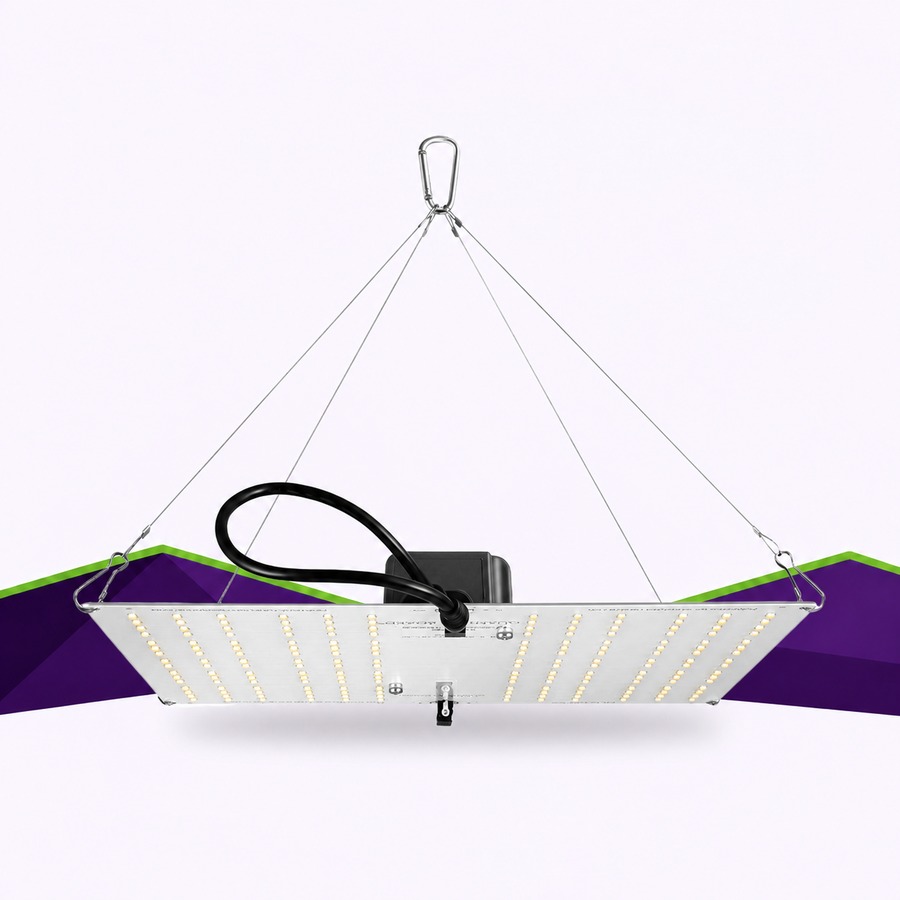
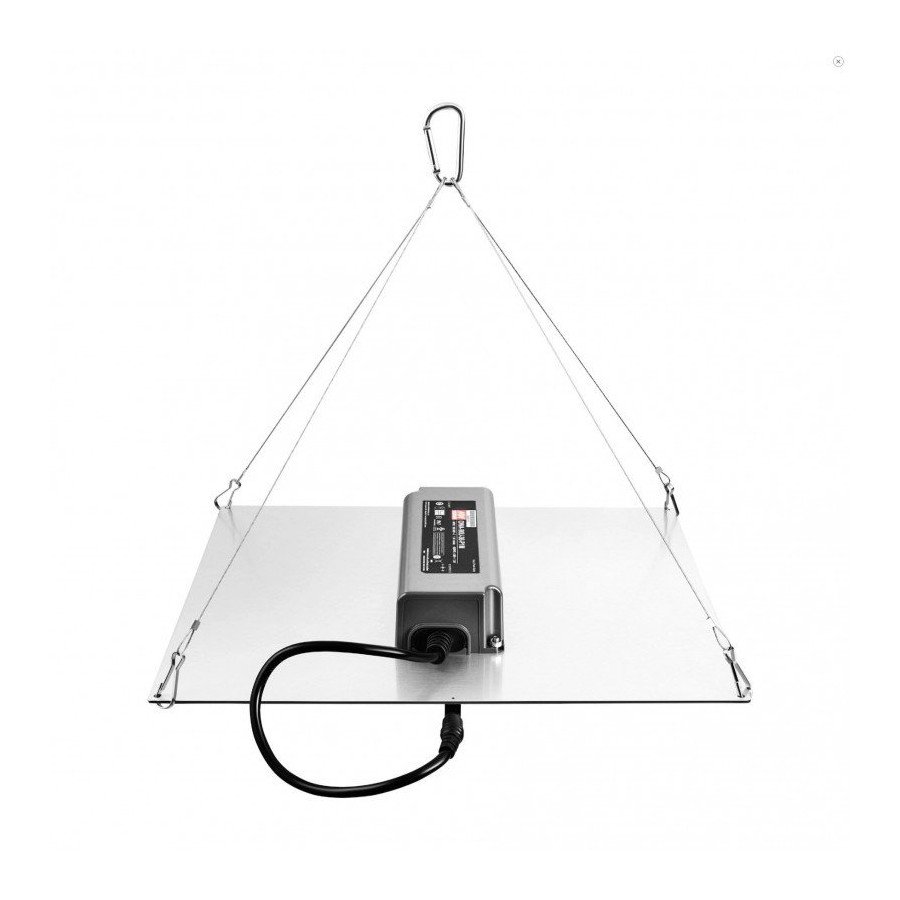
HLG 100 4000K - LED horticultural panel - Samsung LM301H LEDs - Delivered with EU plug
HLG 100 LED horticultural panel in 4000K - This lighting uses Quantum cards with high-efficiency white horticultural light.
EU plug provided
Product presentation
Discover the HLG 100 LED horticultural panel in 4000K. This high-end lighting uses Quantum Boards panels with Samsung LM301H LEDs, it is optimized for the growth of plants indoors.
Sold with European plug.
HLG 100 4000k
- 192 Samsung LM301H LEDs - Quantum Boards
- Cultivation area of 60 x 60cm in flowering and 90 x 90cm in growth
- Sold with European cable
- Consumption of 95 watts
- Perfect for the plant growth phase
- High penetration into the canopy
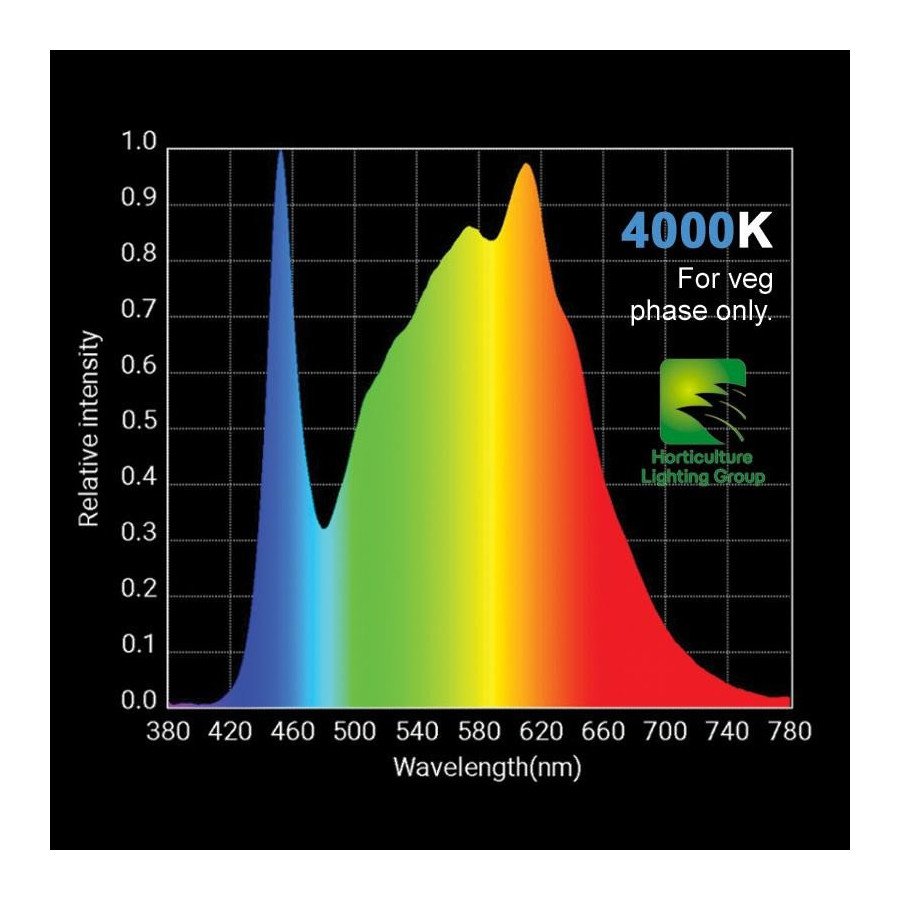
- Full spectrum with high efficiency white light
- Size: 30cm x 27cm x 5cm
Features detailed
| Type of Use | Growth |
|---|---|
| Dimensions | 32.38x27.94x6.35 |
| Growing area | 0.6 à 1m² |
| Power consumption (W) | 95 |
| LED brand | Samsung LM301H |
| LED type | Quantum Boards |
| PPF | 225 µmol/s |
| Efficacy (µmol/J) | 2.43 |
| Compatibility | Prise EU, 90-264V |
| Included accessories | Alimentation Mean Well |
| Number of LEDs | 192 |
| Luminous flux (lumens) | 16000+ |
Reviews customers
Je partais un peu dubitatif sur cette lampe, mais il faut avouer que la gestion thermique sans ventilateur, c'est un plus franchement. Pas besoin de se soucier du bruit, ça reste frais au toucher après plusieurs heures allumé. Le montage est simple, livré avec prise européenne, bien emballé. Le prix vaut le coup pour un modèle qui tient la durée. Top pour ceux qui veulent du solide sans complicité.
Qualité
Reçu rapidement.
Bon
Pas à regretter.
Ça marche super
Ça marche super bien. Pas de problème depuis le jour 1. Vraiment recommande.
Franchement, j'ai été impressionné
Franchement, j'ai été impressionné par ce produit. Après quelques jours d'utilisation, j'ai remarqué une vraie différence dans les résultats. L'efficacité énergétique est au rendez-vous, et les plantes poussent visiblement mieux. Le service client a été réactif à mes questions. Livraison bien faite, produit bien protégé. Je recommande vivement à tous ceux qui cherchent une solution fiable.
Aucun avis ne correspond à ce filtre.
Your questions
Hello, is this HLG 100 4000K LED horticultural panel powerful enough to extend the indoor tomato growing season, especially during winter, while remaining reasonable in power consumption?
Is this LED horticultural panel HLG 100 4000K really easy to install and use for someone like me who is starting indoor gardening?
Its 4000K light is ideal for stimulating the vegetative growth of vegetables and leafy plants, with a moderate consumption of only 96 watts. This panel offers an excellent compromise between performance and simplicity, perfect for easily starting your indoor cultivation.
How to optimize the use of the HLG 100 4000K to differentiate management between growth and flowering without over-consuming?
To optimize the use of the HLG 100 4000K by differentiating between the growth and flowering phases without over-consuming, here are the key points:
In growth: use the 4000K spectrum for balanced light that promotes foliage and strong stems. Cover approximately 90x90 cm (3'x3') with moderate intensity and an 18h on / 6h off cycle. This maximizes photosynthesis while maintaining a controlled consumption around 95W.
In flowering: reduce the area to 60x60 cm (2'x2') to concentrate the light, still at 4000K, with a standard 12h/12h cycle. In this smaller area, plants will benefit from sufficient intensity without increasing power, as the driver is non-dimmable but already efficient.
To avoid over-consumption: maintain the nominal power of the panel, optimize the distance (30-45 cm) between the lamp and the canopy, and take advantage of the very efficient integrated passive cooling, eliminating the need for additional fans.
This tailored management fully values the quality of the HLG 100 4000K while controlling your energy consumption.
What is the difference in luminous efficiency between this HLG 100 4000K Samsung LM301H LED panel and a classic 300W CMH LED in terms of penetration and coverage of crops?
The HLG 100 4000K with Samsung LM301H LEDs offers a very high photon efficiency (~3 µmol/J), meaning it converts electricity into useful light for the plant in a highly optimized way with a consumption of 100W. In contrast, its total output is limited, restricting its light penetration and coverage to about 0.5 to 0.75 m².
The classic 300W CMH, despite having lower efficiency (~1.7–2 µmol/J), delivers three times the power, ensuring better light penetration into the foliage and larger coverage, around 1 to 1.5 m². However, its heat dissipation is higher, which may require more robust ventilation.
In summary, the HLG 100 prioritizes energy efficiency over a small area while the 300W CMH is more suited for larger cultivation needing better penetration and coverage.
Is integration possible with a voice assistant to adjust light intensity in real time? Is temperature and humidity monitoring possible directly via the panel or is an external module needed? Can we easily synchronize on/off with a home automation system like Home Assistant?
The HLG 100 4000K panel is dimmable via its Mean Well power supply, providing flexible light intensity management. However, it does not offer native integration with a voice assistant to adjust the intensity in real time.
Regarding temperature and humidity monitoring, the panel does not have built-in sensors. Therefore, external modules will need to be used to monitor these parameters.
Finally, synchronization with a home automation system like Home Assistant is not natively supported. Integration remains possible through third-party solutions or customizations, particularly due to dimmability, but this will require some technical work.
What is the average lifespan of Samsung LM301H LEDs used in this horticultural panel and how does the panel perform in terms of thermal dissipation to prevent overheating?
The average lifespan of Samsung LM301H LEDs used in this horticultural panel is estimated to be between 50,000 and 60,000 hours. This longevity ensures stable and durable lighting performance for your indoor crops.
Regarding thermal dissipation, the HLG 100 4000K panel benefits from efficient passive cooling through an integrated heat sink. This system prevents overheating without the need for a fan, thus ensuring quiet operation and optimal protection of the LEDs. This thermal design helps extend the lifespan of the panel while maintaining consistent lighting quality.
Spectral efficiency in μmol per joule on the HLG 100 4000K? Is the 4000K spectrum optimal for flowering or growth? Panel size vs covered area, actual light yield on 60x60 cm in bloom?
Spectral Efficiency: The HLG 100 4000K panel delivers an efficiency of about 2.43 to 2.5 µmol/J, which is very performant for horticultural LED lighting of this range.
4000K Spectrum: This full-spectrum white light is ideal for the growth and vigorous development of plants thanks to its balance between blue and red. It can also be used for flowering, but for a more intense flowering phase, a 3000K spectrum, richer in red, would be more suitable.
Size and Covered Area: The panel measures about 32.4 cm x 27.9 cm and is perfect for a growing area of 0.28 to 0.37 m² in flowering. Thus, a standard area of 60 x 60 cm (0.36 m²) perfectly matches its capabilities.
Actual Light Yield in Flowering on 60x60 cm: This panel provides a total PPF of 224.5 to 235 µmol/s, resulting in a PAR flux of about 625 µmol/s/m² on 0.36 m², an optimal level to support effective and generous indoor flowering.
What is the difference in light penetration between this HLG 100 4000K panel and an equivalent CMH model for indoor cultivation on 90x90cm?
This difference implies that the HLG 100 must be suspended very close to the foliage and adjusted more frequently to compensate for its lower penetration, while the CMH can be placed higher with superior light efficiency. Thus, for dense cultivation on 90x90 cm, a CMH offers deeper penetration, while the HLG 100 remains effective due to its low consumption and advanced LED technology, but will sometimes require adjusting the fixture to optimize light depth.
What is the maximum surface temperature for continuous operation to avoid any burns on the leaves near the panel?
For the horticultural panel HLG 100 4000K equipped with Samsung LM301H LEDs, it is recommended to keep the surface temperature of the panel below 40 to 50 °C during continuous operation to avoid any risk of burning on nearby leaves. This range ensures effective heat dissipation while protecting your plants from thermal stress.
To achieve this, it is essential to maintain a sufficient distance between the panel and the foliage, and to ensure good natural or forced ventilation. These precautions help limit the heat emitted and optimize the lifespan of the LEDs as well as the health of your crops.
With an HLG 100 4000K horticultural panel at 95W and a coverage of 60x60cm in flowering, what light intensity (PPFD) can we expect at the canopy level to optimize a LED SCROG and is it better to adjust the height for LST?
With an HLG 100 4000K horticultural panel consuming around 95W and covering an area of 60x60 cm in flowering, you can expect an average PPFD of around 600 to 650 µmol/m²/s at the canopy level, suspended about 30 cm high. This level of illumination is ideal for optimizing a compact LED SCROG.
For the LST technique, it is advisable to fine-tune the height of the panel as your plants grow. This will prevent the light from being too weak or risking burning the leaves, while ensuring good light uniformity thanks to the quality Samsung LM301H LEDs that provide a nice diffusion without hotspots.
Is this panel compatible with a dimmable control system to adjust the power in seedling growth?
The horticultural panel HLG 100 4000K - Samsung LM301H LEDs is indeed compatible with a dimmable control system thanks to its integrated Mean Well power supply. This allows for precise adjustment of light power, ideal for modulating intensity during seedling growth to optimize light and energy consumption.
However, this panel does not offer control via voice assistants or home automation, but the classic dimmable function works perfectly for precise and effective horticultural use.
Can this LED panel be easily plugged in and used with a beginner indoor growing system without complex electrical modifications?
The HLG 100 4000K comes with a standard EU plug, allowing it to be directly connected to a European household power outlet without any complex electrical modifications. Its integrated Mean Well power supply is pre-wired, simply connect the panel to the driver and then plug the socket into the mains.
This ease of installation makes this panel ideal for a beginner indoor growing system: it is ready to use, plug-and-play, with no need for any special technical skills.
What is the light output in µmol per second of the HLG 100 4000K panel and how does it perform during full bloom over 60x60cm compared to a panel with a 3000K spectrum?
The HLG 100 4000K panel, equipped with 192 Samsung LM301H LEDs, delivers a light output PPF of approximately 225 µmol/s for a consumption of 95 W, giving it a photon efficacy of 2.4 µmol/J. Over a cultivation area of 60x60 cm, it provides homogeneous coverage between 0.5 and 0.75 m², ideal for avoiding shadow zones.
Compared to a 3000K spectrum panel, which is more red and geared towards pure blooming, the 4000K offers a full white spectrum, balanced between blue and red. This ensures better diffuse light penetration and overall healthier plant development during bloom. The 3000K may slightly favor strict blooming, but the 4000K remains very effective for this stage while maintaining good versatility.
Viewed recently