












































































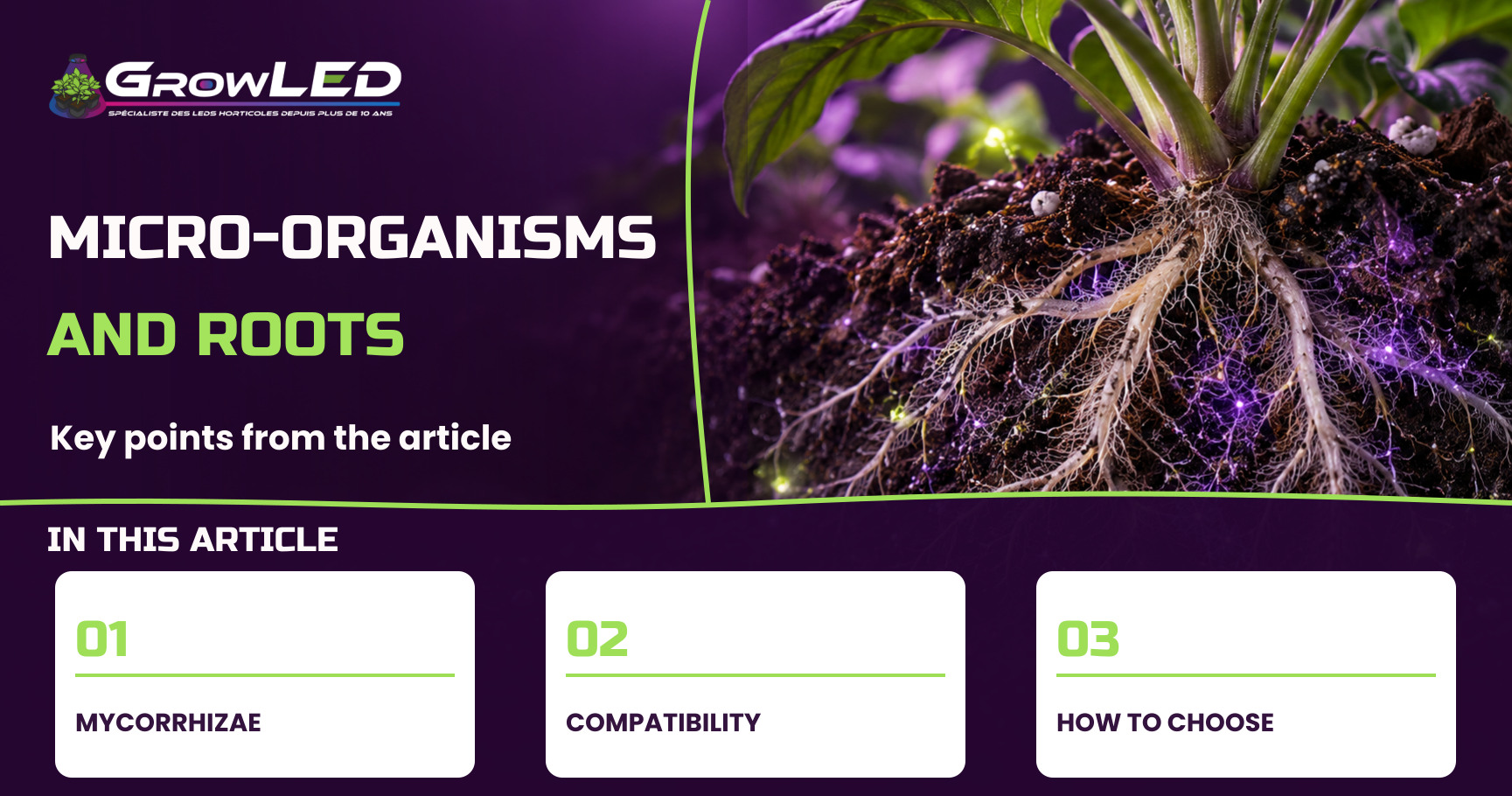
People often ask me why I spend so much time talking about what happens below the surface of the pot rather than what grows above it. The answer fits in a single sentence: a plant never feeds itself alone, it delegates part of the work to fungi and bacteria settled around its roots. In this article, I break down the real mechanics of that partnership, mycorrhizae first, and I show where each product in my selection fits exactly into this living chain.
1What is a mycorrhiza?
A mycorrhiza isn't a product, it's an association. The word literally means the marriage between a fungus (myco) and a root (rhiza). The fungus penetrates the cells of the root cortex, forms small branching structures there called arbuscules, and it's at that precise spot that the exchange takes place: the plant hands over a share of the sugars produced by photosynthesis, and the fungus sends back water and minerals, phosphorus in particular, which it fetches from far away in the substrate thanks to its network of filaments (the hyphae).
What makes this network so effective is how fine it is. A single hypha is a fraction of the diameter of a root hair. It therefore explores micropores in the substrate that are completely inaccessible to the roots, and it multiplies the volume of soil the plant actually draws on. That's why people often talk about a second root system, an invisible one this time.
On this front, I systematically rely on MC4 - Mycorrhizae 5g - Hydropassion, because it's the only product in my selection that precisely documents the strain used: Glomus intraradices, dosed at between 4000 and 6400 viable spores per gram. That precision matters, it lets you know exactly what you're introducing into the pot rather than trusting a vague mention of "beneficial fungi". The product is certified Organic Agriculture under European regulation RCE No. 834/2007 and carries a marketing authorisation number (6080001), a level of traceability I rarely come across on this type of product.
- Contact is essential, the spores have to physically touch the root to germinate and colonise, a standard watering into an already established substrate isn't enough.
- Application window, it's at transplanting or sowing that the roots are most receptive, before they lignify.
- Lasting effect, once colonisation is under way, it holds throughout the whole cycle, unlike a stimulant you have to reapply every week.
🌱 Joseph's tip
I always sprinkle it directly onto the rootball, never diluted in the water poured on top. I dip the rootball or dust the roots before closing the planting hole. It's a one-off gesture, not a weekly feed, and that's exactly what sets a mycorrhizal inoculant apart from a regular stimulant.

2The bacteria that colonise the root zone
Alongside the fungi, there's a whole population of bacteria that settle on the surface of the root, in what we call the rhizosphere. Their mode of action has nothing to do with that of a mycorrhizal fungus: they don't penetrate the cells, they colonise the surface, form a protective biofilm and multiply at a speed fungal biology can't match, a bacterium divides in a few hours where a mycelium takes weeks to spread.
That's exactly what Voodoo Juice - Advanced Nutrients - Root Mass Expander embodies, with its data sheet naming four strains: Bacillus subtilis, Bacillus pumilus, Bacillus licheniformis and Paenibacillus polymyxa, with an explicitly root-focused function. These bacteria quickly colonise the root surface, take up the available space before undesirable organisms can settle there, and stimulate the proliferation of root hairs, which mechanically increases the usable root mass.
Why this timing matters is that bacterial colonisation acts like a close guard during the very first weeks, giving the slower mycorrhizal network time to finish spreading. The two mechanisms don't compete, they take over from one another over time.
| Product | Type of organism | Dominant mechanism |
|---|---|---|
| MC4 | Endomycorrhizal fungus (Glomus intraradices) | Hyphae network, extraction of phosphorus and water |
| Voodoo Juice | Surface bacteria (Bacillus, Paenibacillus) | Rapid colonisation, root mass |
3Building a complete microbial consortium
A common mistake is to believe that a single bacterial inoculant is enough to cover every need. In practice, rhizosphere bacteria divide up specific roles among themselves, a bit like different trades on the same building site.
This is where Tarantula - Advanced Nutrients - Microbial Biostimulant for the Root Zone comes in, with a mechanism that clearly differs from Voodoo Juice's. Its data sheet states that the selected bacteria increase the availability of iron and phosphorus. In other words, where Voodoo Juice bets on rapid colonisation and expansion of the root mass, Tarantula works on unlocking minerals that already exist in the substrate but remain chemically locked away, in insoluble form, and therefore unusable by the plant as they are.
In concrete terms, certain bacteria produce organic acids or chelating molecules that release the iron and phosphorus trapped in the substrate particles. It's ongoing work, not just a start-up effect, which makes it a logical complement rather than a duplicate of Voodoo Juice.
- Same format, easy to compare, both Advanced Nutrients products come in 500 ml and 1 L, which lets you slot them side by side into the same routine without any dosing headaches.
- Two functions, one goal, one builds the root structure, the other feeds what that structure has built.
- No redundancy, using both together isn't the same as doubling the dose of a single product, it's covering two distinct bacterial functions.
🌱 Joseph's tip
I always let tap water stand for 24 hours before diluting bacteria in it. The chlorine added to disinfect drinking water doesn't tell the difference between a pathogenic bacterium and one I've just bought to put to work, it kills them all the same way.
4Beyond mycorrhizae: the other soil fungi
Not all soil fungi are mycorrhizae, and that's a confusion I often correct in the shop. A mycorrhiza forms a nutritional symbiosis inside the root cells. Other fungi, just as beneficial, act on the surface, without ever penetrating the root, with a role closer to protection than to nutrition.
That's the case with Piranha - Advanced Nutrients - Fungal Biostimulant for the Root Zone, whose data sheet names the genera Trichoderma and Gliocladium. These fungi colonise the rhizosphere and occupy the space available around the roots, preventing pathogenic organisms from settling there in turn. Some Trichoderma strains are also known to parasitise the cell wall of other undesirable fungi directly, an action of competition and defence that's well documented in the horticultural literature.
The nuance to keep in mind is that Piranha doesn't replace MC4 and vice versa: one works on the surface to protect and clean up the root zone (confirmed root function, universal substrate compatibility), the other builds an internal network to fetch nutrients from deep in the substrate. We're dealing with two fungal families with complementary roles, not two variants of the same product.
- Glomus intraradices (MC4), penetrates the root cells, forms arbuscules, trades sugar for minerals.
- Trichoderma and Gliocladium (Piranha), colonise the surface, protect the root space, don't enter the plant's cells.
5Feeding soil life day to day (the organic option)
Not everyone needs, or wants, to handle identified strains. Plenty of growers simply want a regular gesture that keeps healthy biological activity going around the roots, without having to think about which bacterium does what.
That's exactly the promise of BioBizz - Root Juice - Organic Root Stimulator, whose data sheet uses the phrase "stimulate the biological life around the root system", a direct echo of the subject at hand here. Its formula is built on humic acid and seaweed extracts, and the product is certified Organic. In concrete terms, the humic acids improve the substrate's ability to retain and exchange minerals, while serving as a carbon source for the bacteria already present. The seaweed extracts supply compounds that naturally stimulate the development of root hairs.
It isn't a targeted inoculant, and its data sheet mentions no specific strain, which is precisely what makes it a maintenance product rather than a symbiosis trigger. With 140 sales, it's by far the most sought-after product in this whole selection, which says a lot about the public's appetite for a simple organic gesture, repeated at every watering rather than reserved for one precise moment in the cycle.
🌱 Joseph's tip
I keep organic stimulants like Root Juice for regular use, not one-off use. Unlike MC4, which happens once on contact with the roots, this kind of product accompanies the whole growth phase, week after week.
6Boosting root vitality day to day
There's one last category of products, the ones I'd call vitality all-rounders. They don't claim to deliver a precise microbial strain, but they support the plant through moments of stress, especially at the start.
Canna RHIZOTONIC is the most common example on my shelves. Its data sheet mentions no microbial strain, which clearly sets it apart from MC4, Voodoo Juice, Tarantula or Piranha, and I always present it to customers that way: a general vitality supplement, not a targeted inoculant. Its most concrete use remains soaking seeds, with a stated dosage of 40 ml per 10 L of water, a step many growers carry out even before putting the seed in the ground.
Its availability in five formats, from 250 ml up to 10 L according to the product sheet, reflects a use that ranges from a small personal grow space right up to far larger volumes. It's a benchmark product, one of those you find in almost every grow, precisely because it needs no expertise in microbiology to be used correctly.
- Soaking seeds, before sowing, to cushion the stress of germination.
- Recovery after transplanting, to limit the transplant shock on a still-fragile root system.
- Regular use during growth, alongside a standard feeding programme.
7Combining these products without getting it wrong
Now that we've separated out each mechanism, there's the practical question left: how to combine them without cancelling out the effect. I've seen too many grows where a good inoculant ends up in the bin because of a scheduling or mixing mistake.
| Product | Organism | Role | Key moment |
|---|---|---|---|
| MC4 | Fungus (Glomus intraradices) | Internal nutrient network | Sowing / transplanting, once |
| Voodoo Juice | Bacteria (Bacillus, Paenibacillus) | Root mass | Early growth |
| Tarantula | Bacteria | Iron/phosphorus availability | Whole cycle |
| Piranha | Fungi (Trichoderma, Gliocladium) | Protection of the root zone | Whole cycle |
| Root Juice | Not specified (humic acid, seaweed) | Soil life maintenance | Regular waterings |
| Rhizotonic | Not specified | General vitality | Seed soaking, recovery |
- No chemical fungicide the same week, a systemic fungicide treatment doesn't sort a pathogen from the fungi in MC4 or Piranha, it weakens them all.
- No excess phosphorus at the start, a plant that finds phosphorus easily available invests fewer sugars in the mycorrhizal symbiosis, which slows the colonisation by MC4.
- Bacteria and fungi coexist, Voodoo Juice or Tarantula don't compete with MC4 or Piranha, they occupy different ecological niches on the same root.
- An inoculant isn't a stimulant, MC4 happens once on direct contact with the roots, whereas Root Juice or Rhizotonic support the grow over the long haul.
Ready to wake up the life in your pots?
Whether you go for a precise inoculant like MC4 or an everyday organic gesture like Root Juice, the key is to pick the right tool for the right stage. Find the whole root-care selection on the growshop.
See the growshop →What I've taken away after years of studying roots pulled out of their pots is that you don't manage soil life the way you manage an NPK dose. A mycorrhizal inoculant like MC4 happens in a single gesture, at the right moment, with direct contact. The Advanced Nutrients bacteria work continuously, on the surface, on distinct functions that are worth knowing before you stack them up. And the more general-purpose products, Root Juice or Rhizotonic, remain useful travelling companions when you're not after microbiological precision but a simple, regular gesture that keeps the whole thing ticking over. The real skill isn't buying the most complex product, it's knowing which one to use, and when.