











































































A yield ceiling isn't always a question of lighting power. Most of the time, it's a question of distribution: a single big top that captures everything, while the branches below languish in the shade. Training fixes that without adding a single watt, by forcing the plant to spread the light it already has across far more flowering sites.
1Why training changes everything
A plant left to its own devices, I see it on nearly every untrained crop that passes through my hands: it grows upward, one main stem takes over, and everything growing below stays stunted. It's the apex, the growing tip, that lays down the law: it's the one receiving the most direct and intense light, so it's the one that bulks up, while the lower branches make do with the scraps.
Training is simply the act of breaking that hierarchy by working on the plant's shape rather than its genetics or its lighting. By bending down the dominant branches and opening up the structure, you mechanically bring all the secondary tops onto the same light plane. The result isn't a plant that gets "more light" in a literal sense: it's a plant that makes better use of the light it already receives, with far more flowering sites developing in good conditions instead of just one.
Two techniques, two levels of intervention. LST works branch by branch, continuously, with soft ties you adjust as the plant grows. SCROG works on the whole canopy at once, with a screen that imposes a uniform height on the entire plant. They aren't at odds: in practice, I almost always start with LST before deciding whether or not to move on to SCROG, depending on the space available.
| Technique | Principle | Intervention | Ideal for |
|---|---|---|---|
| No training | Apical dominance left uncorrected | None | Small plants, tight sea of green |
| LST | Bending and tying down branch by branch | Manual, repeated over time | Fixing a single-stem plant, preparing for a SCROG |
| SCROG | Horizontal screen that levels the height of the whole canopy | One installation, then regular guiding of tops through the mesh | Wide tents, one or two vigorous plants |

2LST, the basic move
LST, or low stress training, is the art of bending a branch without wounding it to force it to grow horizontally rather than vertically. Unlike pruning (HST, high stress training), you cut nothing: you bend, you tie, you gradually release. The plant keeps photosynthesising at full tilt throughout the operation, which avoids the recovery time a cut imposes.
In practice, as soon as the main stem clearly overtakes the secondary branches, I gently bend it down and fix it at the edge of the pot, at a height that brings all the tops back to the same level. The branch keeps growing, but along the axis I've given it, and the apex that takes over at that new spot becomes, in turn, a top to keep an eye on.
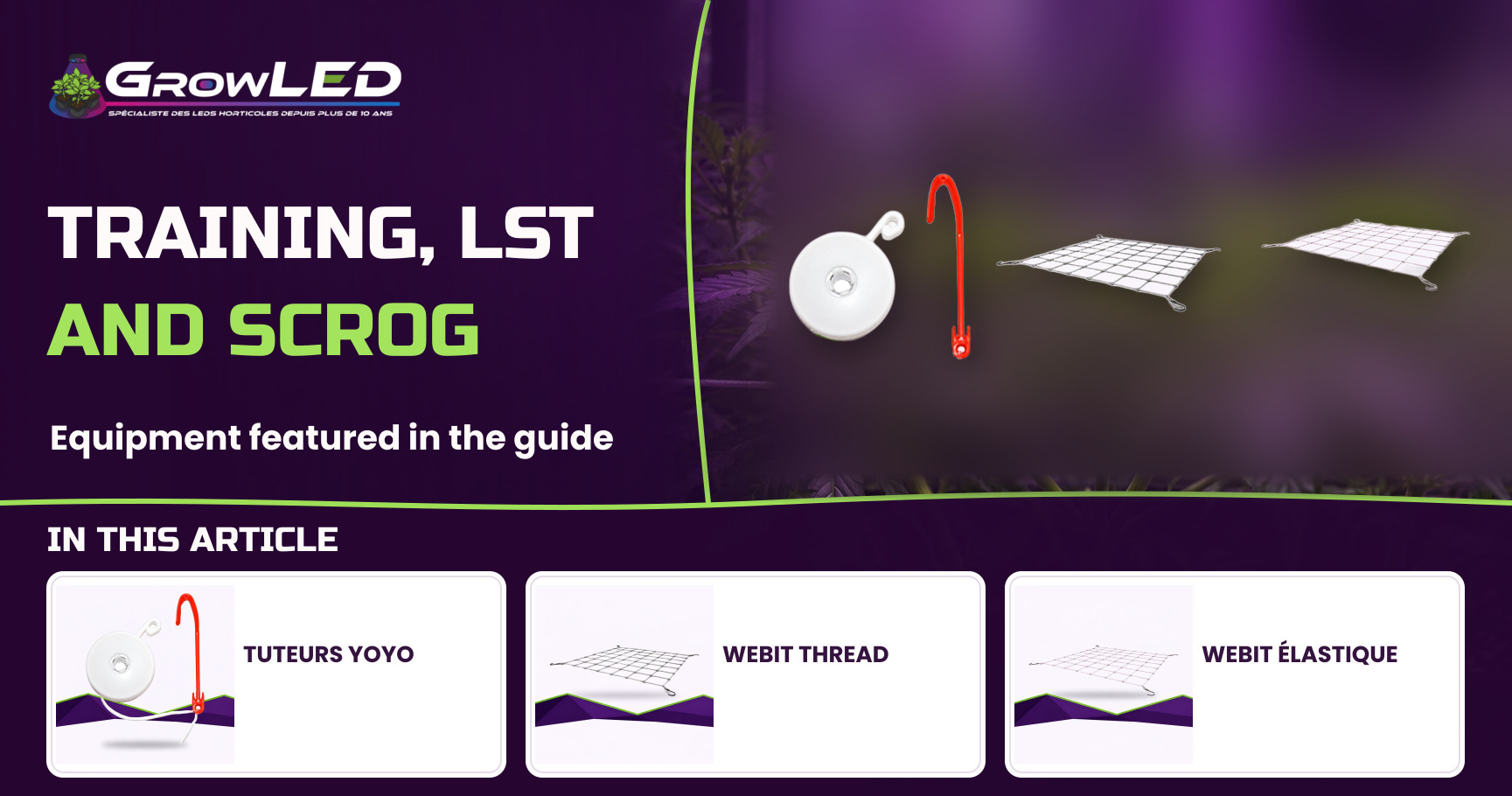
This is where a soft tie changes everything, and that's exactly the role of the Yoyo plant stakes. The principle of the yoyo is a tension-adjustable line that you hook on one side to the tent's structure and on the other to the branch you want to guide: you pull, the branch comes down; you release a notch, it rises back up a little. This lets you fine-tune the height and tension day by day, without ever tightening a fixed tie that would eventually cut into the bark.
- A reversible adjustment, I tighten or loosen the yoyo in a few seconds if one branch grows faster than another, without having to undo a knot each time.
- Zero damage to the plant, the hook spreads the tension across the stem instead of pinching it at a single point the way a rigid wire would.
- A tool that goes on and moves quickly, handy when you're managing several branches at once on the same plant and want to keep an even distribution.
🌱 Joseph's tip
I never bend a branch all the way to its final angle in one sharp move. I bend it gradually over two or three days: the stem has time to strengthen its fibres at the point of the bend, and the risk of a clean break drops almost to zero. A yoyo is perfect for this, since it lets you tighten in small notches rather than piling on all the tension at once.
3SCROG, the screen that evens out the light
SCROG, or screen of green, takes the LST logic further: instead of guiding the branches one by one by hand, you set up a horizontal screen above the pot and force every top to grow through the mesh before rising up. The result is a flat, dense canopy where each top reaches the same light level at the moment of the switch to flowering.
The logic of the screen is to turn a plant into a wide bush rather than a Christmas tree. Every branch that pokes through the net is tucked back sideways under the mesh until it finds its own hole to come back up through. The more tops that break through the screen at the same level, the more flowering sites receive light equivalent to what only the main top used to get before.
To build that screen, I install the WebIt Thread plant training net by Secret Jardin. Its fixed 10x10cm mesh gives regular holes, neither too wide (branches slip and head off anywhere) nor too tight (impossible to thread through an already thick stem). It attaches with hooks directly onto the tent's four vertical bars, so no drilling, no DIY: I tension the net at the desired height and move on to guiding.
A rule I apply every time, I never fill the whole screen before starting flowering. I aim for roughly 70 to 80% of the holes occupied at the switch to 12/12: the branches held in reserve make up for the inevitable tops that stall, and I can still adjust the distribution in the first days of stretch without straining a structure that's already set.
- Five sizes available, from 60x60 to 150x75cm, enough to cover a small tent as easily as a larger growing space without improvising a setup.
- A rigid mesh, which holds its shape even when several branches pull on it at once, unlike a soft net that deforms under the load.
- Tool-free installation, the hooks clip onto the tent's existing structure, so setting it up takes just a few minutes.
| Step | What you do | Why |
|---|---|---|
| 1. Tension the net | Fix it with hooks on the vertical bars, above the pot | Leave enough stem to build the structure under the screen |
| 2. Guide under the mesh | Tuck back each branch that pokes through, bring it back up through an empty hole | Spread the tops across the whole surface rather than at a central point |
| 3. Let it break through | Stop touching a top once it's settled above the net | It becomes a flowering site in its own right |
4Rigid net or elastic net: choosing the right mesh
The WebIt Thread net I've just described covers the vast majority of setups, but it has one clear limit: its rigidity. A fixed mesh doesn't move, which is an advantage for guiding precision, but it becomes a problem as soon as the canopy bulks up hard late in growth or the plant shifts under the weight of the flowering tops, with a risk of excessive tension on branches wedged in holes that have become too small.
That's the role of the WebIt elastic plant training net by Secret Jardin, its mesh made of elastic material absorbs the movement of branches that keep bulking up without ever breaking the weave. Each hole stretches slightly around the growing stem instead of squeezing it, which limits strangulation on stems that have already lignified in full flower.
The other difference is the size. The elastic net goes up to 300x150cm at its largest, well beyond the 150x75cm maximum of the rigid net. It's the only option in the range suited to an XL tent or a crop of several plants sharing a common canopy: over that surface, a rigid net would deform or lack the flexibility to follow the natural movements of such a large volume of foliage.
| Criterion | Rigid WebIt Thread net | Elastic WebIt net |
|---|---|---|
| Mesh | Fixed, 10x10cm | Elastic, adapts to growth |
| Sizes | 5 sizes, up to 150x75cm | 4 sizes, up to 300x150cm |
| Attachment | Hooks on tent bars | Hooks included |
| Strong point | Guiding precision, stable structure | Absorbs movement, large volumes |
| Ideal situation | Standard tent, one well-managed plant | Large tent, several plants, uneven canopy |
- In a small or medium tent with a single well-managed plant, the rigid net gives a cleaner framework that's easier to read for spreading the tops.
- In a large volume or an uneven canopy (several plants, different growth rates), the net's elasticity avoids the tension points that could mark the stems late in flower.
🌱 Joseph's tip
When I'm torn between the two, I look first at the number of plants planned under the same net, not just the size of the tent. A single well-managed plant in a standard tent, and I go for the rigid net for the precision. Several plants, or growth already well advanced before installation, and I go for the elastic one, which is more forgiving of the differences in pace between branches.
5The timeline: combining LST and SCROG without slipping up
The order of operations is often what makes the difference between a flat, even canopy and a half-empty screen with two tops exploding in the middle. I always start with LST alone, during the vegetative stage: that's when the plant is at its most pliable and correcting a dominant stem costs the least stress.
The net comes next, once the basic structure is set by hand: several branches already at roughly the same level thanks to the yoyo stake, ready to be spread under the screen rather than a single vertical stem to tame all at once. Putting the net on too early, on a plant that's still very young, means having to re-tension or move the hooks later: you might as well wait for the plant to gain a bit of volume.
Guiding under the net then continues right up to the switch to flowering, after which I slow the handling down sharply. Once the tops have formed their first clusters of flowers, the plant becomes far more fragile to twisting, and the aim is no longer to reshape the structure but to let each flowering site bulk up quietly.
- Vegetative stage, LST with the yoyo to level out the height gaps between the main branches.
- End of veg, install the net and do the first guiding of the tops through the mesh.
- First days of flowering, final distribution tweaks while the stems are still pliable.
- Rest of flowering, stop bending and just tie back whatever overflows the net so a top doesn't flop onto the others.
6The mistakes that cost you yield
The first mistake is wanting to do everything at once: bending a branch to its final angle in a single move. The stem cracks, the sap stops flowing properly at that spot, and the branch stalls instead of taking off again. Better to make several small adjustments spread out over time, which a tension-adjustable stake allows, rather than a fixed tie you have to keep undoing.
The second is fitting a net that's too small for the tent. An undersized net forces you to compress the canopy onto a reduced surface, which artificially recreates the very competition for light that training is meant to solve. I always check the sizes available before buying, rather than forcing a format that doesn't match the actual space.
The third is continuing to handle the branches in late flower as if you were still in veg. A lignified stem breaks instead of bending, and a top snapped off at the end of the cycle is yield lost for good, not just a delay. Once the stretch is over, I limit myself to guiding whatever naturally pokes out, without forcing.
The fourth is choosing a rigid net for a volume that moves a lot, or conversely an elastic net for a setup where you want a very precise screen. The two Secret Jardin nets answer different needs, and mixing them up means saddling yourself with pointless constraints: rigidity and precision on one side, flexibility and large format on the other.
7Maintaining the canopy in flower
Once the structure is set, the work doesn't stop completely, it just changes in nature. I regularly go under the screen to check that no branch is shading its neighbour: as soon as one top overtakes the others too far, I lay it gently under the net rather than let it hog all the light at the expense of the rest of the canopy.
I also keep an eye on the contact points between the stems and the mesh. On the rigid net, a friction point repeated in the same spot can mark the bark if the stem thickens fast; on the elastic net, that risk is reduced since the mesh follows the movement, but I stay watchful of the areas where several branches cross and rub against each other.
Late in flower, when the tops get heavy, the screen takes over the mechanical support that a conventional stake would normally provide: the flower-laden branches rest on the net instead of buckling under their own weight. It's a benefit often overlooked when talking about yield, but it saves plenty of broken branches in the final weeks, just when they're at their most valuable.
- Check regularly that no top dominates the others too far under the net.
- Clear the friction points between stems and mesh before they mark the bark.
- Let the net bear the weight of the tops at the end of the cycle rather than adding an external stake at that stage.
Build your canopy, not just your lighting setup
To ease into it, the Yoyo plant stakes are enough to correct your first dominant branches. To step up to the screen, the WebIt Thread net and its elastic version cover every tent size. Find the full range of training gear on the growshop.
See the growshop →If I had to sum up years of training in one sentence, it would be this: the yield you gain with a stake and a net, you'd never gain by adding a lamp. The light you already have is more than enough, as long as it reaches every top and not just one. Start simple with the yoyo, move up to the net when the structure is ready, and let the plant do the rest: it's the plant that turns that well-spread surface into a harvest.