


































































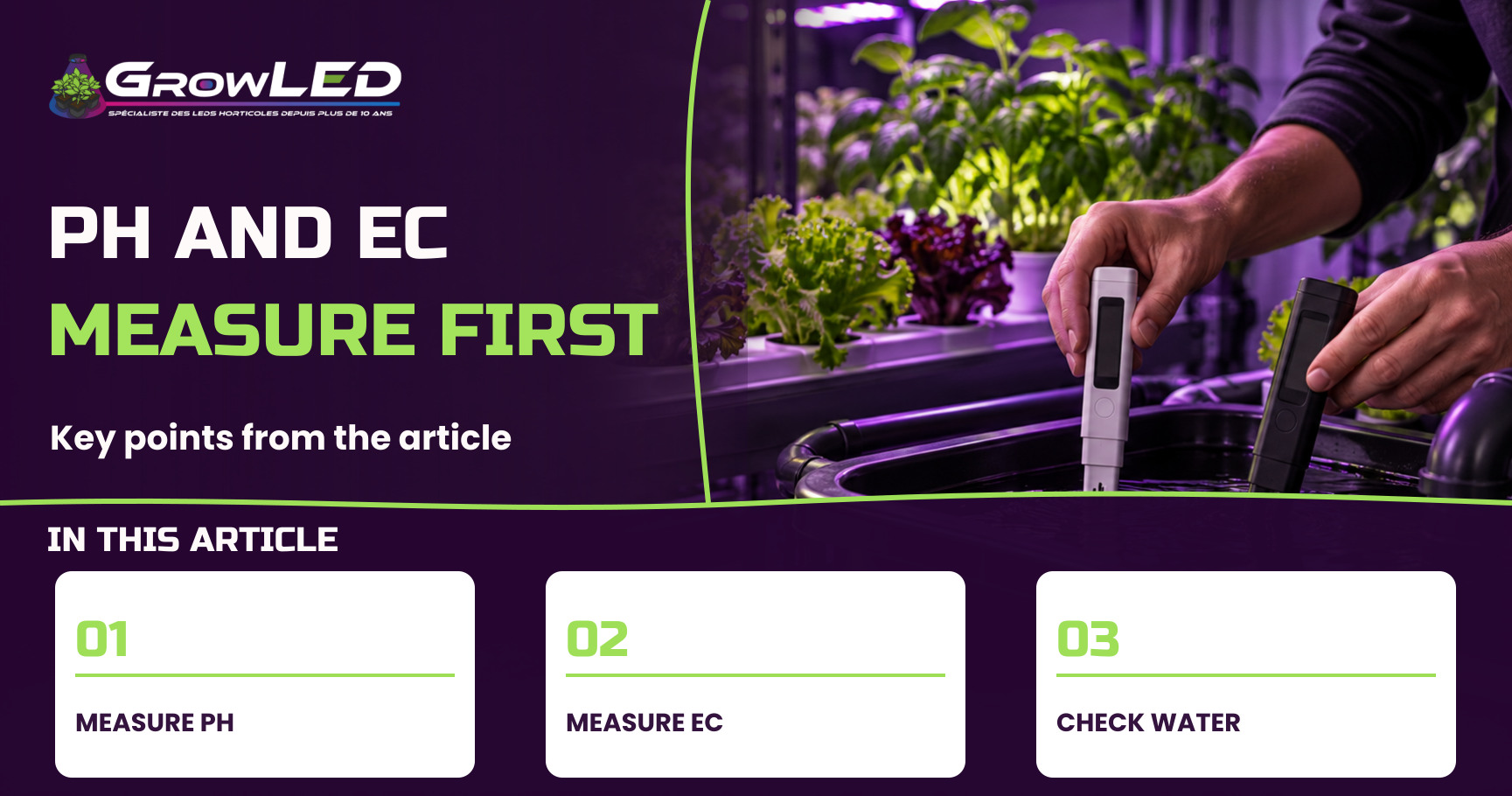
A plant that yellows, that stalls its growth or that burns at the leaf tips doesn't always have a lighting or watering problem. When I troubleshoot a grow with a customer, nine times out of ten it all comes back to the same thing: pH and EC have never been checked, or not for far too long. Here is how I go about it, using the kit I actually rely on for my own grow.
1Why pH and EC drive the whole grow
pH is the lock on the front door to nutrients. A root doesn't take up an element because it's present in the solution, it takes it up because it's chemically available in that precise pH form. Iron, manganese or phosphorus, for example, precipitate or become insoluble outside certain ranges: a plant can sit in a perfectly dosed solution and still show deficiencies, simply because the pH is blocking access to those elements. That's what we call nutrient lockout, and it's the first cause I look for when faced with a chlorosis that doesn't match the rest of the diagnosis.
EC, for its part, says nothing about the balance of the elements but everything about their overall concentration: it's the flow rate behind the lock. Too low an EC and the plant runs short of everything, growth slows, foliage turns pale. Too high an EC and the roots suffer reverse osmosis, water struggles to enter the cell or even leaves it, which shows up as burnt leaf edges (the notorious nutrient burn) even though watering was generous.
The trap, in indoor growing as in hydroponics, is that neither of these two parameters shows to the naked eye until several days of drift have passed. Unlike an open-ground grow where the soil naturally buffers the swings, an inert substrate or a hydro tank forgives nothing: the pH can drift by a full unit in 48 hours under the effect of root activity and bacteria, and EC climbs mechanically with every evaporation since the water leaves but the salts don't.
- A pH that's too high (above 6.5 in hydro, above 7 in soil) mainly blocks iron, manganese and phosphorus: leaves yellowing between the veins, growth stalling.
- A pH that's too low (below 5.5) on the contrary encourages over-uptake of certain micro-elements to the point of toxicity, with leaf margins turning brown.
- An EC that climbs without you adding anything almost always signals evaporation or water uptake by the plant that's faster than expected: it's a warning sign, not just a number.

2Measuring pH: the everyday tools
I always start with the most accessible option: the Manual pH tester for indoor growing - GHE - For 200 tests Soil/Hydroponics. It's a classic colorimetric test, a few drops of reagent in a sample of solution and a reading by colour comparison. It's not high precision, but it's by far the best-selling tool in our measurement aisle, with 127 units sold: proof that you don't need a big budget to start seriously keeping an eye on your grow. With 200 tests in a single bottle, it's also the tool I keep as a backup for when the digital probe dies on a repotting evening.
The limit of the colorimetric method is the subjectivity of the reading and the lack of temperature compensation: the very same sample can shift slightly depending on the ambient light or on how tired your eyes are at the end of the day. That's why, as soon as a grow gains value (late flowering, several tanks to manage), I switch to a digital pH meter.
The logical middle step is the Ph Meter - Vanguard - (6 MONTH WARRANTY) - Ph tester for hydroponic growing. Stated accuracy of ±0.1 pH, automatic temperature compensation over a range of 0 to 50°C, which changes everything: without that compensation, a cold or lukewarm solution skews the reading independently of the real pH, because the electrical conductivity of the electrode itself varies with heat. It's the second best-selling pH meter in the pool, just behind the Hanna combo, and it's the one I recommend as soon as you're running more than two or three plants at once.
| Tier | Tool | What it measures | Who it's for |
|---|---|---|---|
| Beginner | GHE manual tester 200 tests | pH by colorimetry | First grow, small budget |
| Intermediate | Vanguard pH meter | Digital pH ±0.1, temperature compensation | Regular grow, several tanks |
| Expert | Hanna HI98130 Combo | pH ±0.05, EC, temperature | Demanding grow, managed hydro/coco |
🌱 Joseph's tip
Always rinse with demineralised water, never with tap water, between two measurements. Tap water mineral salt residues skew the next reading, especially on colorimetric testers where a simple residual film already changes the reference tint. It's a thirty-second reflex that saves plenty of false diagnoses.
3Measuring EC: what conductivity reveals
EC (electrical conductivity) is measured in millisiemens per centimetre (mS/cm) or in microsiemens (µS/cm) depending on the device, and rests on a simple principle: the more dissolved salts a solution contains, the more it conducts electricity. The probe sends a current between two electrodes and measures the resistance it meets. It's not a measure of the "quality" of the nutrients, only of their overall quantity, which means an EC in the right range doesn't rule out an imbalance between the elements: it gives you the volume, not the recipe.
In practical terms out in the grow, what I watch above all is the trend rather than the absolute value at any given moment. An EC that rises gently between two waterings in hydro is normal: the plant drinks the water and leaves part of the salts behind, so you need to refresh the solution regularly rather than simply topping up with plain water. An EC that collapses after a nutrient addition, on the other hand, almost always signals a badly calculated dilution or a mix that has precipitated (precipitates are no longer dissolved, so no longer conductive).
- Fine resolution (0.01 mS/cm) makes all the difference in late flowering, when you're trying to gradually reduce the concentration without swinging from one extreme to the other.
- Temperature also affects EC exactly as it does pH, which is why a serious device includes a temperature probe and automatic compensation.
4Calibrating your kit, the pH side
A pH meter electrode ages. The glass bulb that picks up the signal slowly gets coated with a film (mineral deposits, biofilm) and its electrical response drifts, even on a quality device. Without regular calibration, your digital pH meter becomes as unreliable as a badly read colorimetric tester, with the illusion of precision on top, which is worse: you make a correction decision based on false data.
For that I use the BUFFER pH7 - Calibration solution - 300ml IONIC, a buffer solution with a known and stable value (accuracy ±0.01, NIST traceability) that serves as a neutral reference point. It's the second best seller in the pool in the calibration segment with 68 bottles sold, and each 300 ml bottle allows a dozen calibrations: enough to last a whole season without giving it a second thought.
But a single reference point isn't enough to be reliable across the whole growing range. The Hanna combo offers precisely a one or two point automatic calibration, and the second point is the one that really counts for us: the BUFFER pH4 - Calibration solution - 300mL IONIC. By setting the device on pH7 then pH4, you precisely bracket the useful growing range (roughly between 5.5 and 7), where a single neutral-point calibration would let the device drift in exactly the zone that interests you most, between 5.5 and 6.5.
| Solution | Role | Recommended frequency |
|---|---|---|
| Buffer pH7 | First point, neutral reference | Before each major new stock solution |
| Buffer pH4 | Second point, brackets the growing range | Alongside the pH7 for a two-point calibration |
| EC solution 1.413 µS/cm | Reference for the EC probe | At each start of cycle or when drift is noticed |
5Calibrating your kit, the EC side
The EC probe drifts too, for reasons close to those of pH: deposits, slight oxidation of the electrodes, wear. The difference is that an EC drift often goes more unnoticed than a pH drift, because you read the gap as a real change in the solution rather than as a fault in the device.
I calibrate mine with the IONICS EC 1.413 µs calibration solution - 300 mL, compliant with NIST/ISO 3696 standards, so with a guaranteed reference value reproducible from one bottle to the next. It's the best-selling EC calibration solution in the pool, well ahead of the rival alternatives, which says a lot about its adoption by growers who take EC seriously rather than glancing at it once a month.
The habit to build: calibrate pH and EC together, at the same time, rather than treating the two measurements as separate subjects. That's exactly what a device combining both probes allows, and we'll come back to that in the last section.
🌱 Joseph's tip
Never reseal a half-empty bottle of calibration solution and keep it for months. Buffers absorb CO2 from the air and their value drifts slowly even in storage, especially the pH7 which is particularly sensitive to this. Write the opening date on the bottle: it's the best way to tell whether a dubious calibration is coming from the device or from the solution itself.
6Correcting pH and EC: the right move
Once the measurement is taken, comes the correction. For pH, when the reading goes beyond the target range (generally between 5.5 and 6.5 depending on the substrate), I use the Plagron Ph Min - Ph reducer - 1L. It explicitly targets that optimal nutrient-uptake range and works just as well in soil, coco or hydroponics, which makes life simpler when you're juggling several growing media in the same room.
The technique matters as much as the product. The biggest mistake I see is corrector poured "by eye", by the ladleful, into a bucket of several litres. pH doesn't react linearly to the amount of corrector added: the last tenths of a point often demand more product than the first, because of the natural buffering effect of the nutrient solution. Pouring too fast almost always means overshooting the target and having to correct back the other way, a phenomenon I call pH bounce, exhausting for the plant and for the grower alike.
This is where a tool we always underestimate comes in: the 10mL/20mL Syringe. It is, by a wide margin, the best-selling product in our entire catalogue linked to measurement and correction, with more than 900 units sold: proof that precise dosing isn't a detail, it's a daily move for anyone growing seriously. With its fine graduation (0.5 mL) and its transparent barrel, it lets you add the corrector drop by drop, stir, remeasure, rather than pouring in a blanket dose blind.
- Always correct after measuring, never before. It sounds obvious but it's the most common mistake among hurried beginners.
- Add little by little with the syringe, stir, wait a minute for the solution to homogenise, then remeasure before adding more.
- Never correct EC and pH on the same day in the same move without remeasuring in between: adding a pH corrector slightly changes the EC, and vice versa.
Build your measurement and correction kit
From the entry-level tester to the all-in-one combo, by way of the dosing syringe, everything is designed to follow the same path: measure, calibrate, correct. Find in particular the Durable EC / PH / T° tester Combo HI98130 - Hanna and the 10mL/20mL Syringe for precise dosing at every correction.
See the growshop →7Going further: measuring both at once
After years of juggling a separate pH meter and EC probe, I switched to the Durable EC / PH / T° tester Combo HI98130 - The best portable tester - Hanna, and it's the only device in this whole selection that measures both quantities of the subject at the same time: pH, EC and temperature, in the same casing, in a single dip. Accuracy ±0.05 pH, EC resolution of 0.01 mS/cm, automatic calibration recognising one or two calibration points, waterproof and floating casing that forgives a drop in the tank.
This isn't a loss-leader item, it's the purchase of a grower who has moved past the trial-and-error stage. Despite a premium positioning and a deliberately limited stock, it counts 17 sales with us: a figure that looks modest next to the 127 of the entry-level GHE tester, but that tells another story, that of growers who chose to stop wasting time taking two separate measurements, with two devices, two calibrations and two error margins that add up.
My honest advice: if you're starting out, begin with the GHE tester and the Vanguard pH meter, that's plenty to learn the right habits. The Hanna combo comes into its own when you're managing several grows in parallel, or when every minute saved on measurement really counts.
If there were only one thing to remember, it would be this: pH and EC aren't control measurements you take once to reassure yourself, they're working measurements, to be repeated at every change of solution. I've seen more grows saved by a simple syringe and a bottle of corrector well used than by any lighting setting. Start small if you need to, but start measuring: it's the cheapest and most rewarding move in all of indoor growing.