

































































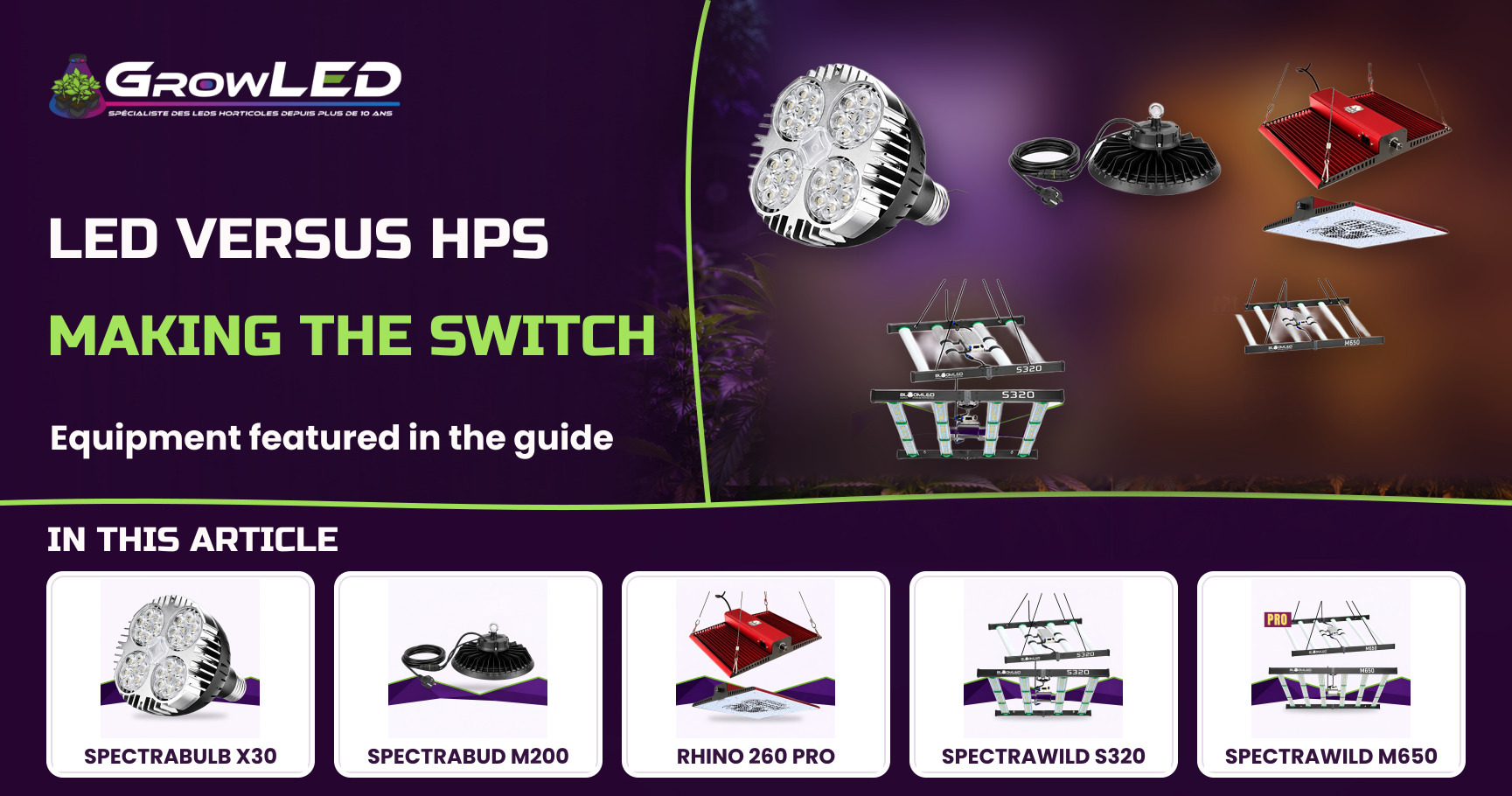
After fifteen years growing under HPS and then guiding hundreds of GrowLED customers through their switch to horticultural LED, I still see the same hesitations coming back: watts, equivalences, spectrum, heat. This article goes through, point by point, what actually changes when you move away from a high pressure sodium bulb to a horticultural LED, and how to choose the right model based on your growing area and your growth stage.
1Why HPS shows its limits in indoor growing
HPS is a lamp that heats before it lights, that is the first thing I get across to a grower who is just starting out. A high pressure sodium bulb produces its light through an electrical arc inside a tube of pressurised gas: a good share of the energy it draws is lost as radiant heat before it even reaches the plant. The concrete result out in the field: a grow room that climbs quickly in temperature, extraction that runs non-stop, and a bulb you have to replace every 6 to 12 months once its spectrum starts to drift.
The HPS spectrum is fixed, and that is where the problem lies, because a plant does not have the same needs during cloning, growth and flowering. HPS emits a light dominated by orange and red that suits flowering well, but stays a compromise for the vegetative stage, where a spectrum richer in blue promotes dense rooting and short internodes. With an HPS lamp alone you can adjust almost nothing: you light the room, and that is all.
Horticultural LED changes the mechanics at the root, a light emitting diode converts electricity into light with far less diffuse heat loss, which lets you bring the panels closer to the canopy without any risk of burning, dim the intensity, and often pick a different spectrum depending on the stage. That is exactly what this article is about: showing you, model by model, how this switch plays out in practice depending on your growing area.
| Criterion | HPS (high pressure sodium) | Horticultural LED |
|---|---|---|
| Heat produced | High, extraction sized to run non-stop | Lower at the source, panel can sit closer to the canopy |
| Spectrum | Fixed, orange and red dominant | Adjustable depending on the model (growth/flowering, dimmer, smart control) |
| Lifespan | Bulb to replace every 6 to 12 months | Diodes rated up to 50,000h on some models (e.g. SpectraBULB X30) |
| Control | Ballast, little to no fine adjustment | Built-in dimmer and/or WiFi/app control depending on the model |
On small areas, this switch shows straight away, and that is exactly the ground where the SpectraBULB X30 - E27 30W horticultural LED bulb (BloomLED) comes in. Its spec sheet quotes 35W drawn for an HPS/MH equivalence of 70W, over a 40x40 area in flowering (50x50 in growth). It is the clearest conversion ratio in the whole BloomLED range: you almost halve the power shown on your meter for equivalent lighting. It carries an OSRAM OSLON SSL diode rated for a 50,000h lifespan, and it is currently the best selling lamp in the entire BloomLED range (629 units sold), which is no accident: it is often the very first LED an HPS grower installs to test the switch on a small cabinet, before re-equipping a whole room.
🌱 Joseph's tip
Never compare two lamps on raw wattage, compare them on the equivalence quoted in the spec sheet. A 35W LED that replaces a 70W HPS is not "half as powerful", it delivers the same useful work to the plant for less consumption. That is the number one mistake I see in growers coming over from HPS: they look for an LED with the same watt figure as their old bulb, when what they should be looking for is the equivalence.

2Cloning and growth: why spectrum changes everything
A clone does not need the same light as a plant in flower, and this is probably the most misunderstood point among growers switching over from HPS. A spectrum rich in blue (around 6400K) drives compact development, dense roots and faster rooting, whereas a warm, orange spectrum like that of HPS pushes the plant to stretch to "reach for" a light it associates with flowering. Under HPS alone, you therefore often grow clones that shoot up in height before they even have an adequate root system.
The SpectraBUD M200 V2 - 200W LED panel, blue spectrum for cloning/growth (BloomLED) answers this problem head on, with a targeted blue spectrum designed for rooting and vegetative growth, exactly the stage where HPS is structurally ill-suited. Its spec sheet quotes an equivalent 400W HPS replacement for 200W drawn, which makes it the most usable figure in the whole line-up for drawing a direct LED versus HPS comparison in this power segment. It is a recent addition to our catalogue, still without any sales history, and I would rather say so plainly than dress it up with a fake popularity argument: judge it on its spec sheet, not on a sales figure that does not exist yet.
- Denser roots, a dominant blue spectrum promotes a branched root system before the plant goes into growth.
- Shorter internodes, the plant does not stretch to reach for a warm light it would associate with flowering.
- A cleaner stage transition, moving from a cool spectrum in growth to a warm spectrum in flowering gives the plant a clear signal, something a single HPS cannot reproduce.
Out in the field, I often see growers keep their HPS for flowering and switch only the cloning/growth station over to LED, that is a perfectly valid gradual transition, and often the first step before re-equipping the whole room.
3The 60x60 tier: moving on from a 400W HPS
The 60x60 is the most common area among growers replacing a 400W HPS, it is the most widespread tent format, and the one where the difference between the two technologies is felt most strongly, both on the electricity bill and on the heat to manage.
The Rhino Series 260 PRO V3 - 200W LED panel with dimmer (BloomLED) is calibrated exactly for this tier, its spec sheet quotes 200W drawn for an HPS/MH equivalence of 330W, a power very close to a classic 400W HPS, the most commonly replaced reference among growers making the switch. It carries Samsung LM301H LEDs and a full spectrum (3000K/5000K, plus 660nm red, infrared and UV), where an HPS alone only covers its fixed orange band.
The built-in dimmer genuinely changes the way you run a grow, because it lets you modulate the intensity stage by stage: you ramp the power up gradually over the first weeks of flowering so as not to stress a still young plant, then push it to the maximum at the flowering peak. An HPS ballast offers nothing comparable, it is either on at full power or off.
It is also the second best seller in the entire BloomLED range in our catalogue, with 439 units sold, just behind the SpectraBULB X30. That is no accident: it is the logical entry point for anyone who already owns a 60x60 tent fitted with a 400W HPS ballast and wants to move to LED without changing their growing area.
480x80 to 100x100: scaling up in silence and control
On an area of 80x80 to 100x100, an HPS setup almost always calls for heavy, noisy extraction, the heat generated at this power forces you to run an extractor non-stop, often the noisiest item in the whole grow room.
The SpectraWILD S320 - 320W Samsung LED bars, smart-control compatible (BloomLED) covers exactly this area, with 320W for 80x80 to 100x100 according to the spec sheet, Samsung LEDs and a quoted efficiency of 2.7 µmol/J. It is presented as silent, with no fan, a direct contrast with the heavy extraction that the heat of an HPS demands on that same area: you are not just replacing a lamp, you are also removing a good part of the thermal constraint that until now drove the whole ventilation of the room.
The real strong point of this reference is the separate growth/flowering control, via dimmer and console/Tuya app compatibility. In practice, that means setting one spectrum channel differently from the other with no extra hardware, a level of control an HPS ballast simply does not offer, since it only has a single channel, on or off.
- Less background noise, the absence of a fan on the panel itself removes a source of noise that HPS growers know all too well.
- 3-year warranty, a reliability horizon to weigh against replacing an HPS bulb, which comes round every 6 to 12 months.
- Remote control, the smart-control compatibility lets you adjust a cycle without opening the grow room.
5100x100 and beyond: replacing a multi-HPS room
Beyond 100x100, a classic HPS setup often involves several lamps, several ballasts, several heat points to manage and extraction sized accordingly. This is where the move to horticultural LED changes the layout of a grow room most radically.
The SpectraWILD M650 - 650W Samsung LED bars, smart-control compatible (BloomLED) is designed for exactly this case, 600 to 700W to cover 120x120 to 150x150cm in a single module according to the spec sheet, where an equivalent HPS setup often calls for several separate lamps. The WiFi/smart control and the quoted silent operation (zero noise) are two very concrete arguments against a classic HPS room, noisy ballasts and continuous extraction included.
In this power range, the warranty becomes a real deciding factor, 3 years quoted on this reference, to be set directly against replacing an HPS bulb every 6 to 12 months: over three years of use, that is a maintenance budget of a completely different nature.
| Area | Stage | BloomLED reference | Key spec figure |
|---|---|---|---|
| 40x40 (50x50 in growth) | All stages, small space | SpectraBULB X30 | 35W for 70W HPS/MH equivalence |
| All areas | Cloning / growth | SpectraBUD M200 V2 | 200W, equivalent 400W HPS replacement |
| 60x60 | All stages, dimmer | Rhino Series 260 PRO V3 | 200W for 330W HPS/MH equivalence |
| 80x80 to 100x100 | All stages, smart control | SpectraWILD S320 | 320W, 2.7 µmol/J efficiency |
| 100x100 and beyond (120x120 to 150x150) | All stages, smart control | SpectraWILD M650 | 600 to 700W, single module |
6Getting your transition right: setting your light cycle
A well-chosen LED is useless if the light/dark cycle is not respected precisely, this is the point I repeat most often to growers who have just switched over from HPS: the benefit of an optimised spectrum depends entirely on a stable photoperiod, 18h/6h in growth or 12h/12h in flowering as needed, with no interruption or drift from one day to the next.
This is where the Mechanical timer / programmer 24h - 15min for horticultural LED lighting comes in, and it is no secondary accessory: it is the best-selling product in our whole growshop catalogue, across all categories (986 units sold), well ahead of the lamps themselves, including the SpectraBULB X30. Adjustable in 15-minute slots over a 24h cycle, which lets you set a precise on and off time, without relying on a switch you forget to flick one evening. In practice, it is the near-systematic purchase that goes with an HPS to LED replacement, because a well-designed LED spectrum does not make up for an irregular light cycle.
- A stable photoperiod avoids the stress of reversed flowering, a plant in pre-flowering that receives light during its dark phase can revert to vegetative growth or develop male flowers on a female plant.
- Adjustment in 15-minute slots allows fine tuning, useful for setting the switch-on during the least loaded hours on the electricity meter.
- It is a minimal investment next to the rest of the setup, but it is often the thing that decides whether the grow keeps to its schedule.
🌱 Joseph's tip
Never set your light cycle on the same day you change the lamp, do it the day before and check that it runs correctly over a full cycle before plugging your new LED into it. I have seen more than one grow lose a week of flowering because of a badly set timer on the day of the HPS to LED switch, when the setup takes five minutes done cold.
7Getting your transition right: working under LED
Visual comfort is the friction point most often overlooked in the HPS to LED switch, an orange HPS light, however intense, does not strain the eye the same way a LED spectrum rich in blue and white does. Many growers only discover the discomfort after installing their first LED panel, spending time examining their canopy up close.
The BloomLED green glasses suited to growing under horticultural LEDs filter out exactly this blue component, with a filtered spectral band quoted at ±20nm, designed specifically for growing under horticultural LED and compatible with the BloomLED and TerraLED ranges. 139 units sold to date: an accessory that stays discreet in an order, but one that meets a real need as soon as you spend time each day observing, pruning or checking your grow under a LED spectrum.
It is not a superfluous comfort gadget, it is a genuine working tool: a less tired eye spots the early signs of deficiency or stress on the foliage better, and it is precisely during these close observation phases that eye strain under a blue spectrum makes itself felt the most.
Ready to move from HPS to horticultural LED?
Choose the BloomLED reference suited to your area, from the SpectraBULB X30 for a 40x40 to the SpectraWILD M650 for a 100x100 room and beyond, and complete your setup with a timer to secure your light cycle. The whole GrowLED growshop is sorted by area and by growth stage.
See the growshop →I never tell a customer that HPS is a bad technology, it proved itself over decades. What I do say is that today it demands more constraints (heat, bulb replacement, fixed spectrum) for a result that horticultural LED matches or exceeds with fewer compromises. The switch does not happen in a day: start with the area you actually grow in, choose the BloomLED reference that fits it, and neglect neither the timer nor your own working comfort under this new spectrum. It is that discipline, more than the choice of lamp itself, that makes an HPS to LED transition a success.