

































































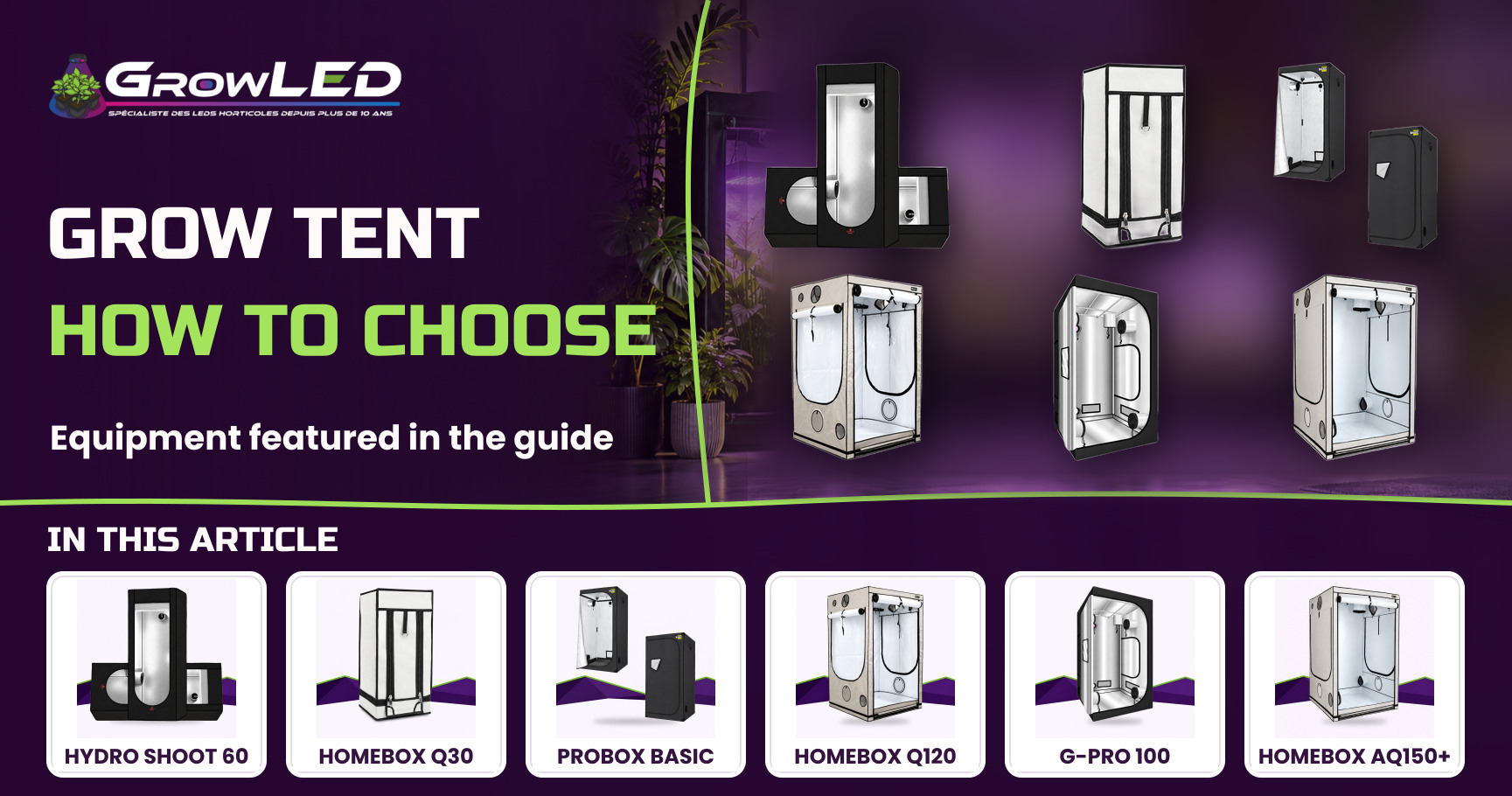
Choosing a grow tent isn't only about size. It's a balance between the number of plants you're aiming for, the real quality of the fabric and the structure, and the height you actually have available at home. Let me share the concrete markers I use, figures in hand, to sort through the models before recommending one.
1The standard format: the benchmark to know before anything else
Before you even look at a catalogue, you need to answer one simple question: how many plants, in pots, and how tall they'll grow. That answer sets the tent size, not the other way round. Too many beginner growers buy on the strength of a tempting photo, and end up with a volume poorly matched to their number of plants or their lighting setup.
In practice, a format like the Hydro Shoot - 60x60x158 cm Version 2 - Grow Tent - Secret Jardin naturally stands out as the market reference: across the whole growshop catalogue, it's the best-selling model by far, with a score that reaches double that of its nearest rival. That's no statistical fluke, it's a size that matches the most common need, one to four plants grown in pots, with enough room to move around them without bumping into the walls.
Concretely, this 60x60 footprint offers a floor area that stays manageable for a medium-sized extractor and a single central lamp, with no pronounced shadow zones at the edges. The 16 mm steel frame and the 70D Mylar interior lining (95% reflectivity) make it a solid model for this level of load, though we'll come back later to what that fabric density really means against thicker canvases.
- One plant per 60x60 cm is the baseline rule for free growth in a pot, without aggressive pruning or tight training.
- Two to four plants is workable in that same volume with a Sea of Green setup, or with SCROG-style training that spreads the canopy horizontally rather than upward.
- Usable height: always subtract 25 to 30 cm from the figure printed on the box, that's what's left once you take out the hung lamp, the rail system and the safety gap above the canopy.

2Small spaces: cuttings, mother plants and flats
At the other end of the spectrum, there's the need to keep a mother plant going or to secure a propagation phase without taking over a whole room. That's where the HomeBox Ambient Q30 - Grow Tent 30x30x60 cm comes in, the smallest format in the range with barely 0.09 m² of floor space.
What's surprising is that this format still stays in demand even though its use case is narrow: keeping a mother plant, taking cuttings, or trialling a strain before committing it to a full cycle in a larger volume. It's a poor choice for a complete flowering run, but an excellent tool for anyone who wants to keep a genetic line alive without sacrificing a square metre of their home.
The trap with small volumes is that they concentrate every constraint. Less air, less thermal inertia, less margin for error on watering. A lamp that's too powerful in 0.09 m² quickly heats the whole enclosure, and an oversized extractor dries out the atmosphere in a matter of hours. In a format like this, the gear has to be sized to the volume, not carried over from a bigger tent.
- Check lamp/volume compatibility, a wattage designed for 60x60 cm inside 30x30 cm all but guarantees heat stress.
- Think gentle ventilation, a small extractor with a speed controller beats an oversized model you're forced to throttle down constantly.
- Keep that use in mind, mother plant or cuttings, not full-scale flowering: the volume simply doesn't allow it.
3Quality: the criteria to check on the label
Once the size is settled, the real sorting happens on build quality, and this is where most buyers make do with a glance at the photo. Yet there are objective, quantified markers that let you compare two tents of identical dimensions without relying on a general impression.
The first marker is the density of the outer fabric, expressed in deniers (D). The higher the number, the thicker the thread and the tighter the weave, so the more the canvas resists abrasion, repeated handling and gear being hung on the walls. It's an indicator of mechanical durability, not just looks.
The second marker is the reflectivity of the inner lining, usually Mylar. A higher percentage sends more light back toward the canopy instead of letting it soak into the fabric, which improves light uniformity for the plants at the edges, the ones that get the least direct light.
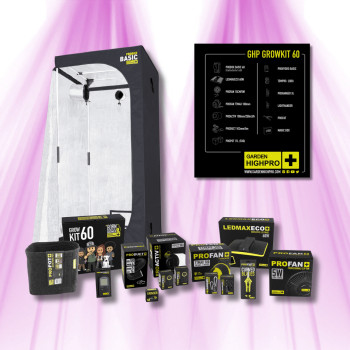
To put the gap in concrete terms, the Probox BASIC - 60x60x160 cm - Grow Tent - Garden Highpro stacks up four identifiable quality markers on a footprint almost identical to the standard format seen above: 420D nylon (versus 70D on the entry-level model), lacquered anti-corrosion metal frame, 97% reflective Mylar, and a claimed water resistance in case of a splash or a reservoir leak. It also takes a maximum load of 28 kg on its structure, a figure that comes into its own in the next section.
| Criterion | Entry level (60x60x158 reference) | Mid range (60x60x160 reference) |
|---|---|---|
| Fabric density | Mylar 70D | Nylon 420D |
| Interior reflectivity | 95% | 97% |
| Structure | 16 mm steel | Lacquered anti-corrosion metal |
| Water resistance | Not specified | Yes |
| Claimed max load | Not specified | 28 kg |
🌱 Joseph's tip
Before you buy, ask yourself what you're going to hang inside: carbon filter, extractor, reflector, training system. Add up those weights in your head and compare them to the claimed maximum load. It's often that figure, more than the fabric's denier, that decides whether the structure will hold up over a full cycle.
4Structure and load rating: the point everyone overlooks
The fabric is visible, the structure has to be inferred. Yet it's the structure that bears all the weight hung inside the tent for months: carbon filter, extractor, cabling, reflector, sometimes even the weight of horizontal training late in flowering. Neglect this criterion and you risk a frame that bends or a bar that gives way in the middle of the night.
The diameter of the tubes is the first clue to sturdiness. On compact formats you generally find 16 mm tubes, enough for light use. On larger volumes, where the hung weight mechanically increases, the diameter goes up to 22 mm.
That's exactly what the Ambient Q120 - 120x120x200 cm - Grow Tent - Homebox illustrates: 22 mm tubes for a claimed maximum load of 75 kg, almost triple the mid-range reference seen above. Over 1.44 m² of floor space, this model is designed to take several attachment points without sagging. It's a point that buyers who compare floor areas alone forget too often: two tents with the same footprint can have very different load capacities.
- List the gear you'll hang before buying the tent, not after, to check that the claimed maximum load leaves plenty of headroom.
- Tube diameter, 16 mm or 22 mm, is a quick indicator of a model's sturdiness class, even without reading the whole spec sheet.
- An undersized structure is a risk that often materialises in the middle of flowering, just when the hung weight is at its peak and a failure costs the most in stress for the plants.
5The premium tier: when the viewing window changes everything
At the top of the range there's a third quality tier, recognisable by an even denser fabric and by features the entry and mid-range models don't have. That's the case with the G-PRO Grow Tent - 100x100x200 - 22mm Tubes - GreenCube, with a Diamond 600D fabric, the densest in the whole selection, well ahead of the 70D and 420D seen above.
What really sets this model apart is its built-in viewing window. On paper it sounds trivial, in the field it's a genuine change in the way you work: being able to check the state of the plants, the colour of the leaves, the possible presence of a pest, without opening the tent door. Every opening, however brief, is a thermal and humidity shock to the internal climate, and an escape route for odours if airflow isn't restored straight away.
On the structure, you find the 22 mm tubes already mentioned and a maximum load of 50 kg, a sensible compromise for a 100x100 format that doesn't need to reach for the 75 kg of the large format covered just after.
- The inspection window, a real plus for keeping an eye on things without disturbing the climate, especially useful deep into flowering when every variation counts.
- The Diamond 600D, a fabric built to withstand years of heavy use, best kept for growers who run their tent over many cycles.
- A good load/format compromise, 50 kg on 100x100 cm leaves plenty of margin for standard equipment without chasing the extreme.
6Moving up to large formats: ceiling height, the forgotten criterion
When you scale up in surface area, you almost always think about the floor space available in the room. Far too often you forget to check the actual ceiling height, when that's exactly what decides whether the large format you've chosen will really fit the space.
The Ambient AQ 150+ - 150x150x220 cm - Grow Tent - Homebox is the only model in the range to exceed 2 metres in height, with 220 cm claimed versus 160 to 200 cm on the other formats. That extra height isn't a luxury: it makes room for the extractor and carbon filter up top, out of the canopy zone, while keeping enough distance between the lamp and the tops of the plants throughout the growth phase.
Without that margin, you end up having to choose between a lamp too close to the plants (risk of burning the tops) or an extractor that eats into the usable growing space. The maximum load of 75 kg, identical to the 120x120 format seen above, confirms that the structure is calibrated to carry several heavy pieces of equipment without weakening despite the added height.
- Measure the room first, ceiling included, before picking a format over 2 metres: the real elbow room sometimes comes down to centimetres.
- Reserve height for the extractor-plus-filter combo, which on its own takes up several dozen centimetres up top depending on the gear you choose.
- Anticipate the lamp/canopy distance, it changes as growth progresses: what's comfortable at the seedling stage can get too tight deep into flowering.
7Pitfalls to avoid: don't confuse propagation with flowering
The most common trap among beginners is buying a tiered structure thinking it'll do the job for a full cycle right through to flowering. That's exactly the case with the Probox Propagator L - 60 x 40 x 200cm - Grow Tent - Garden HighPro, a model designed and sold for one precise phase of use, propagation, with 5 levels and 4 shelves spread over a volume of 0.48 m³.
On paper, the external dimensions (60x40x200 cm) can be misleading and give the impression of a volume comparable to a classic flowering tent. In reality, that volume is split into horizontal strata to multiply the propagation surfaces, not to house a plant at full height with a root system developing freely. Planting a strain destined for flowering into that kind of structure means condemning yourself to disappointment at the flip, when the plant needs all the vertical space available.
Other classic pitfalls keep coming up in the feedback I see in the field: ignoring fabric density and going purely on looks, underestimating the load the structure will bear once all the gear is attached, or choosing too generous a volume relative to the actual number of plants, which then makes humidity harder to control in a half-empty space.
- Always check the stated phase of use, a propagator isn't the same as a full-height grow tent, even if the external dimensions look alike.
- Don't undersize the structure, fall back on the load-rating reflex from the section above before validating a purchase.
- Don't oversize the volume either, a space too big for the number of plants makes the internal climate harder to stabilise, not easier.
🌱 Joseph's tip
If a model is described with a precise phase of use or a number of shelves, it's a clear signal: it's designed for one stage of the cycle (seedlings, cuttings, mother plant), not for the whole growth-plus-flowering run. Always read that mention before settling on the external dimensions, which can be misleading.
Ready to choose your format?
Here are the two benchmarks from this article, the Hydro Shoot - 60x60x158 cm Version 2 - Grow Tent - Secret Jardin, the reference format for one to four plants, or the Ambient AQ 150+ - 150x150x220 cm - Grow Tent - Homebox to move up to a large volume. The rest of the selection, from small formats to premium models, is waiting for you at the growshop.
See the growshop →After years of fielding questions about choosing a tent, I always come back to the same advice: start from the number of plants and the height you have at home, not from the prettiest photo in the catalogue. The 60x60 format remains the safest benchmark to get started, fabric density and structure diameter make the real quality difference at equal size, and a tiered propagator has never replaced a flowering tent. Take the time for these few checks before you buy, and your grow will repay you across the whole cycle.