


































































CannaLED
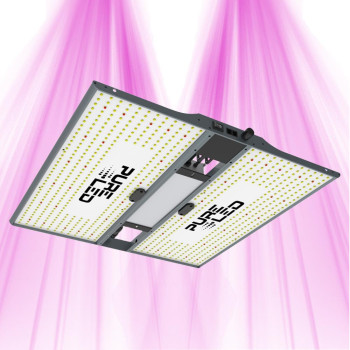
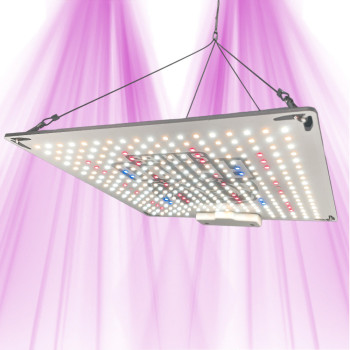
Rhino Series 130 V4 - New generation LED horticultural panel
In stock · Shipped within 24 h
219,90 € or 3× 73,30 €

Product successfully added to your shopping cart
Ça pousse dans le bon sens

17 products
100W horticultural LEDs represent the sweet spot for growers looking for high-performance lighting without breaking the bank on electricity bills. With a real power consumption of around 100 watts, these LED panels offer an optimized light spectrum to support your plants from germination to harvest. Perfect for grow spaces from 60x60cm to 80x80cm, they advantageously replace older 250W HPS lights while halving power consumption.
Frankly, 100W LEDs have been a game-changer for small setups. Where a 250W HPS would continuously draw 250 watts plus the ventilation to dissipate heat, a modern 100W LED actually draws 100-110 watts from the wall. Photosynthetic efficiency? We're talking 2.5 to 3.0 µmol/J for recent models, compared to a maximum of 1.7 µmol/J for an HPS. It's simple math: more useful photons for fewer watts consumed.
The other huge advantage is thermal management. A 100W LED heats up much less than an HPS, which drastically simplifies the ventilation of your space. No more oversized extractors making airplane noises. With an LED, a simple 125mm extractor is often enough to renew the air without temperature issues. And in terms of spectrum, modern full spectrum LEDs cover from blue (440nm) to far red (730nm), with peaks in the areas that plants truly love.
First criterion: the actual power drawn from the wall. Beware of manufacturers who advertise "200W equivalent" for an LED that only draws 50W real. Always check the actual consumption, usually indicated in fine print. For a true 100W LED, you should see a consumption between 95 and 110 watts.
Next, look at the spectrum. The best 100W LEDs integrate Samsung LM301B or LM301H diodes, known for their efficiency and longevity. The spectrum should cover at least 380-780nm with marked peaks at 450nm (blue), 660nm (red), and ideally 730nm (far red) to optimize photomorphogenesis. Some models add UV (365nm) and infrared (850nm) to boost terpenes and resin.
For cooling, opt for models with massive aluminum heatsinks and silent fans. An LED that overheats ages poorly and loses efficiency. The best manufacturers guarantee 50,000 hours of operation with less than 5% light degradation. Finally, check that the driver is dimmable: being able to adjust the intensity from 10 to 100% gives you enormous flexibility depending on the growth phases.
A quality 100W LED effectively covers 60x60cm for vegetative growth and 50x50cm for flowering. To optimize light penetration, maintain a PPFD between 200-400 µmol/m²/s during growth and 400-600 µmol/m²/s during flowering. Beyond 80x80cm, light intensity becomes insufficient at the edges, especially for demanding plants. If your space is 100x100cm, it's better to opt for two 100W LEDs or switch to a 200W.
Start at 60-70cm from young plants, then gradually move closer to 30-40cm during flowering. The ideal is to measure the PPFD with a lux meter: you aim for 200-300 µmol/m²/s for seedlings, 400-500 µmol/m²/s for vegetative growth, and 500-700 µmol/m²/s for flowering. If the leaves yellow or curl, it's too close. Conversely, if the internodes stretch excessively, move the LED 10cm closer.
Modern 100W LEDs are indeed full spectrum and perfectly handle all phases. The spectrum includes blue (440-460nm) for compact vegetative growth, red (660nm) to trigger flowering, and far red (730nm) for stem elongation. Some models add UV-A (365nm) which stimulates trichome production and infrared (850nm) for the Emerson effect. Unlike older blue/red LEDs, you no longer need to change lighting between phases.
Absolutely, and it's even recommended! A quality 100W LED produces as many usable photons as a 250W HPS, while consuming 60% less. HPS wastes a lot of energy in useless infrared heat, whereas LED concentrates its energy in photosynthetically active wavelengths. You maintain the same yield in grams per watt, or even better, while drastically reducing your electricity costs and thermal footprint. The return on investment is achieved in 6-8 months depending on your electricity tariff.
Maintenance of a 100W LED is minimal but crucial. Clean the heatsinks every 2-3 months with a dry brush to prevent dust accumulation that impairs cooling. Check that the fans rotate freely and replace them if they become noisy. Avoid thermal shocks: never wet a hot LED and let it cool before handling. Use a quality timer to avoid micro-cuts that strain the drivers. With these precautions, your LED will easily last its advertised 50,000 hours, which is 5-6 years of intensive use.
Available in 3 models
Available in 4 models
Available in 3 models
Available in 17 models
Available in 17 models
Available in 17 models
Available in 2 models
Available in 4 models
Available in 2 models
Available in 3 models
Help & advice
About 100W — click a question to see the answer.
For a grow area of 60x60cm to 80x80cm, I highly recommend a 100W horticultural LED. This is the "sweet spot" for achieving excellent results without excessive power consumption. If you have a larger space, say 100x100cm or more, you'll need to consider higher wattages, such as a 200W or even multiple panels.
Generally, for a 100W LED, I advise a distance of 30 to 45 cm from your plants' canopy. For seedlings and young sprouts, you can start a bit higher, around 45-50 cm, then gradually lower it. The idea is to provide intense light without burning the leaves. I encourage you to observe your plants carefully to adjust the height.
Most modern 100W horticultural LEDs I see on the market offer a full spectrum, optimized to cover all life phases of the plant, from vegetative growth to flowering. This is what I recommend for simplicity and efficiency. If you have a model with specific spectrum options, a bluer spectrum is ideal for growth and a redder spectrum for flowering.
The light cycle depends on your plants' life stage. For vegetative growth, I generally recommend an 18-hour light and 6-hour darkness cycle (18/6). During flowering, you need to switch to 12 hours of light and 12 hours of darkness (12/12) to stimulate flower production. This is a golden rule in indoor horticulture.
Yes, absolutely! A 100W horticultural LED is more than sufficient for most indoor plants, especially if you're growing in a medium-sized space (60x60cm to 80x80cm). It's an excellent option for amateur gardeners or for a small dedicated grow space. It advantageously replaces older technologies like 250W HPS lamps.
The major difference lies in the light spectrum and efficiency. A horticultural LED is specifically designed to emit the wavelengths of light that plants use for photosynthesis, often a full spectrum or optimized blue/red spectra. A classic LED, like those for home lighting, is optimized for the human eye and is not effective for plant growth. This is a crucial point I always emphasize.
If your lamp is too close, you'll see signs of light stress: leaves yellowing or bleaching on top, burnt tips, or leaves curling upwards. If it's too far, your plants will stretch, meaning they will become long and thin with large spaces between nodes, desperately seeking light. Observation is your best ally in finding the right distance.
The energy savings with horticultural LEDs are significant. A 100W LED can replace a 250W or higher HPS bulb, while producing equivalent or even superior yields. This represents a reduction in electricity consumption of over 50%, which directly impacts your bill. I also explain how we value old technologies in this article.
Cannot find your answer? 01 88 33 45 52 or by message.