

































































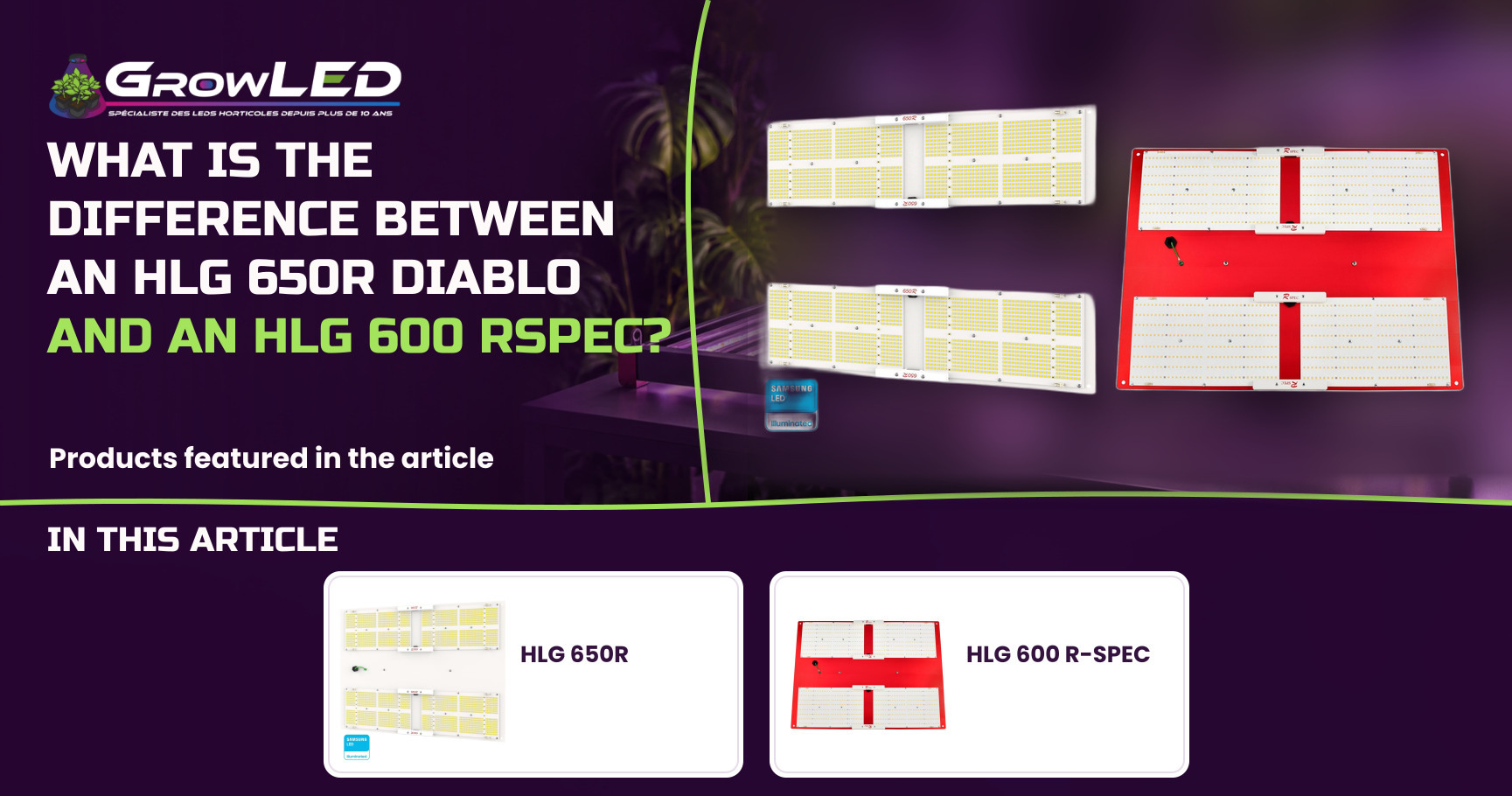
What is the difference between an HLG 650r Diablo and an HLG 600 Rspec?
In this article we will see the difference between Rspec LED horticultural lighting and the brand new Diablo panels from the American brand Horticulture Lighting Group.
If you are looking for a new LED light for your 150 x 150cm tent, chances are you have come across some QB (Quantum Board) panels from the HLG group during your research. Here we will show you our results and what we think of the latest models of the brand.
1st difference: Quantum Board panels
The older models have Quantum Board 288 boards and the newer Diablo 650Rs use the new QB648 boards.
The two LED lights use the same heat sink and the same power supply, the only difference is the integrated quantum cards (QB). The old 600 R-Spec models are equipped with 4 QB288 R-Spec boards which each consist of 272 Samsung LM301H diodes in 3500k color temperature and 16 Samsung LH-351H V2 deep red 660 nanometers diodes for a total of 1088 white chips and 64 deep red chips.
On the HLG 650R Diablo lamp we have four Diablo QB648 boards which each have more than double the number of diodes of the R-Spec 288. Each of the four QB648 boards is made up of 648 LM301H diodes and a mix of 3000k and 5000k , and these are supplemented by 18 of the same dark red LH-351H V2 diodes as the R-Spec version, that makes a total of 2592 white and 72 deep red LEDs on the 650R Diablo.
You therefore have more than double the number of LEDs on the new HLG 650R Diablo version.

2nd difference: power
As you might have guessed, despite the fact that these two lights use the same power supply, the 650R draws around 650 watts of power and the HLG 600R draws around 600 watts.
Both of these LEDs heat up and the measurements show 60 degrees Celsius on the back of the heat sink in some places.
HLG submitted their reports and the measured photosynthetic photon flux for the HLG 600R lamp is 1552 micromoles per second while the 650R produces 1770 micromoles per second. It is basically a measure of the amount of light emitted and absorbable by plants. We can clearly see here that the Diablo versions are more efficient with more micromoles emitted.
As for micromoles per joule, you can expect 2.55 micromoles per joule for the 600R and 2.81 micromoles per joule for the 650R Diablo. Again, we are at the top for the new version.
The Diablo has more than twice as many diodes as its previous version, which means from testing that the Diablo's diodes are going to be powered by half the amount of power (I know, this part is not easy to follow!). This makes the Diablo considerably more efficient.
More in-depth testing
Let's start our tests at a height of 75cm, in a box of 120 x 120cm. With this configuration, the HLG 600R lighting peaks at just over 900 micromoles per square meter per second. Centered under lighting, the Diablo 650R amounts to over 1,000 micromoles per square meter per second.
Here are the measurements at 80cm tall, we think this might be the sweet spot if you're trying to maximize PPFD without giving up too much space and uniformity. The HLG Diablo is very efficient in a box of 150 x 150cm to 80cm, this lamp always emits more than 900 micromoles on a good part of the center, the 600R is not left out and overall, it does not average only about 100 micromoles less than the Diablo and still shows big numbers.
In conclusion, the HLG 600 R-Spec is an excellent LED light with very good performance, for its lower price than its big brother. The 650 Diablo version is more powerful, with more LEDs to provide better performance in growth and flowering.
Rspec, Bspec, Diablo, Quantum Boards, Scorpion: the full HLG range, the recommended lamp for each grow area and customer reviews are on our Horticulture Lighting Group brand page.