





































































A pot is never a neutral choice. Fabric or rigid, with or without a drainage hole, 2 litres or 15: every container decision changes the way your roots breathe, drink and develop. I'll show you how to make that choice at every stage, from seedling to final pot.
Why the container changes (almost) everything
A grower who neglects the pot, I can spot from a mile off: a plant that stalls late in growth, leaves yellowing for no obvious reason, waterings that no longer make any sense even though the light and the feed are dialled in to perfection. Nine times out of ten the problem is neither the lamp nor the nutrients: it's the volume, the material or the drainage of the container failing to keep up with the plant's actual pace.
Three mechanisms govern everything, and I'll go through them in detail in this article: air-pruning (the way the pot walls self-prune the roots), water dynamics (how water moves and evaporates depending on the material) and the risk of over-potting (a volume that's too large for a still-young root system, which then stays waterlogged for too long). Understanding these three points is understanding why we repot in stages rather than dropping a seedling straight into 15 litres of soil in the hope of saving time.
- Air-pruning, unique to fabric: a root that touches a breathable wall meets the air, stops its progress and branches out instead of circling round.
- The breathing of the walls, which speeds up evaporation and therefore the watering rhythm, very different between a fabric pot and a rigid plastic one.
- The volume-to-plant ratio, which has to follow the actual size of the root system, not the other way round.
A table says more than a long speech here, so this is how the progression plays out in practice, from seedling to final pot, with the volume and the type of drainage matching each stage.
| Stage | Volume | Drainage | Why this choice |
|---|---|---|---|
| Seedling / cutting | 7x7x8cm pot | None | Tiny roots, controlled manual watering |
| Young plant | 2 L | Draining base | First real need to evacuate water |
| Growth | 4 L (fabric) | Breathable walls | Tests air-pruning on a small volume |
| Flowering | 11 L | Fabric or rigid, your call | Final volume suited to most genetics |
| Vigorous genetics | 15 L | 260g geotextile | Same footprint, more reserve |

Fabric or rigid: the duel that reshapes your roots
The question comes back every season, fabric or rigid plastic, and the honest answer is: it depends on what you're trying to optimise, root density or the spacing between waterings. Let me walk you through the mechanisms that really make the difference, not just the look or the colour.
Air-pruning first, because it's the number one argument for fabric. In a rigid pot, a root that reaches the wall has nowhere to go: it follows the contour, spirals round, and eventually forms a compact root ball that chokes itself over time and limits water uptake at the very moment the plant needs it most. In a fabric pot, that same root touches a breathable wall, meets the surrounding air, dries out slightly at its tip and stops advancing. The plant responds by putting out new rootlets just upstream, which densifies the whole root system instead of letting it run off to the edges. The concrete result: more fine rootlets, and therefore more surface area to exchange water and nutrients.
Then there's substrate oxygenation, a point that's often overlooked. Roots don't only consume water, they breathe too: they need the oxygen held in the tiny air pockets of the substrate. A fabric pot promotes gas exchange across its whole surface, which helps the substrate re-oxygenate faster after a watering. A rigid pot, by holding moisture for longer, leaves less room for that air exchange until the substrate starts to dry out, which is exactly why you should never water before the surface has genuinely dried.
Water dynamics last of all, and this is where a lot of people get caught out when they switch material. Geotextile breathes across its entire surface: water evaporates through the walls too, not just from the top of the substrate. In practice that means more frequent waterings, a substrate that dries out faster, but also a slight cooling effect on the root zone in summer, handy when the tent heats up. The rigid pot, on the other hand, only lets moisture escape through surface evaporation: it holds water longer, which spaces out waterings, but leaves you far more exposed to overwatering if you keep your fabric-pot habits without adjusting your frequency.
🌱 Joseph's tip
When you switch material mid-culture, don't keep your usual watering schedule: run a finger into the substrate before every feed, fabric and rigid never behave the same way under your hand.
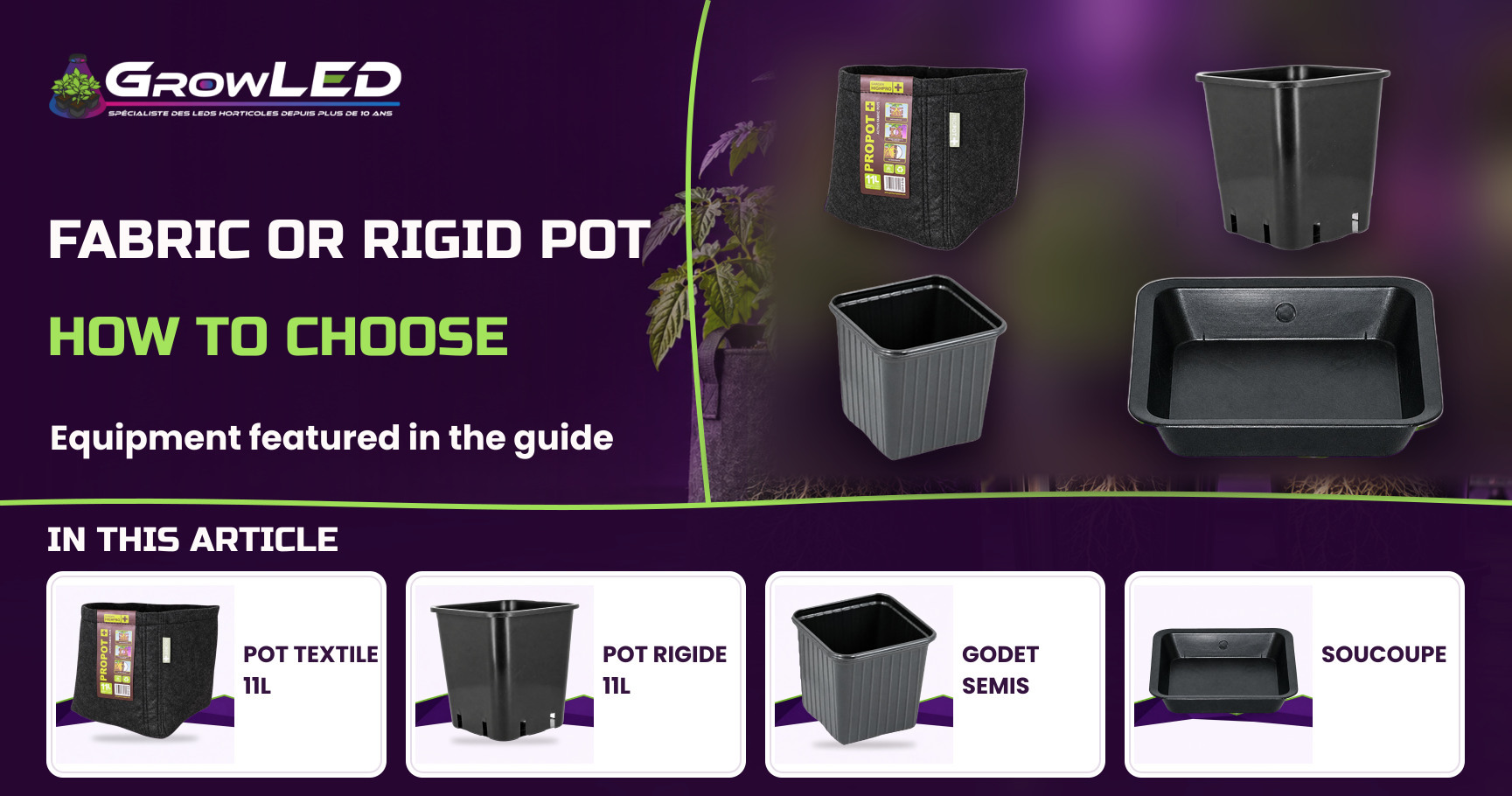
To settle the two at equal volume, nothing beats a direct comparison. I put the 11L Fabric Pot - 23x23x25cm head to head with the 11L Growing Pot - Black square - 25x25x25.5cm: same volume, same use as a final flowering pot, but radically different behaviour day to day.
| Criterion | Fabric pot | Rigid pot |
|---|---|---|
| Root system | Air-pruning, dense branching, no spiralling | Risk of a root ball if repotting is late |
| Watering frequency | Closer together (evaporation through the walls) | Further apart (water stays put) |
| Root temperature | Slightly cooled in summer | More stable, prone to overheating in full sun |
| Handling | Soft, handy carry handles, machine washable at 30°C | Holds its shape, moves without deforming |
| Main risk | Drying out if you forget to water | Overwatering and anoxia if waterings aren't adjusted |
1The seedling pot, no drainage and that's on purpose
At the very first stage, forget the "you need a hole at the bottom" reflex: the Seedling Pot - 7 x 7 x 8cm deliberately doesn't have one. A cutting or seedling root system sits in just a few cubic centimetres of substrate: a pierced base would dry it out in a matter of hours, before the first rootlets have even had a chance to take hold.
Control is done by hand, with small, frequent, measured waterings rather than passive drainage. It's also the best-selling item in the range (1584 sales): the starting reference for the vast majority of growers, who use it just as much for a seed in soil as for rooting a cutting.
- Minimal volume, suited to a still-embryonic root mass.
- No drainage, to keep the moisture in direct contact with the first roots.
- Length of the stage, just a few weeks before the first real repot.
2The first real repot, time for drainage
As soon as the first true leaves appear, the seedling pot becomes too small and, above all, too closed: it's time to move to the 2L Pot - 13x13cm - Draining base. It's the first container in the chain that demands active water evacuation, and that change is no small thing.
Why drainage becomes essential here: the volume of substrate increases, and so does the watering frequency, and without a drainage hole the excess water would sit stagnant at the bottom of the pot. That stagnant water starves the roots of oxygen (what's known as root anoxia) and encourages the development of pathogenic fungi on the most fragile roots. With a draining base, the surplus flows away and never stays in prolonged contact with the root system.
This size has racked up 1700 sales, and the product page describes it as "perfect for a grow tent": the dimensions are designed to stay compact while offering enough volume to see the plant through its first real growth phase.
🌱 Joseph's tip
Never sit this pot directly on the tent tray, the water that runs out through the draining base has to be collected, otherwise it pools under the pot and you recreate the very problem drainage is meant to solve.
3The fabric bridge to test air-pruning
Between the rigid 2L and the final 11L pot, there's a step many people wrongly skip: the Fabric Pot - 4L - 15x15x20cm. This size acts as a bridge: it moves the plant into active growth while introducing, for the first time, fabric as a material and its air-pruning effect.
Jumping straight from the 2L to the 11L is the classic over-potting trap. A young root system placed in too large a volume of substrate can't dry all of it out between two waterings: the part of the substrate the roots haven't explored stays waterlogged far longer than expected, oxygen becomes scarce there, and the roots that venture in end up suffocating before they've even had time to develop. The 4L fabric pot avoids this trap by respecting the pot-volume-to-root-mass ratio at this precise stage.
It's also the ideal size, one I recommend as a matter of course, for getting to grips with fabric care: the geotextile of this pot is machine washable at 30°C, which lets you reuse it culture after culture without having to buy a new one every cycle.
- Breathable geotextile, the first air-pruning effects visible when you unmould.
- Natural drainage, excess water passes through the walls instead of stagnating.
- Washable at 30°C, a pot you reuse from one culture to the next.
4The final pot, fabric or rigid
This is the choice that matters most, the final flowering pot, and it's here that the fabric-versus-rigid duel from the previous section really comes into its own in real conditions. Two references at the same volume (11 litres) let you decide according to how you run your culture: the 11L Fabric Pot - 23x23x25cm and the 11L Growing Pot - Black square - 25x25x25.5cm.
The 11L fabric pot is the reference of the range, made by Garden HighPro and by far the best-selling size (2457 sales): its 23x23cm square base makes the most of the floor space in a standard tent tray, without losing usable volume to dead corners. It's the default choice if you water often and keep a close eye on your substrate's moisture.
The 11L rigid is its direct counterpoint, with 1596 sales to its name: same volume, but a slightly wider base (25x25cm) and, above all, a material that holds its shape when moved and retains moisture better between two spaced-out waterings, since there's no lateral evaporation through the walls. It's the logical choice if you're not around every day or if you prefer longer watering cycles.
- Go fabric if you monitor your culture daily and want to maximise root density.
- Go rigid if your waterings are further apart or if the pot needs moving often without deforming.
In both cases, the saucer isn't a comfort accessory, it's part of the drainage system. Indoors, with no evacuation to the outside, all the water that passes through the substrate has to land somewhere: that's the job of the Black Saucer 28.5x28.5cm, sized to fit both the 23x23 base of the fabric pot and the 25x25 base of the rigid one, and described on the product page as "ideal for an 11L pot". It's actually the best-selling saucer of the range (1598 sales), precisely because it matches the most common final pot size.
One point of caution, though: a saucer that catches the run-off isn't a water reserve to leave sitting there. If the bottom of the pot stays in permanent contact with the water pooled in the saucer, you artificially recreate the overwatering that drainage was meant to remove. Empty it after every generous watering, especially with a rigid pot where the water takes longer to evaporate.
🌱 Joseph's tip
No need to pick "the best" between fabric and rigid in the abstract, choose the one that fits how present you actually are in the tent: frequent waterings and close monitoring, go fabric; a more spaced-out schedule, go rigid.
5Moving up to 15L for vigorous genetics
Some genetics don't stop at 11 litres, and forcing a vigorous root system into a volume that's too tight ends up holding the plant back late in flowering. The signal is unmistakable: growth slowing down while the plant is still young, roots starting to appear on the surface of the substrate or against the walls. For those cases, the 15L Fabric Pot - 23x23x28cm takes over.
What's clever about this size is that it keeps exactly the same floor footprint as the 11L (23x23cm): only the height gains 3cm to offer 4 extra litres of reserve. In practice, you move up a size without reconfiguring your tent tray or changing the layout of your plants under the light.
The geotextile used here is 260 grams, a thickness designed to stay rot-proof over the long haul, and the stitched handles are no cosmetic detail: a 15L pot full of moist substrate weighs a lot, and moving it without handles quickly turns into a balancing act. This size has racked up 1759 sales, a sign that the need to go bigger without changing the footprint is common among growers working with vigorous genetics.
For the saucer, switch reference: the Saucer 33.5x33.5cm - Black square is rated compatible from 1 to 25 litres, with a 25x25cm interior that leaves a safety margin around the 23x23 base of the 15L. It's also the option to favour if you want a single accessory able to follow the whole repotting chain, from the 2L to the final pot, without multiplying references in stock.
- Same floor footprint, a seamless upgrade in an already configured tent.
- 260g geotextile, durability over time, rot-proof.
- Integrated handles, useful the moment the full pot weighs more than a few kilos.
- Universal 1-25L saucer, a single purchase that follows the plant at every stage.
Build your repotting chain
From the seedling pot to the final pot, every step has its container: find the 11L Fabric Pot - 23x23x25cm and the 11L Growing Pot - Black square - 25x25x25.5cm, along with every other size in the progression, on the growshop.
See the growshop →If there's one thing to take away, it's that a pot is never just a container: it's a management tool in the same way as your light or your feed. I still see too many growers put a seedling straight into a final pot "to avoid having to repot", only to end up with a substrate that stays wet too long and roots that stall. Take the time to work through the stages, choose the material according to how present you really are in the tent, and never neglect the saucer: it's often the detail that decides whether your run-off drains away cleanly or your plant ends up with its feet in the water.