




































































CannaLED
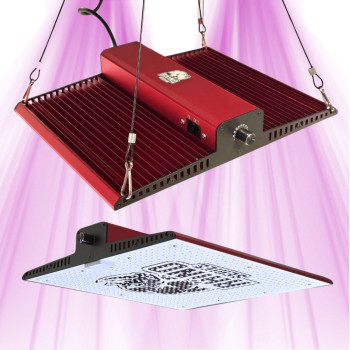
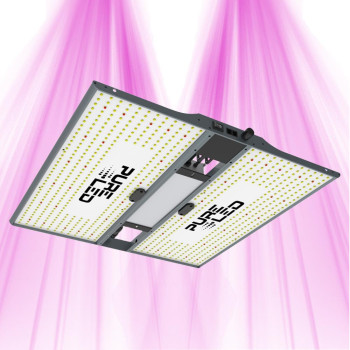
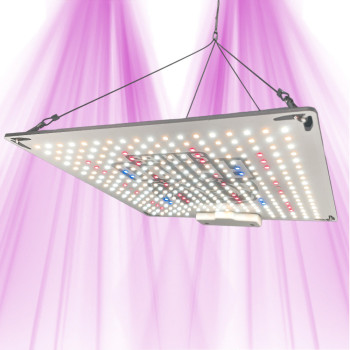
Rhino Series 130 V4 - New generation LED horticultural panel
In stock · Shipped within 24 h
219,90 € or 3× 73,30 €

Product successfully added to your shopping cart
Ça pousse dans le bon sens

18 products
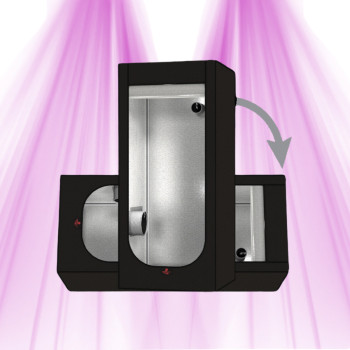
A 60cm x 60cm lighting area represents 0.4m², the perfect size for starting indoor cultivation or maintaining a few mother plants. This dimension perfectly matches the most compact grow tents and requires specifically adapted lighting to optimize every available square centimeter.
On such a small surface, every watt counts. Improperly sized lighting will either burn your plants or cause them to stretch. For 0.4m², we generally aim for between 120W and 200W in LED, depending on the growth stage. The advantage of LEDs on this surface is that they generate less heat than HPS – crucial when you have little volume to evacuate hot air.
Headroom becomes critical in these small spaces. With a 60x60cm tent, which is often 140cm high, you need to account for the extractor, filter, and maintain 30-40cm between the lamp and the top of the plants. Slim LED panels take up less space than traditional HPS reflectors.
First criterion: actual power. For 0.4m², count on a minimum of 120-200W actual power, which is 300-500W/m². Beware of fanciful "equivalences" – an LED advertised as "600W equivalent" often only consumes 100W actual. Always check the effective electrical consumption.
Second crucial point: the light spectrum. Full spectrum with warm white (3000K) and cool white (6500K) plus some red (660nm) and blue (450nm) diodes give good results throughout the entire grow. Panels with only red and blue (blurple) are outdated.
Finally, consider heat dissipation. On 0.4m², an LED that heats up too much will turn your space into an oven. Opt for models with sturdy aluminum heatsinks or efficient passive cooling. Integrated fans often fail after 2-3 years.
For a 0.4m² area, aim for between 120W and 200W of actual power depending on your goals. For vegetative growth, 120-150W is ample. For flowering, go for 180-200W to maximize bud density. Never rely on "HPS equivalences" advertised by manufacturers – only look at the actual power consumption indicated in the technical specs. A good ratio is 400-500W/m², which means 160-200W for your surface.
With 150-200W LEDs on 0.4m², start at 40-50cm height then gradually move closer. Young plants tolerate 60-70cm, growing plants 40-50cm, and in flowering you can go down to 30-35cm if the temperature remains correct. The hand test works well: if it's too hot for your hand after 30 seconds, it's too close. Monitor the top leaves – if they curl or yellow, raise the light by 10cm.
For 0.4m², LEDs clearly win. A 250W HPS will generate too much heat in such a small volume – you'll struggle with ventilation and temperature. 150-180W LEDs produce just as much usable light with 2-3 times less heat. Plus, no bulky ballast or annual bulb changes needed. The only advantage of HPS is the initial purchase price, but in the long run, LEDs are more cost-effective.
The 18 hours light / 6 hours darkness cycle is standard for vegetative growth. Program the light to turn on around 6-7 AM to take advantage of off-peak electricity hours if you have them. Turning it off around midnight-1 AM helps avoid daytime heat peaks in summer. On 0.4m², consumption remains modest (150-200W) so the impact on your electricity bill remains manageable. Some growers do 20/4 or even 24/0 for growth, but 18/6 remains the best compromise between growth and consumption.
Clean the LEDs every 2-3 months with a slightly damp microfiber cloth (lamp off and cooled). Dust easily reduces light efficiency by 10-15%. Avoid harsh chemicals that can damage the diodes. For longevity, temperature is the most important factor: an LED running at 60°C will last 50,000h, the same one at 80°C will only last 25,000h. Ensure the heatsinks are not blocked and that air circulates well around the lamp.
Help & advice
About 60cm x 60cm - 0.4m² — click a question to see the answer.
For a 60cm x 60cm (0.4m²) area, I generally recommend an LED power of between 80W and 120W actual draw. This will, of course, depend on the type of plants and your yield goals. If you're aiming for intensive cultivation, you could even go up to 150W, but be mindful of heat management. I explain in more detail how to choose the power in this article.
The ideal distance varies depending on your LED's power and your plants' growth stage. Generally, I start at 30-45 cm from young seedlings and can lower it to 20-30 cm during peak flowering for the most powerful models. The important thing is to observe your plants: if the leaves yellow or curl, the light is too intense or too close.
For a small area like 60x60cm, I clearly lean towards LED. It generates much less heat than HPS, which is a significant advantage in a confined space where temperature management is crucial. Furthermore, LEDs are more energy-efficient and offer a light spectrum better suited for plants. HPS is often too powerful and too hot for this size.
For versatile cultivation on 0.4m², I recommend a 'full-cycle' or 'full-spectrum'. This means the lighting covers both the needs for growth (more blue) and flowering (more red). It's the most practical and efficient solution, as it avoids having to change lamps between phases. Some models even include UV and IR to optimize production.
Installation is usually simple. I advise you to hang your LED lamp using the provided suspension kits, ensuring it is centered above the growing area. Use rope ratchets or pulleys to easily adjust the height. Make sure cables are not obstructing anything and that the power supply is well-ventilated, preferably outside the tent.
The most common mistake I see is placing the LED too close to the plants, which can cause light stress. Another mistake is underestimating ventilation; even though LEDs generate less heat than HPS, good air circulation remains essential. Finally, don't neglect the quality of your LED: a higher initial investment in a good product will save you money in the long run.
Cannot find your answer? 01 88 33 45 52 or by message.