




































































Sanlight
FLEX10 - Compact Linear Led Horticultural Lighting - 10W
Ships within 2 weeks
54,90 € or 3× 18,30 €

Product successfully added to your shopping cart
Ça pousse dans le bon sens

100 products
LED grow lights have transformed the world of indoor growing, offering advanced technology that replicates the ideal lighting conditions for plant growth. Whether you’re a home gardener or a seasoned professional, these lights are designed to maximize your yields while minimizing your energy costs. In this article, discover why LED grow lights are a must-have, how to choose and use them, and which brands to choose for the best results.
LED grow lights offer a revolutionary solution for indoor growers thanks to their multiple technological and economic advantages. They far outperform traditional options such as halogen or fluorescent bulbs.
One of the biggest advantages of LED lights is their low energy consumption . They use up to 70% less energy than other types of lights, which helps reduce your electricity bills while reducing your carbon footprint. In addition, they generate less heat, eliminating the need for expensive cooling systems in your grow spaces.
Unlike traditional bulbs, LED grow lights are designed to emit an adjustable light spectrum . This means they can be configured to meet the specific needs of your plants at each stage of their development, whether it’s germination, vegetative growth or flowering. This precise control ensures optimal growth, no matter what type of plant you’re growing.
There are a wide range of LED lights available, each designed to meet specific needs. Understanding these differences is crucial to choosing the best model for your crops.
These lamps reproduce natural sunlight and are ideal for growers looking for a versatile solution. They cover all stages of plant growth, from germination to harvest. They are particularly suitable for spaces where several types of plants are grown simultaneously.
Some LED lamps are optimized for specific phases:
These models offer the ability to adjust light intensity according to the needs of the plants. This flexibility is ideal for adapting to different periods of the day or specific varieties of plants.
With so many options available, choosing the right lamp can seem complex. Here are the essential criteria to consider to make the best choice.
The power of a lamp (expressed in watts) should correspond to the size of your growing space. For example, a 300W lamp is suitable for an area of approximately 1 m² . Larger spaces require more powerful lamps or multiple connected units.
The light spectrum is crucial for photosynthesis and plant growth. Opt for a full spectrum if you want a versatile solution or specific spectra to meet the specific needs of your crops.
Investing in a quality LED grow light, with a manufacturer warranty, is essential to ensure long-term use. High-end LED lights have an average lifespan of 50,000 to 100,000 hours , offering considerable savings on frequent replacements.
Known for its affordable and efficient lamps, BloomLED offers solutions adapted to amateurs and small growing spaces. Their products combine simplicity and performance.
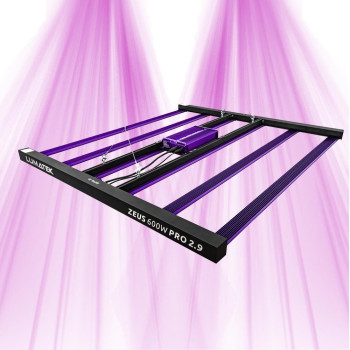
A world leader, Lumatek stands out for its multi-bar systems, perfect for professionals looking to maximize their yields. Models like the Zeus 600W are highly prized for their quality.
This innovative brand focuses on eco-responsible products, integrating the latest technologies to reduce energy consumption while optimizing plant growth.
To avoid burning the leaves, place your LED lights at a distance of 30 to 50 cm from the plants. This distance can be adjusted depending on the light intensity and the specific needs of the crops.
Adjust the lighting duration according to the type of plant:
Keep your lamps clean to prevent dust build-up, which can reduce their effectiveness. Also, inspect cables and connections regularly to ensure safe operation.
Although they emit less heat than other types of lamps, a slight heat may be felt after prolonged use. However, this does not affect your plants or the environment.
LED grow lights have an impressive lifespan, often between 50,000 and 100,000 hours , which equates to several years of continuous use.
No. LED grow lights are specially designed to provide a light spectrum suitable for photosynthesis, which conventional LEDs cannot offer.
By choosing our products, you benefit from:
LED grow lights combine efficiency, durability and adaptability, making them an ideal choice for indoor growing. Discover our range of LED grow lights today and transform your growing spaces into veritable havens of greenery.
Help & advice
About LED horticultural lamps — click a question to see the answer.
To choose your LED grow light, I advise you to consider several key factors. First, think about the available growing area, as this will determine the necessary power and light coverage. Next, evaluate the type of plants you wish to grow and their life cycle (vegetative, flowering), as some lights offer optimized light spectra for each phase. Finally, don't forget your budget and the quality of the components to ensure the durability and effectiveness of your investment. I often detail these points with my clients to help them make the best choice.
The ideal power depends directly on the surface area of your grow space and the specific needs of your plants. As a general rule, I recommend an effective power of about 30 to 50 watts per square foot (or 0.09 m²) for most crops. For more demanding plants or intense flowering phases, you might go up to 60-70 watts per square foot. It is crucial not to over- or under-size to optimize growth and avoid energy waste.
The main difference lies in technology and efficiency. HPS (High-Pressure Sodium) lamps are older technologies that generate a lot of heat and consume more energy for a given light output. LED grow lights, on the other hand, are much more energy-efficient, produce less heat, and offer a much more precise and adjustable light spectrum, which allows for optimized growth and long-term savings. That's why I favor them for modern cultivation. I even have an article comparing some models, such as the comparison between Calitek Quantum Bears and Lumatek ATS.
An LED grow light is used to provide the necessary light for plant photosynthesis in indoor cultivation, or as a supplement to natural light. It reproduces the sun's light spectrum, but optimized for the specific needs of plants, thus promoting their growth, flowering, and fruiting. In practice, it allows you to grow any plant, anywhere, anytime, regardless of external conditions.
For a small area, such as a 60x60 cm closet, a 100 to 150W light will generally be sufficient. For an 80x80 cm space, I advise aiming for 150 to 250W. For a 100x100 cm tent, a 300 to 400W light is a good starting point. Beyond that, for areas like 120x120 cm, you should consider 600W and higher lights, or even multiple units for better distribution. This is a general rule, but the type of crop and plant requirements can vary these figures.
The ideal distance between your LED grow light and your plants is crucial and depends on the power of the light and the growth stage. In general, for seedlings and young sprouts, I recommend a greater distance (45-60 cm) with lower light intensity. For vegetative growth, you can go down to 30-45 cm, and for flowering, often between 20 and 35 cm, depending on the power of your LED. The goal is to avoid light stress (burns) while maximizing exposure. It is important to observe your plants to adjust this distance.
The advantages of LED grow lights are numerous, which is why I highly recommend them. They offer superior energy efficiency, which significantly reduces your electricity bill. Their low heat emission simplifies temperature management in your grow space. Moreover, they have a long lifespan and a customizable light spectrum, allowing you to optimize the growth and yield of your plants at every stage. It's an investment that quickly pays for itself.
Cannot find your answer? 01 88 33 45 52 or by message.