































Hydroponics
73 products
Hanna – Technical Calibration Solution pH 7.01 – 20 ml sachet
Graduated pitcher 2mL / 50mL
Available in 2 models
Euro Pebbles clay balls in 10 liter bag
Available in 2 models
Product successfully added to your shopping cart
Ça pousse dans le bon sens
73 products
Hydroponics is a growing method that allows you to grow plants without using soil, using only water and nutrients. It can be used in agriculture, horticulture and gardening to grow a wide variety of plants, from vegetables to flowers to aromatic herbs.
There are several types of hydroponics, each using different techniques and equipment:
Liquid culture hydroponics: In this method, plants are grown in a container filled with a nutrient solution that is directly injected into them.
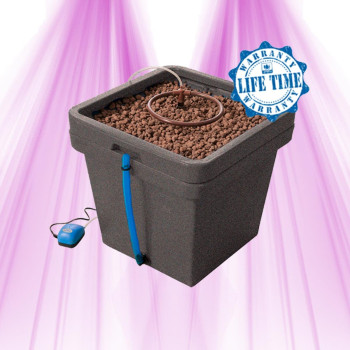
Air-culture hydroponics: In this method, plants are grown in an inert substrate, such as clay balls or perlite, which are moistened regularly with a nutrient solution.
Hanging Root Growing Hydroponics: In this method, plants are grown with their roots suspended in a nutrient solution.
To be successful in hydroponics, it is important to maintain optimal growing conditions in terms of temperature, humidity, lighting and nutrient concentration. It is also important to choose plants suitable for this growing method and to ensure their regular maintenance.
Hydroponics can be a very efficient growing method and allows plants to be grown all year round, even in small spaces or with little sunlight. However, it requires an initial investment and constant attention to succeed and achieve good results.
Available in 2 models
Help & advice
About Hydroponics — click a question to see the answer.
The choice of system really depends on your goals and experience level. For beginners, I often recommend simple systems like DWC (Deep Water Culture) or Ebb & Flow, which are relatively easy to manage. If you're aiming for larger or professional crops, PRO RDWC systems are an excellent option. I invite you to explore our range of hydroponic and aeroponic systems to find the one that suits you.
That's an excellent question I frequently encounter. NFT (Nutrient Film Technique) circulates a thin film of nutrient solution over the roots, ensuring excellent oxygenation. DWC (Deep Water Culture), on the other hand, immerses the roots directly in the nutrient solution, which is oxygenated by an air pump. In practice, NFT is often preferred for fast-growing, compact crops, while DWC is more forgiving and ideal for larger crops and beginners. Each has its advantages, and I advise you to consider the size of your plants and your budget.
LED lighting is absolutely crucial in hydroponics, especially indoors, as it replaces sunlight. I often see growers underestimate its importance. A good LED light provides the precise light spectrum your plants need for photosynthesis, promoting healthy growth and optimal yields. It's an investment that quickly pays for itself through the quality of your harvests.
pH and EC are vital parameters in hydroponics; I cannot overstate their importance. Generally, I recommend a pH between 5.5 and 6.5 for most plants, as this is the range where nutrients are best absorbed. EC (Electrical Conductivity) indicates the nutrient concentration; it varies depending on the growth stage and plant type. It is essential to measure them regularly with reliable EC/pH testers and adjust if necessary, possibly with pH regulators.
LED lighting power depends on several factors: the growing area, the type of plants, and the growth stage. For a small home setup, a few tens of watts may suffice, but for more intensive cultivation or demanding plants, I recommend higher wattages, often between 100W and 600W, or even more. What I primarily look at is the PPFD (Photosynthetic Photon Flux Density), which is a more precise indicator of the useful light intensity for photosynthesis. Feel free to contact me for more personalized advice based on your project.
As an expert, I often see the same mistakes among beginners. The most frequent is not regularly monitoring the pH and EC of the nutrient solution. Another mistake is neglecting root oxygenation, which can lead to problems. I also advise against overfeeding plants, as this can cause nutrient burn. Finally, make sure you have a good filtration system to prevent algae and diseases. The key to success is regularity and observation.
En tant qu'expert, je vois souvent les mêmes erreurs chez les débutants. La plus fréquente est de ne pas surveiller régulièrement le pH et l'EC de la solution nutritive. Une autre erreur est de négliger l'oxygénation des racines, ce qui peut entraîner des problèmes. Je conseille également de ne pas suralimenter les plantes, car cela peut provoquer des brûlures nutritives. Enfin, assurez-vous d'avoir un bon système de filtration pour éviter les algues et les maladies. La clé du succès est la régularité et l'observation.
Cannot find your answer? 01 88 33 45 52 or by message.