




































































Bloomled
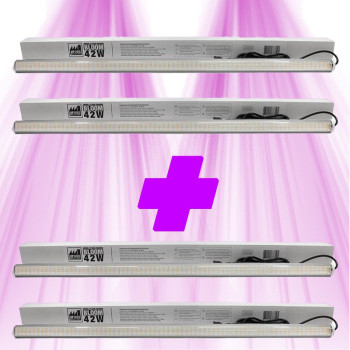
Pack 2 SpectraBULB X30 - 2 E27 cables 100cm
Ships within 2 weeks
202,71 € 213,38 € or 3× 67,57 €

Product successfully added to your shopping cart
Ça pousse dans le bon sens

41 products
Multi-light kits combine several synchronized LED panels to efficiently cover large grow areas. Rather than purchasing your lights separately, these kits offer a complete solution with multiple perfectly compatible units. This is the winning strategy for growers who want to expand their space or optimize lighting over rectangular areas.
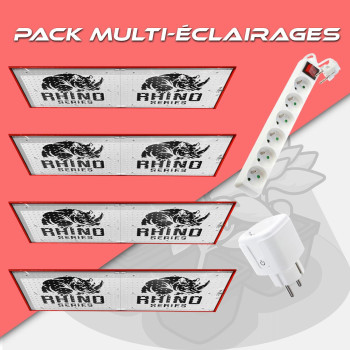
Frankly, when you want to illuminate an area of 160x160cm or more, a single panel is no longer enough. Multi-light kits solve this problem by combining several units for homogeneous light distribution. The RHINO 130 W PRO X4 Pack, for example, perfectly covers 160x160cm with its four 130W panels, totaling 520W intelligently distributed.
The major advantage? No shadow areas or hot spots. With multiple light sources, you create uniform lighting impossible to achieve with a single large panel. The BloomLED SpectraWild L900 x3 Pack with Control Console goes even further by allowing you to control all three panels from a single interface.
In terms of consumption, it's also smarter. Instead of a 600W monster that heats up like a radiator, you distribute the power across multiple points. The result: less thermal stress for your plants and easier temperature management in your grow space.
First criterion: the area to be covered. For 120x120cm, three panels are more than enough. The BloomLED SpectraWild L900 x3 Pack is perfect for this configuration. For 160x160cm or more, go for at least four units.
Second crucial point: power per m². Count 35-40W per m² in LED for high-performance cultivation. A 4x130W pack (520W total) over 2.56m² gives you approximately 203W/m², which is more than sufficient for all growth phases.
Also consider ease of installation. Some packs like the Rhino 130W PRO X3 Pack are designed for quick installation with standardized suspensions. This is particularly practical when you need to adjust the height of multiple panels simultaneously.
For a 90x90cm tent (0.81m²), a pack of three 130W LEDs each is perfect. You get 390W total, or 481W/m², which gives you plenty of headroom for all varieties. The Rhino 130W PRO X3 Pack adapts perfectly to this surface with its three panels arranged in a triangle. The advantage of three sources rather than one: you eliminate shadow areas in the center and on the edges of your tent.
Installation involves uniformly distributing the panels over your grow area. For three LEDs, arrange them in an equilateral triangle. For four LEDs, opt for a square with one panel at each corner of your area. Suspend each panel at the same height (generally 40-50cm from the plants) and ensure that the power cables reach your outlets. Some packs include specific extension cords to simplify wiring. Use a lux meter to check the uniformity of the lighting once installed.
LED packs consume 40% less electricity than T5HO for equivalent light output. A pack of 4x130W LEDs (520W total) easily replaces 8x54W T5HO tubes (432W total) while producing less heat. LEDs also offer a more complete spectrum with peaks in red and blue, optimized for photosynthesis. T5HOs remain interesting for germination and cuttings, but for growth and flowering, LED packs are clearly more efficient. The lifespan is also incomparable: 50,000h for LEDs versus 20,000h for T5HOs.
Hang your LEDs between 40 and 60cm from the canopy depending on the power. For 130W panels, 45-50cm is perfect. Always start higher and gradually move closer, monitoring your plants' reactions. If the top leaves curl or yellow, it's too close. Use a timer for 18h/day during growth and 12h/day during flowering. With packs equipped with dimmers, start at 60% power for the first few days then gradually increase to 100%. The goal: 400-600 µmol/m²/s during growth and 600-1000 µmol/m²/s during flowering.
Turn off and unplug all panels before cleaning, then wait 30 minutes for them to cool completely. Use a slightly damp microfiber cloth with demineralized water to wipe aluminum surfaces and heat sinks. For the LEDs themselves, a soft-bristled brush is sufficient to remove dust without risking damage. Absolutely avoid chemicals, alcohol, or water directly on electronic components. Clean at least once a month to maintain light efficiency. A dusty panel can lose up to 15% of its light output.
Help & advice
About Multi-Lighting Packs — click a question to see the answer.
As an expert, I see multi-light packs as the ideal solution for uniformly covering large growing areas. Rather than having a single intense light source, these packs distribute light evenly, promoting more balanced growth and more abundant flowering throughout your space. It's a winning strategy to maximize your yield.
To choose the right pack, I advise you to first evaluate the size of your growing area. Then, consider the total power needed, the light spectrum (growth, flowering, or full spectrum), and the quality of the LEDs. Finally, make sure the panels are easy to install and adjust. I invite you to consult our blog to learn more about news and tips.
The power depends directly on the area to be lit and the types of plants. Generally, I recommend aiming for about 30 to 50 watts per square foot (0.09 m²) for intensive cultivation. For a large area, it is better to opt for several modules of moderate power rather than a single very powerful one, to ensure better light distribution.
Installation is generally simple. I advise starting by securely fixing the supports to the ceiling of your grow room. Then, hang each LED panel, respecting the recommended distance from the plants. Finally, connect the modules to each other and to the power supply. Most of our packs are designed for intuitive setup.
The main difference, and what I observe in the field, is the consistency and homogeneity of the lighting. A single LED is perfect for a small area or as a supplement. A multi-light pack, on the other hand, is designed to cover a large area with optimized light distribution, avoiding shaded areas and hot spots, which is crucial for uniform production.
For this, I recommend that you check the coverage specifications indicated for each pack. They usually mention the optimal area for growth and flowering. Precisely measure your space and compare it to the manufacturer's data. Do not hesitate to contact us if you have any doubts; I am here to guide you.
For growth, I prefer a spectrum richer in blue, which promotes vegetative development. For flowering, a spectrum with more red and far-red is ideal for stimulating flower and fruit production. Many of our packs offer a full spectrum or the possibility to adjust the spectrum, which is very practical for adapting to the different phases of your plants.
The distance is crucial and depends on the power of your pack. As a general rule, I advise starting with a distance of about 40 to 60 cm from the tops of the plants and then adjusting. Observe your plants carefully: yellowing or curling leaves can indicate that the light is too intense or too close. I recommend always following the manufacturer's recommendations.
Cannot find your answer? 01 88 33 45 52 or by message.