



































































Sanlight
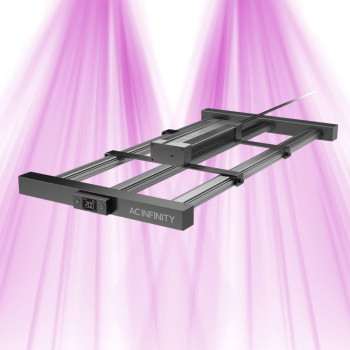
SANlight EVO 4-80 – LED grow light 265 W
Available in 17 models
Ships within 2 weeks
448,00 € or 3× 149,33 €

Product successfully added to your shopping cart
Ça pousse dans le bon sens

16 products
HPS and MH lamps in the 300-400 watt range represent the sweet spot for many indoor growers. This power range offers an excellent compromise between light output and heat management, perfect for medium-sized grow spaces. Whether you opt for an HPS during flowering or an MH during vegetative growth, this power guarantees solid results without skyrocketing your electricity bill.
These lamps effectively cover areas from 80x80cm to 100x100cm depending on your setup height. With a PPFD of around 400-600 µmol/m²/s at 60cm distance, you are in the optimal zone for efficient photosynthesis.
Frankly, this power is the right balance. Unlike 600W lamps that heat up like ovens, 300-400W lamps remain manageable in terms of temperature. You can run them in a room without turning your apartment into a sauna, especially if you have proper extraction that moves at least 150-200 m³/h.
The spectrum of HPS at this power delivers approximately 55,000 lumens, more than enough to boost your yields during flowering. MH lamps of the same power excel in vegetative growth with their blue spectrum that promotes compact and vigorous development. Light penetration easily reaches 80-100cm deep, allowing you to grow taller plants without losing density on the lower branches.
The other big advantage is their lifespan. A well-maintained 400W HPS lamp will easily last 2-3 full cycles before losing efficiency. And in terms of consumption, we're talking about 0.4 to 0.45 kWh actual with the ballast, which is about €10-12 per month when operating 12h/12h depending on your electricity tariff.
First, define your space. For an 80x80cm grow tent, a 300W is more than enough. If you go up to 100x100cm or more, opt for a 400W. Height also matters: with less than 1m80 total height, stick to 300W to avoid burning your plant tops.
Regarding ballasts, magnetic ones are still indestructible but generate more heat. Electronic ballasts are more expensive but more efficient and often allow you to vary the power (250W/400W/600W on the same ballast). For the reflector, a good Adjust-A-Wing or a hammered reflector distributes light better than a simple smooth reflector.
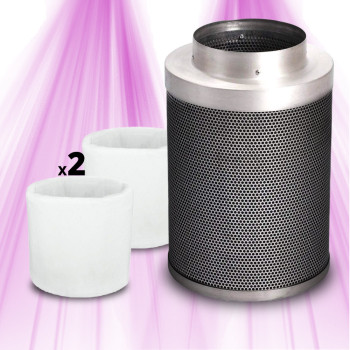
Don't forget extraction: plan for a minimum of 200 m³/h to dissipate the heat from a 400W, and 150 m³/h for a 300W. A good silent extractor will help avoid noise pollution, especially if your setup runs at night.
A 300W lamp effectively covers an area of 80x80cm, or 0.64m². For a 400W, you can go up to 100x100cm (1m²) with a good reflector. The optimal hanging height is between 40 and 60cm from the plants depending on the power. The higher you raise the lamp, the larger the covered area but the intensity decreases. The ideal is to aim for 400-600 µmol/m²/s at canopy level.
Under a 300W, 4 to 6 plants in 7-11L pots yield good results. With a 400W, you can go up to 6-9 plants depending on your growing technique. In SOG (Sea of Green), count 9-16 small plants per m². In SCROG, 1-4 plants are sufficient if you train them correctly. The important thing is to uniformly fill the space under the lamp without creating significant shadows between plants.
A 400W HPS lamp emits about 1200-1400 BTU/h of heat, compared to 800-1000 BTU/h for an equivalent LED. In terms of efficiency, HPS lamps achieve 1.2-1.4 µmol/J compared to 2.0-2.8 µmol/J for good LEDs. A 200W LED can replace a 400W HPS in terms of PPFD, while generating half the heat. However, HPS lamps remain unbeatable for deep light penetration and are much cheaper to purchase.
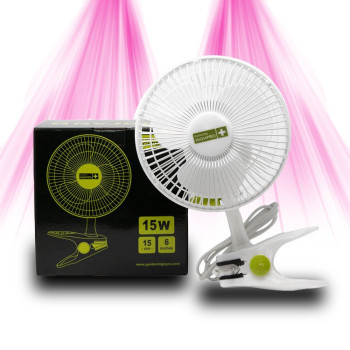
Extraction is key: a minimum 200-250 m³/h extractor with a carbon filter if needed. Place the fresh air intake at the bottom of the tent and the exhaust at the top, on the opposite side. An oscillating fan helps to homogenize temperatures. Hang the lamp with yo-yos to easily adjust the height. If the room gets too hot, schedule a nocturnal cycle (lamp on at night) to take advantage of cooler outdoor temperatures.
Change the bulb every 2-3 cycles or when you lose 10-15% light intensity. Clean the reflector and protective glass every 2-3 weeks with isopropyl alcohol. Regularly check electrical connections, especially on magnetic ballasts that vibrate. Avoid repeated on/off cycles that prematurely wear out the bulb. An electronic ballast with soft start significantly extends the lifespan of your bulbs.
Available in 17 models
Available in 17 models
Available in 4 models
Available in 3 models
Help & advice
About 300 - 400 Watts — click a question to see the answer.
As an expert, I can tell you that the main difference lies in their light spectrum. MH (Metal Halide) lamps emit a bluer spectrum, ideal for the vegetative growth phase of your plants, promoting robust leaf and stem development. HPS (High Pressure Sodium) lamps produce a redder/orange spectrum, perfect for flowering and fruiting, stimulating the production of flowers and fruits. In practice, I often recommend using an MH for growth and switching to an HPS for flowering to optimize yields.
For a medium-sized grow space, a 300-400W HPS/MH lamp is generally an excellent choice. I recommend this wattage for areas ranging from approximately 0.6 m² to 1 m². If your space is smaller, you risk overheating, and if your space is much larger, the light coverage will be insufficient. This is the sweet spot for a good balance between performance and heat management.
Distance is crucial to avoid burning your plants while maximizing light intensity. For a 300-400W lamp, I generally recommend a distance of 40 to 60 centimeters between the bulb and the canopy. It's essential to closely monitor your plants: if the top leaves yellow or curl, it's a sign they are too close. Don't forget to use a thermometer to check the temperature at leaf level.
Technically, you can use an HPS for growth, but I don't recommend it for optimal results. The red spectrum of HPS promotes stretching in growing plants. For robust and compact vegetative growth, an MH is much more effective. If I had to choose for a full cycle, I would opt for an MH in growth and an HPS in flowering. This is the best way to fully exploit the potential of each bulb type.
Installation is quite simple but requires precision. You will need a ballast suitable for your bulb's wattage, a reflector, and of course, the bulb itself. I advise you to always connect the ballast to the bulb via the reflector before plugging the entire setup into the mains. Make sure the ballast is placed outside the grow space if possible to reduce heat. Electrical safety is paramount, so check all connections.
This is a common question! 300-400W HPS/MH lamps offer excellent initial value for money and are very effective for light penetration into the canopy. However, they generate more heat and consume more energy in the long run than LEDs. LEDs, although more expensive to purchase, are more energy-efficient, have a longer lifespan, and emit less heat, offering more precise spectrum control. The choice will depend on your budget and your priorities for environmental management.
Cannot find your answer? 01 88 33 45 52 or by message.