



































































Lumatek
Lumatek Zeus 600W PRO 3.1 – LED grow light
Available in 5 models
In stock · Shipped within 24 h
1 089,00 € or 3× 363,00 €

Product successfully added to your shopping cart
Ça pousse dans le bon sens

2 products
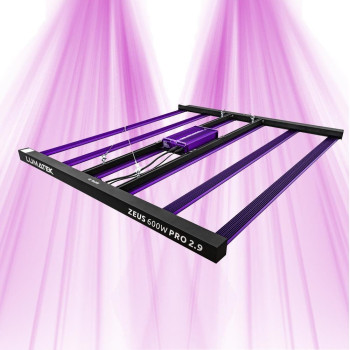
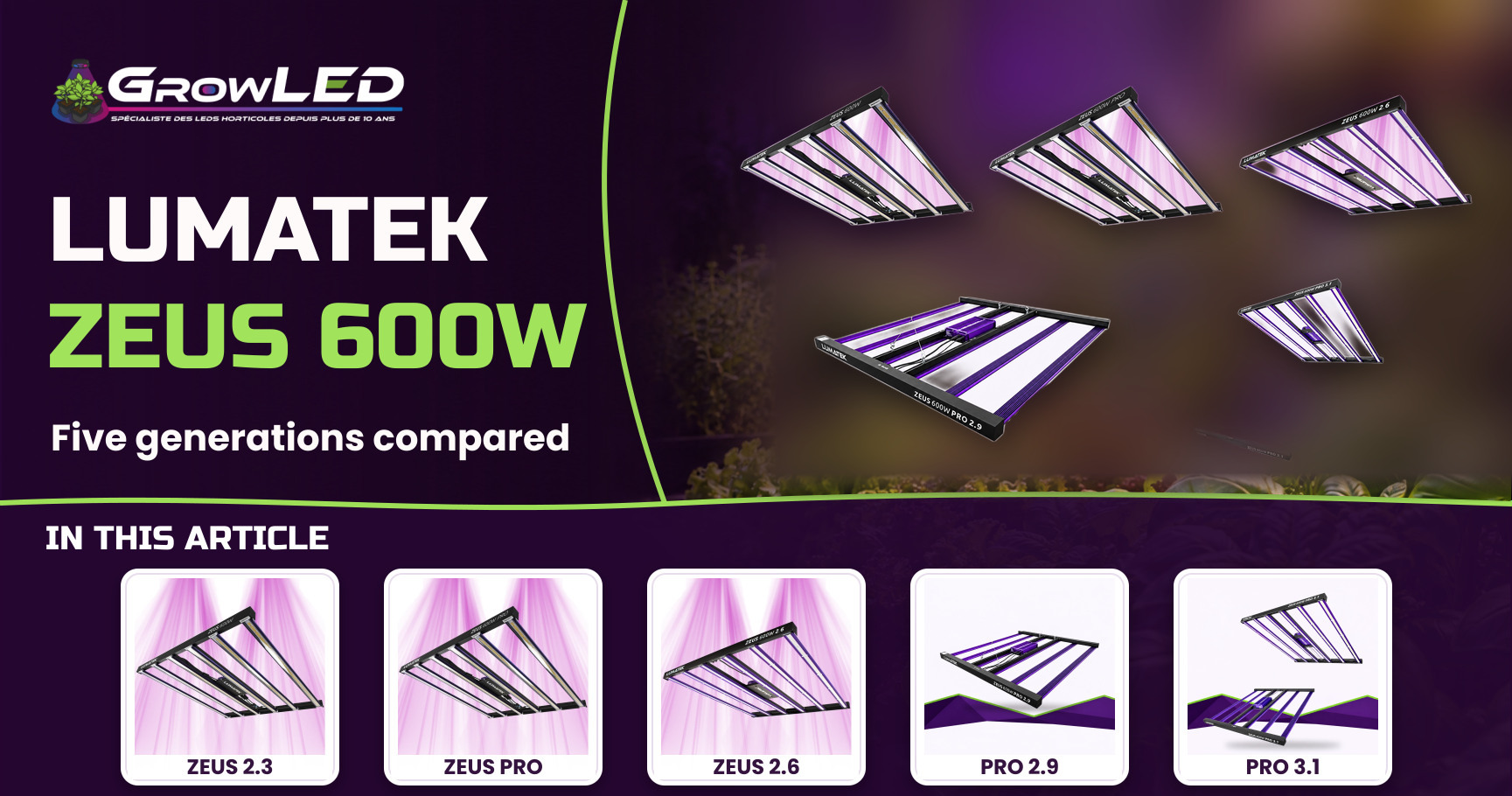
The Zeus 600W range from Lumatek revolutionizes horticultural lighting with its ultra-efficient modular LED bars. These next-generation panels combine 600 watts of power with exceptional photosynthetic efficiency ranging from 2.7 to 3.1 µmol/J depending on the model. Designed to advantageously replace 1000W HPS systems, they offer homogeneous light distribution and optimized thermal management.
The Zeus 600W stands out with its unique modular architecture that allows independent adjustment of light intensity according to cultivation phases. Unlike classic LED panels, these systems use separate bars that eliminate shaded areas and ensure uniform light penetration down to the lower levels of your plants. Their optimized full-spectrum (3000K + 660nm) effectively stimulates photosynthesis from germination to harvest.
Energy efficiency is another major asset: where a 1000W HPS actually consumes 1100W with the ballast, a Zeus 600W only draws 600W from the mains while delivering equivalent or even superior PPFD. This difference translates into substantial savings on your electricity bills, particularly valuable during extended growing cycles.
The choice between the different versions mainly depends on your growing area and your yield objectives. The Pro 2.7 model is perfect for beginners with an excellent price-performance ratio, while the Pro 3.1 maximizes efficiency for experienced growers seeking the best grams per watt. The Pro 2.9 version offers a balanced compromise for most setups.
Also consider the height of your space: these lights require a minimum distance of 30cm during flowering and can be installed up to 80cm high depending on the desired intensity. The optimal coverage area extends from 120x120cm during vegetative growth to 100x100cm during flowering to fully exploit their light potential.
The numbers correspond to photosynthetic efficiency expressed in µmol/J: the Pro 2.7 delivers 2.7 micromoles per joule consumed, the Pro 2.9 reaches 2.9 µmol/J, and the Pro 3.1 peaks at 3.1 µmol/J. Concretely, the Pro 3.1 produces about 15% more photons than the Pro 2.7 at equal consumption. This difference translates into higher yield potential, particularly noticeable during flowering where every photon counts for resin production and bud density. The Pro 2.9 represents the best compromise for most indoor growers.
For germination and young seedlings, maintain 60-80cm distance with reduced intensity at 30-40% to avoid light stress. During vegetative growth, gradually reduce the distance to 50-60cm with 60-70% power to promote compact and vigorous development. During flowering, the optimal distance is between 30-40cm with 100% intensity to maximize light penetration and dense bud production. These distances may vary depending on the sensitivity of your varieties: monitor for signs of stress (curling leaves) and adjust accordingly.
Replacing a 1000W HPS with a Zeus 600W generates approximately 45% savings on direct electricity consumption, which is a reduction of 500W per hour of lighting. Over an 8-week flowering cycle (12h/day), this represents a saving of 336 kWh, or about €50-60 depending on your electricity tariff. Add to this the reduction in air conditioning costs: Zeus units emit 40% less heat, significantly reducing the workload of your extractors and air conditioners. Over a year of cultivation, total savings can reach €200-300 per replaced light.
The Zeus 600W uses a system of 6 LED bars connected to a central driver via waterproof cables. Each bar can be positioned individually to adapt to your grow setup, allowing customized coverage even in irregular spaces. Power control is done via a potentiometer integrated into the driver, allowing dimming from 0 to 100% of the entire system. Some models also accept external 0-10V controllers for complete automation with your climate control systems. This modularity greatly facilitates maintenance: in case of a bar failure, only that element needs replacement.
A Zeus 600W effectively covers 120x120cm during the vegetative phase with a PPFD of 400-500 µmol/m²/s, and 100x100cm during flowering to reach 800-1000 µmol/m²/s depending on the chosen model. This area can be extended to 140x140cm for less demanding crops or reduced to 80x80cm to maximize intensity for light-hungry varieties. Maintenance is limited to monthly dusting of the bars with a dry cloth and a semi-annual check of connections. Lumatek LEDs have a lifespan of at least 50,000 hours, which is about 8-10 years of intensive use without significant degradation of light output.
Available in 5 models
Available in 3 models
Help & advice
About 600W — click a question to see the answer.
As an expert, I can tell you that the difference is significant. A 600W LED like the Lumatek Zeus is designed to advantageously replace a 1000W HPS. LED offers better energy efficiency, producing more useful light per watt consumed (PPF/W), which often translates to higher yields for lower electricity consumption. Furthermore, LED generates less heat, simplifying climate management in your space. It's a choice I recommend for efficiency and durability.
That's an excellent question, and the answer depends on your surface area. For a Lumatek Zeus 600W, I generally recommend a growing area ranging from 120x120 cm to 150x150 cm. The advantage of modular models is that you can adjust the bar configuration to optimize light distribution over your space. If you're unsure, I always advise opting for slightly more power, which you can then dim down.
Installation distance is crucial to avoid light stress or insufficient intensity. For a 600W LED, I generally start with a distance of 40 to 60 cm above the canopy during the vegetative phase, and gradually lower it to 20 to 40 cm during flowering, depending on your plants' reaction. It's essential to carefully observe signs of stress and adjust accordingly. Feel free to check out our PRO range for models with integrated dimmers that facilitate this adjustment.
For optimal flowering, I generally aim for a PPFD (Photosynthetic Photon Flux Density) between 800 and 1000 µmol/m²/s at canopy level. With a quality 600W LED like the Lumatek Zeus, you should be able to achieve these values without a problem. It's important to measure this PPFD with a good photometer to ensure your plants receive the light energy they need to produce dense, quality flowers.
That's a legitimate concern. A 600W LED does indeed consume 600 watts per hour of operation. However, if I compare it to a 1000W HPS, the LED is much more efficient. In practice, you will achieve equivalent, or even superior, results with less electricity consumption and better heat management. This is a significant long-term saving that I regularly observe with our customers.
The Lumatek Zeus 600W offers a full spectrum, which is ideal because it covers your plants' needs at all stages of their life cycle. For growth, a spectrum with a dominance of blue is beneficial, while for flowering, red and far-red are crucial. Modern full-spectrum LEDs are designed to provide an optimal balance, saving you from having to change lamps between phases. This is one of the reasons I recommend them.
Height adjustment is key. I recommend using adjustable hangers to make this task easier. Start higher than necessary and gradually lower it, carefully observing your plants' leaves. Yellowing or upward curling leaves can indicate light stress. Conversely, plants that stretch (long stem, spaced leaves) lack light. It's a matter of observation and regular adjustment.
Absolutely! This is one of the great advantages of the modularity of the Lumatek Zeus 600W. If your growing space evolves, or if you want to optimize light distribution for different plant configurations, the ability to reposition or adjust the LED bars is a major asset. I often see growers adapting their lighting to different sized tents or specific growing areas, which is not possible with fixed panels. This is a flexibility I value greatly.
Cannot find your answer? 01 88 33 45 52 or by message.