




































































Secret Jardin
Secret Jardin Cosmorrow 20 W 50 cm – ultraviolet LED bar
Available in 2 models
In stock · Shipped within 24 h
29,89 €

Product successfully added to your shopping cart
Ça pousse dans le bon sens

68 products
Lighting area is a key consideration when growing plants indoors. It determines the amount of light available to plants, which can affect their growth and development.
It is important to choose lighting that covers the correct growing area based on the size and quantity of plants you want to grow. For a small growing area, low wattage lighting may be sufficient. For a larger growing area, you will need more wattage lighting to cover the entire growing area.
On the other hand, if the lighting is far from the plants, you will need more wattage lighting to compensate for the loss of brightness due to the distance. Be sure to follow the recommended distances for each lighting type and plant species for the best growing results.
It is also important to learn about the lighting needs of each plant species and choose lighting suited to those needs to ensure optimal growth. Some plants need more light than others, and it's essential to make sure you're providing your plants with the light they need to thrive.
In conclusion, lighting area is a key consideration when growing plants indoors. Be sure to choose lighting appropriate for the size of your growing area and the distance between plants and lighting, and know the lighting needs of each plant species for the best growing results.
Available in 2 models
Available in 2 models
Available in 4 models
Available in 3 models
Available in 3 models
Available in 3 models
Available in 2 models
Available in 3 models
Available in 7 models
Available in 4 models
Help & advice
About Lighting area — click a question to see the answer.
The lighting footprint is absolutely fundamental in indoor cultivation. It determines the area that your light will effectively cover for your plants. In practice, this is the surface area where your plants will receive sufficient and homogeneous light intensity for their growth and flowering. If your lighting doesn't adequately cover your surface, some plants will be under-lit, which will directly impact their development.
To choose an LED grow light, I advise you to start by precisely measuring your grow space. Once you have these dimensions (for example, 60cm x 60cm), you can then look for an LED panel whose recommended lighting footprint matches yours. This is the most important criterion to ensure good light coverage. For example, for a 60cm x 60cm space, I would choose a model specifically designed for that size.
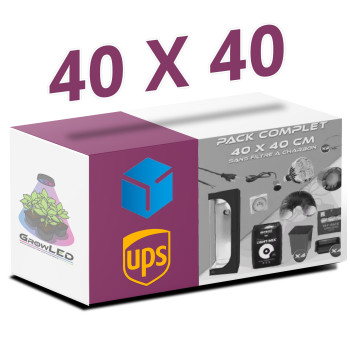
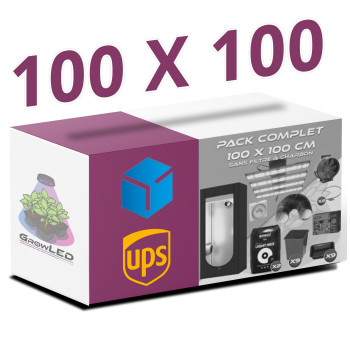
LED wattage, expressed in watts, is an important indicator, but it's not the only one. What I look at first and foremost is the effective coverage area specified by the manufacturer. To give you an idea, for a small area like 40cm x 40cm, a panel of 100-150W actual power may be sufficient, while for a 100cm x 100cm area, you'll need to aim for 300-400W actual power or more, depending on your plants' needs.
The best way to know is to refer to the manufacturer's specifications, which usually indicate the recommended coverage area for growth and flowering. In practice, I also advise you to observe your plants: if some are stunted or stretching (a phenomenon called 'stretch') while others nearby are doing well, this may indicate uneven light coverage. Good light distribution is essential.
The most common mistake I see is underestimating the necessary lighting footprint or not taking into account the actual power of the LEDs. Many people think that a 'advertised' 1000W panel is sufficient for a large area, when in reality, the consumed power is much less. You should also avoid placing LEDs too close or too far, which can cause burns or a lack of light. Always rely on the manufacturer's distance recommendations.
For a small area, such as 40cm x 40cm, I would recommend a compact and efficient LED panel, often around 100-150W actual power. For a large area, say 120cm x 120cm, a more powerful system will be needed, potentially a 600W actual power panel or more, or even several smaller panels for better distribution. The important thing is to ensure that the entire surface is well covered.
Cannot find your answer? 01 88 33 45 52 or by message.